

CNT Conductive Additives for High-Loading Electrodes
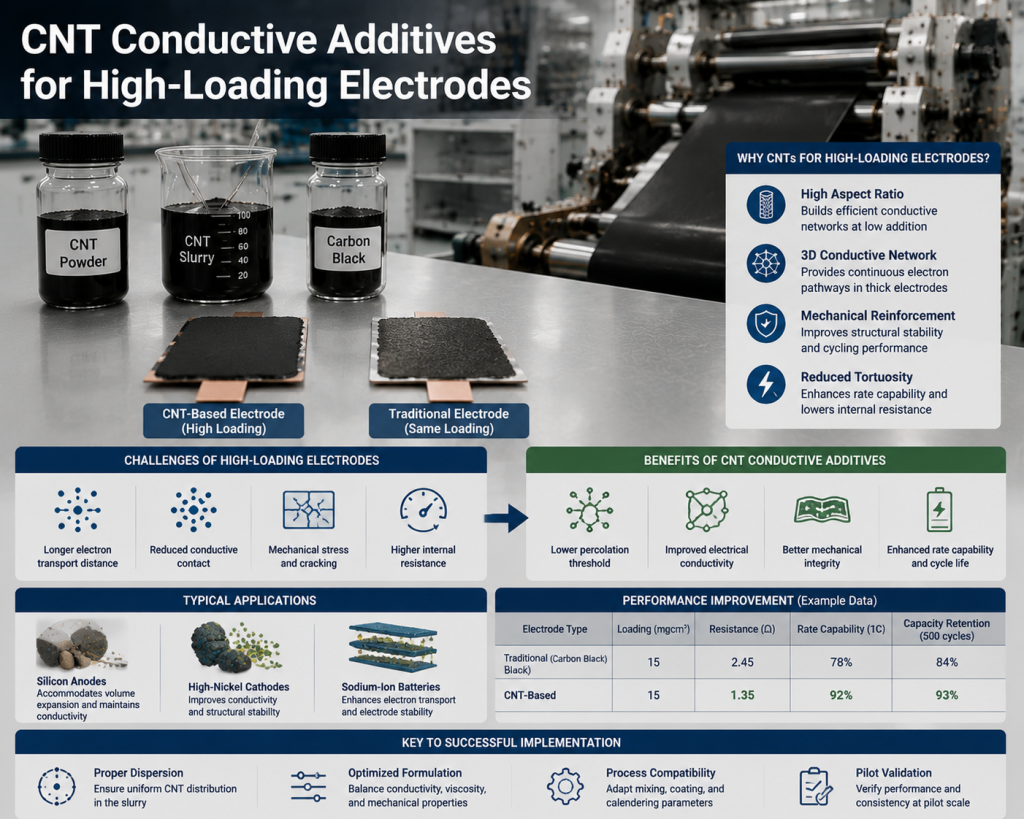
The continuous development of high-performance batteries requires electrodes with higher active material loading.
Increasing active material content is one of the most direct approaches to improving battery energy density.
However, high-loading electrodes introduce new challenges:
- Longer electron transport pathways
- Reduced conductive network efficiency
- Increased mechanical stress
- More difficult electrode processing
Traditional conductive additives may become insufficient when electrode thickness and loading continue to increase.
Carbon nanotubes (CNTs), with their unique one-dimensional structure and high aspect ratio, have attracted significant attention as advanced conductive additives for high-loading battery electrodes.
By creating efficient conductive networks, CNTs can help maintain electrical connectivity while minimizing the amount of inactive conductive material.
The Challenge of High-Loading Electrodes
Increasing electrode loading appears simple: add more active material.
However, higher loading creates several engineering problems.
Longer Electron Transport Distance
Thicker electrodes require electrons to travel through longer pathways.
Without an effective conductive network, this may lead to:
- Higher internal resistance
- Lower rate capability
- Reduced energy efficiency
Reduced Conductive Contact
As active material particles increase, maintaining particle-to-particle electrical contact becomes more difficult.
A small amount of conductive additive must create a continuous network throughout the electrode.
Mechanical Stability Issues
During cycling, electrode materials experience:
- Expansion
- Contraction
- Structural stress
A stable conductive framework helps maintain electrode integrity.
Why CNTs Are Effective Conductive Additives
Carbon nanotubes have several characteristics that make them suitable for advanced electrodes.
High Aspect Ratio Network Formation
CNTs are extremely long compared with their diameter.
This allows them to form interconnected conductive pathways at relatively low loading levels.
Advantages include:
- Efficient electron transport
- Reduced inactive material content
- Improved electrode conductivity
Three-Dimensional Conductive Architecture
Unlike traditional carbon particles, CNTs can create a three-dimensional conductive network.
This network can connect:
- Active material particles
- Carbon structures
- Current collector interfaces
creating continuous electron pathways.
Mechanical Reinforcement
CNTs also provide structural support.
They can improve:
- Electrode flexibility
- Crack resistance
- Cycling stability
This is particularly valuable for:
- Silicon anodes
- High-capacity materials
- Thick electrodes
CNT Applications in Advanced Battery Electrodes
Silicon-Based Anodes
Silicon offers extremely high theoretical capacity but suffers from significant volume expansion during cycling.
CNT networks can help:
- Maintain electrical contact
- Improve mechanical stability
- Reduce electrode degradation
High-Nickel Cathodes
High-nickel cathodes require improved conductivity and structural stability.
CNT additives can support:
- Electron transport
- Electrode integrity
- High-rate performance
Sodium-Ion Batteries
Sodium-ion materials often require optimized conductive networks.
CNTs can improve:
- Electrical conductivity
- Electrode stability
- Material utilization
CNT Compared With Traditional Conductive Additives
Traditional conductive additives such as carbon black provide effective conductivity improvement.
However, high-loading electrodes create new requirements.
Carbon Black
Advantages:
- Low cost
- Mature technology
- Easy processing
Limitations:
- Requires higher loading
- Limited long-range conductive pathways
CNT
Advantages:
- Lower loading requirement
- Strong network formation
- Better mechanical reinforcement
Limitations:
- Higher material cost
- Dispersion challenges
The Importance of CNT Dispersion
The performance of CNT additives depends strongly on dispersion quality.
Poor dispersion can cause:
- CNT aggregation
- Uneven conductivity
- Processing instability
Industrial electrode manufacturing requires:
- Stable CNT dispersion
- Controlled slurry rheology
- Repeatable mixing processes
CNT Slurry Engineering
For practical battery production, CNTs are often incorporated into conductive slurries.
Important parameters include:
Viscosity Control
The slurry must maintain suitable flow behavior for coating.
Uniform Distribution
CNTs must be evenly distributed throughout the electrode.
Compatibility With Binders
CNT networks must work together with binder systems to maintain electrode structure.
CNT in High-Loading Electrode Manufacturing
Moving from laboratory samples to pilot production requires process optimization.
Important manufacturing steps include:
Mixing
Optimizing:
- Mixing sequence
- Dispersion energy
- Material ratio
Coating
Controlling:
- Coating thickness
- Surface uniformity
- Loading consistency
Drying
Managing:
- Solvent removal
- Binder distribution
- Electrode structure
Calendering
Balancing:
- Electrode density
- Porosity
- Conductive network preservation
Pilot Validation of CNT-Based Electrodes
Pilot-scale testing is essential before commercial production.
It helps evaluate:
- Conductive network stability
- Electrode manufacturing repeatability
- Cell performance consistency
Key validation areas include:
- Capacity retention
- Internal resistance
- Rate capability
- Cycle life
Combining CNT With Graphene
CNT and graphene can provide complementary advantages.
CNT:
- Creates three-dimensional conductive bridges
Graphene:
- Provides large-area conductive pathways
- Improves thermal transport
Together they can create hybrid carbon networks for advanced electrodes.
Potential benefits include:
- Better conductivity
- Improved mechanical stability
- Reduced conductive additive content
Future Trends
The demand for higher energy density batteries will continue driving interest in advanced conductive additives.
Future electrode designs will focus on:
- Thicker electrodes
- Higher active material loading
- Faster charging capability
- Lower inactive material ratio
CNT-based conductive networks will play an increasingly important role in enabling these technologies.
High-loading electrodes are essential for next-generation battery technologies, but they introduce significant challenges in electrical connectivity and mechanical stability.
CNT conductive additives provide an efficient solution by creating interconnected conductive networks with minimal material addition.
However, successful industrial application requires more than selecting the right material.
It requires:
- Proper dispersion technology
- Electrode formulation optimization
- Manufacturing compatibility
- Pilot-scale validation
As battery manufacturers continue pursuing higher energy density and improved performance, CNT conductive networks will become an increasingly important component of advanced electrode engineering.