

Why Small-Batch Pouch Cell Validation Matters
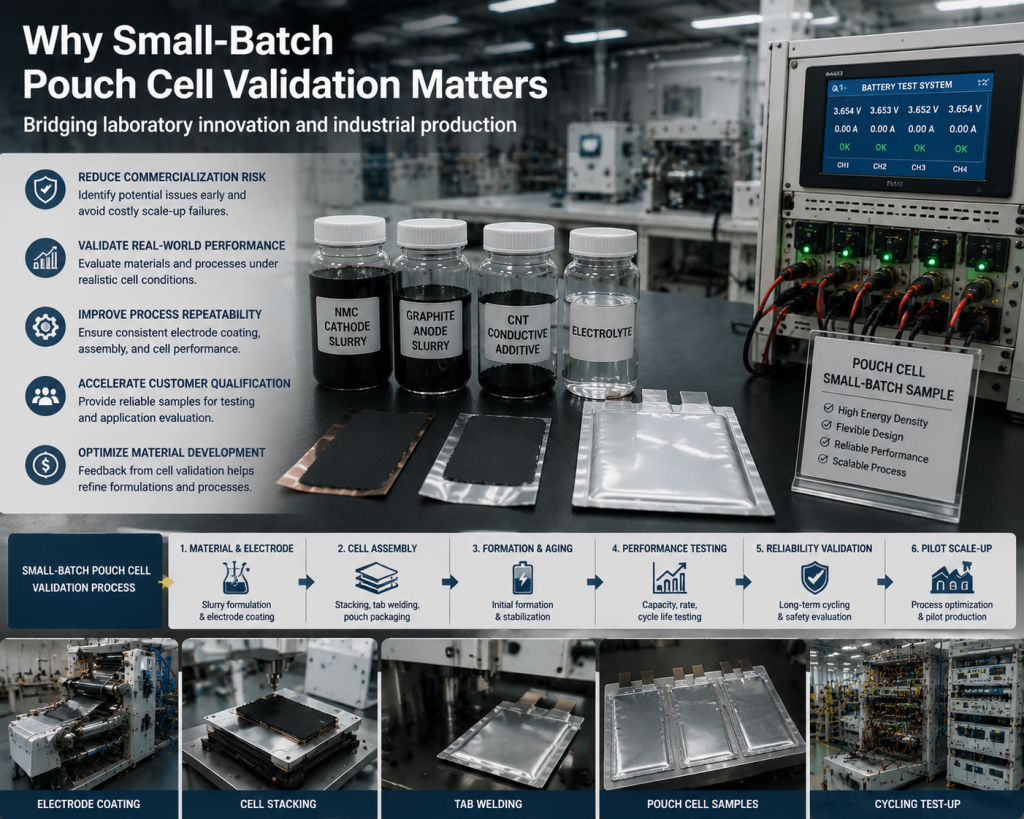
The development of advanced battery technologies often begins with promising laboratory results.
New materials, electrode formulations, and battery concepts may demonstrate excellent performance in small experimental tests.
However, laboratory success does not automatically guarantee commercial viability.
Before investing in large-scale manufacturing, battery developers need a practical validation stage that connects research and industrial production.
Small-batch pouch cell validation provides this critical bridge.
It allows companies to evaluate:
- Real cell performance
- Manufacturing feasibility
- Process repeatability
- Customer application requirements
before committing significant resources to large-scale production.
From Material Innovation to Real Battery Performance
Many battery innovations begin at the material level.
Examples include:
- New cathode materials
- Silicon-based anodes
- Sodium-ion battery materials
- Graphene and CNT conductive additives
- Advanced electrolyte systems
Laboratory testing can demonstrate:
- Material conductivity
- Electrochemical activity
- Initial cycling behavior
However, a battery cell is a complex system.
Performance depends on the interaction between:
- Active materials
- Conductive additives
- Binders
- Electrolyte
- Electrode structure
- Manufacturing process
Small-batch pouch cell validation evaluates the complete system.
Why Laboratory Coin Cells Are Not Enough
Coin cells are widely used during early research because they are:
- Simple to assemble
- Low cost
- Suitable for rapid screening
However, they do not fully represent commercial battery conditions.
Limitations include:
Small Electrode Size
Small samples may not reveal:
- Coating variation
- Electrode defects
- Manufacturing inconsistencies
Limited Process Representation
Coin cell preparation often uses laboratory methods that differ from industrial production.
Examples include:
- Manual coating
- Small-scale drying
- Simplified assembly
Different Mechanical Behavior
Commercial cells experience:
- Larger electrode stresses
- Packaging effects
- Gas management challenges
Small-batch pouch cells provide a more realistic evaluation platform.
The Role of Small-Batch Pouch Cells
Small-batch pouch cells help answer critical commercialization questions.
Can the Material Work in a Real Cell?
A promising material must demonstrate performance under realistic cell conditions.
Evaluation includes:
- Capacity
- Energy density
- Rate capability
- Cycle life
Can the Electrode Process Be Repeated?
Battery manufacturing requires consistency.
Small-batch validation evaluates:
- Slurry stability
- Coating uniformity
- Electrode quality
- Assembly reliability
Can the Technology Be Scaled?
Before moving toward pilot or mass production, developers need confidence that:
- Processes are stable
- Performance is reproducible
- Manufacturing risks are understood
Key Validation Stages
Stage 1: Electrode Validation
Before cell assembly, electrodes are evaluated for:
- Loading consistency
- Thickness uniformity
- Density
- Conductivity
Stage 2: Cell Assembly Validation
Small-batch pouch production evaluates:
- Stacking process
- Tab welding
- Electrolyte filling
- Packaging quality
Stage 3: Electrochemical Validation
Testing includes:
- Initial capacity
- Coulombic efficiency
- Rate performance
- Cycle stability
Stage 4: Reliability Evaluation
Long-term testing examines:
- Capacity degradation
- Internal resistance increase
- Mechanical stability
Advantages of Small-Batch Validation
1. Reducing Commercialization Risk
Large-scale battery production requires significant investment.
Small-batch validation identifies problems earlier.
It reduces risks related to:
- Material selection
- Process design
- Manufacturing compatibility
2. Accelerating Customer Qualification
Many battery customers require realistic samples before cooperation.
Small-batch pouch cells allow:
- Prototype testing
- Application evaluation
- Performance comparison
3. Improving Material Development
Validation feedback helps optimize:
- Material formulation
- Electrode composition
- Manufacturing parameters
The development process becomes faster and more efficient.
Small-Batch Validation for Advanced Carbon Materials
Advanced carbon materials provide a good example of why validation is necessary.
Materials such as:
- CNT
- Graphene
- Hybrid carbon networks
can improve:
- Conductivity
- Electrode stability
- Thermal performance
However, their real benefits depend on:
- Dispersion quality
- Electrode formulation
- Manufacturing process
Small-batch pouch cells help verify whether laboratory advantages translate into practical battery improvements.
Challenges During Small-Batch Production
Although small-batch production is smaller than mass manufacturing, it still requires careful engineering.
Material Consistency
Small differences in:
- Particle size
- Surface properties
- Moisture content
may influence cell performance.
Process Control
Important parameters include:
- Mixing conditions
- Coating parameters
- Drying profile
- Assembly environment
Data Interpretation
A limited number of cells must still provide meaningful information.
Proper testing design is essential.
Small-Batch Validation as a Bridge to Pilot Production
The development pathway can be summarized as:
Laboratory Research
↓
Material Evaluation
↓
Small-Batch Pouch Cell Validation
↓
Pilot Production
↓
Commercial Manufacturing
Each stage reduces uncertainty and improves technology readiness.
Future Trends
Battery development is moving toward faster innovation cycles.
Future validation platforms will focus on:
- Flexible pilot manufacturing
- Automated testing
- Digital process monitoring
- Rapid material screening
- Application-specific cell design
Small-batch pouch cell validation will remain an important tool for accelerating next-generation battery commercialization.
Small-batch pouch cell validation is a critical step between laboratory research and industrial battery production.
It provides realistic information about:
- Material performance
- Electrode processing
- Cell manufacturing
- Long-term reliability
For emerging battery technologies, success depends not only on discovering better materials but also on proving that those materials can be integrated into reliable and scalable manufacturing processes.
Small-batch pouch cell validation helps transform promising laboratory concepts into commercially viable battery technologies.