Process Window Development in Graphene Pilot Production
Graphene has moved beyond the laboratory stage and is increasingly being evaluated for conductive coatings, energy storage, thermal management, composite materials, EMI shielding, sensors, and advanced functional films. However, moving a graphene process from laboratory experiments to pilot production is not simply a matter of increasing equipment size or production speed.
The critical challenge is to establish a stable process window in which graphene can be produced, dispersed, coated, or incorporated into a final product with consistent quality. A well-defined process window provides a practical bridge between laboratory research and industrial manufacturing, helping manufacturers control material properties, production efficiency, yield, and cost.
This article explains the key principles of process window development in graphene pilot production, including critical process parameters, material variability, dispersion, coating, quality control, scale-up, and pilot validation.
What Is a Process Window in Graphene Production?
A process window is the range of operating conditions within which a graphene production or application process can consistently deliver the required product specifications.
Depending on the application, the process window may include parameters such as:
- Graphene concentration
- Particle or flake size
- Layer thickness
- Dispersion stability
- Mixing speed and time
- Solvent composition
- Viscosity
- Surface tension
- Coating speed
- Drying temperature
- Drying time
- Line tension
- Web speed
- Pressure and shear conditions
- Material residence time
- Environmental humidity and temperature
The objective is not necessarily to identify one “best” operating point. Instead, pilot production should determine a sufficiently wide and robust operating range that can tolerate normal variations in raw materials, equipment, environment, and operators.
For example, a laboratory coating experiment may achieve excellent electrical conductivity at a coating speed of 1 m/min. This does not necessarily mean that 1 m/min is the optimal industrial condition. A pilot-scale process may need to determine whether 0.8–1.5 m/min can deliver acceptable conductivity, thickness uniformity, adhesion, and surface quality.
A wider stable process window generally means a more manufacturable process.
Why Process Window Development Is Important for Graphene Scale-Up
Graphene is particularly sensitive to processing conditions because its final performance depends not only on the intrinsic properties of the graphene material but also on morphology, dispersion state, orientation, aggregation, interfaces, and processing history.
A graphene powder with excellent laboratory characterization can perform poorly in a production process if it is difficult to disperse or if the dispersion becomes unstable during storage.
Similarly, a graphene coating formulation may show excellent conductivity on a small test sample but develop streaks, pinholes, agglomerates, thickness variations, or poor adhesion when the coating width and production speed increase.
Therefore, scale-up should be treated as a process development project, rather than simply an equipment expansion project.
The pilot stage provides an opportunity to answer several important questions:
- Which parameters have the greatest influence on product performance?
- Which parameters are critical to process stability?
- How much variation can the process tolerate?
- What happens when production speed increases?
- How sensitive is the process to raw material variation?
- Which quality parameters must be monitored continuously?
- Where does the process begin to lose stability?
These questions form the foundation of an industrial graphene manufacturing process.
Step 1: Define the Target Product Specifications
Before developing a process window, the required final product specifications should be clearly defined.
For graphene materials, specifications may include:
- Carbon purity
- Number of graphene layers
- Lateral size
- Thickness
- Specific surface area
- Electrical conductivity
- Moisture content
- Ash content
- Bulk density
- Dispersion stability
For graphene dispersions or inks, additional specifications may include:
- Solid content
- Viscosity
- Surface tension
- pH
- Particle size distribution
- Sedimentation behavior
- Storage stability
For graphene films and coatings, the requirements may include:
- Coating thickness
- Sheet resistance
- Electrical conductivity
- Surface roughness
- Adhesion
- Flexibility
- Optical properties
- Defect rate
- Width uniformity
Defining these requirements first makes it possible to establish meaningful process limits instead of optimizing individual parameters in isolation.
Step 2: Identify Critical Process Parameters
Not every process parameter has the same impact on product quality.
During pilot production, parameters should be divided into three categories:
Critical parameters directly affect product performance or process stability.
Important parameters influence performance but may have a wider acceptable range.
Non-critical parameters have relatively limited influence under normal operating conditions.
For a graphene dispersion process, mixing energy, solid concentration, dispersant ratio, temperature, and mixing time may be critical.
For a roll-to-roll graphene coating process, coating gap, coating speed, ink viscosity, web tension, drying temperature, and substrate condition may become critical.
Identifying these parameters prevents pilot production from becoming an uncontrolled trial-and-error exercise.
Step 3: Understand the Interaction Between Parameters
One of the most common mistakes in pilot-scale development is changing only one parameter at a time.
Although this approach can be useful during initial laboratory screening, it may not adequately describe a production process because parameters often interact.
For example, increasing coating speed may require changes in:
- Coating viscosity
- Wet coating thickness
- Drying capacity
- Web tension
- Pump flow rate
Similarly, increasing graphene concentration may alter viscosity, mixing requirements, dispersion stability, and coating behavior simultaneously.
A process that works at low speed may therefore fail when the line speed increases because several variables have moved outside their combined operating range.
Design of Experiments (DOE) can be particularly useful for pilot development because it helps identify significant variables and interactions while reducing the number of experimental runs.
Graphene Dispersion: A Key Process Window
For many graphene applications, dispersion is one of the most important process-development challenges.
Graphene sheets have strong interlayer interactions and can easily form agglomerates. A dispersion process therefore needs to achieve sufficient deagglomeration without introducing unnecessary structural damage.
Important variables can include:
- Mixing intensity
- Mixing time
- Temperature
- Solvent system
- Dispersant concentration
- Graphene loading
- Equipment geometry
- Shear rate
Too little mixing energy may result in large agglomerates and poor coating uniformity.
Excessive mechanical or ultrasonic treatment, however, may reduce graphene flake size or modify the desired morphology.
The target is therefore not simply “maximum dispersion.” The objective is controlled dispersion that preserves the properties required by the final application.
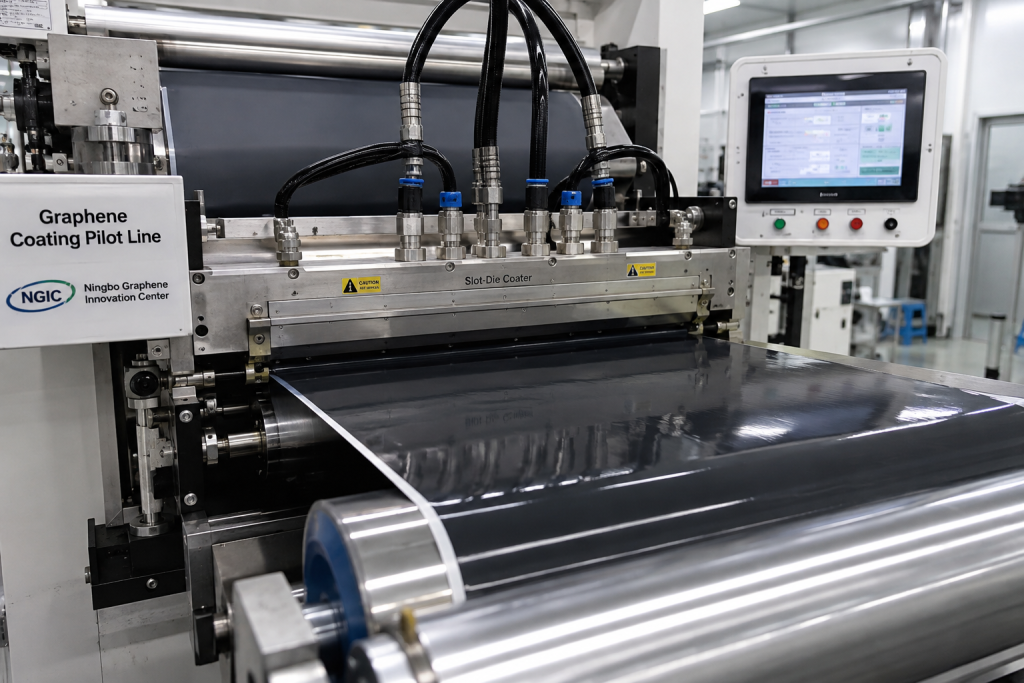
Developing a Coating Process Window
Graphene coatings are another area where pilot-scale process development becomes particularly important.
A coating process may use slot-die coating, blade coating, gravure printing, spray coating, or other technologies depending on the substrate and application.
For continuous coating, a basic process window may relate:
Ink properties → flow behavior → coating parameters → drying conditions → final film properties.
For example, increasing coating speed without adjusting ink flow can change wet film thickness. Increasing drying temperature may improve solvent removal but can also influence film morphology, substrate deformation, adhesion, or cracking.
A stable pilot process should therefore define acceptable ranges for coating speed, flow rate, viscosity, coating gap, drying temperature, and substrate tension.
The final process window should be based on measurable outputs such as coating thickness, sheet resistance, surface quality, adhesion, and defect rate.
Drying and Thermal Management
Drying is sometimes treated as a secondary operation, but it can strongly influence graphene film performance.
A coating that appears uniform immediately after application may develop defects during drying because of:
- Uneven solvent evaporation
- Binder migration
- Surface tension gradients
- Film shrinkage
- Agglomeration
- Internal stress
Pilot production should therefore evaluate drying conditions systematically rather than simply increasing temperature to accelerate production.
A useful development strategy is to establish a drying map that considers temperature, air flow, residence time, coating thickness, and line speed.
The goal is to achieve sufficient solvent removal while maintaining the desired film morphology and substrate properties.
Raw Material Variability Must Be Included
A laboratory process may appear stable because the same batch of graphene is used repeatedly. Industrial production is different.
Graphene raw materials can vary in:
- Flake size
- Layer number
- Surface chemistry
- Moisture
- Purity
- Bulk density
- Agglomeration state
- Functionalization level
A robust process window should therefore be tested with more than one representative raw material batch whenever possible.
If a process only works with one ideal graphene batch, it may not be ready for commercial production.
Pilot production should establish both material specifications and process tolerances.
Quality Control During Pilot Production
Quality control should be integrated into the process rather than performed only at the end.
Depending on the application, useful monitoring methods may include:
- Particle size analysis
- Viscosity measurement
- Raman spectroscopy
- SEM analysis
- Electrical resistance testing
- Thickness measurement
- Surface inspection
- Moisture analysis
- Adhesion testing
- Dispersion stability testing
For continuous graphene film production, in-line or at-line monitoring can eventually become important for identifying process drift before large quantities of material are produced.
The goal is to connect process parameters with measurable quality indicators.
For example:
Higher viscosity → higher flow resistance → coating thickness variation → increased sheet resistance variation.
Understanding these relationships makes process control much more effective.
From Laboratory Optimization to Pilot Validation
The transition from laboratory to pilot production should normally occur in stages.
Laboratory Stage
The objective is to establish basic material-process relationships and identify promising formulations and operating conditions.
Small Pilot Stage
The objective is to determine whether the laboratory process remains stable under continuous or semi-continuous operation.
Expanded Pilot Stage
The process is tested at higher throughput, wider coating width, longer production time, or higher line speed.
Pre-Production Stage
The objective is to confirm repeatability, production yield, quality consistency, equipment capability, and preliminary manufacturing economics.
At each stage, the process window should be updated based on actual production data.
How to Define the Final Process Window
A useful process window should not simply state one recommended parameter.
Instead, it should define:
Target range: preferred operating condition.
Warning range: process remains acceptable but requires closer monitoring.
Limit range: operation may produce quality deviations.
Failure range: product or process performance becomes unacceptable.
For example, a pilot coating process might identify a target coating speed, viscosity range, drying temperature range, and web tension range. These values can then be correlated with final electrical and physical properties.
This approach creates a practical operating envelope for future production.
Process Window Development Is the Bridge to Commercialization
Successful graphene commercialization requires more than high-performance material characterization. Customers need reproducible products, stable supply, predictable quality, and scalable manufacturing.
Process window development provides the connection between these requirements.
A well-developed graphene pilot process should demonstrate:
- Repeatable product quality
- Stable dispersion or formulation
- Controlled coating or processing behavior
- Acceptable production yield
- Tolerance to normal raw material variation
- Defined quality-control methods
- Scalable operating parameters
- A clear path toward industrial production
The pilot line is therefore not simply a smaller production line. It is a process-learning platform for understanding how graphene behaves under realistic manufacturing conditions.
Developing a process window is one of the most important steps when moving graphene technology from laboratory research toward industrial production.
The key is to understand the relationship between material properties, formulation, equipment, process parameters, environmental conditions, and final product performance.
Rather than searching for a single optimal operating point, manufacturers should establish a robust operating envelope that can tolerate reasonable variation while maintaining product specifications.
For graphene dispersions, coatings, conductive films, composites, and other advanced materials, pilot production can reveal problems that are difficult to identify at laboratory scale. Dispersion stability, coating uniformity, drying behavior, raw material variability, equipment limitations, and process interactions all become more visible as production scale increases.
A systematic approach—combining process mapping, DOE, pilot trials, statistical analysis, quality control, and scale-up validation—can significantly reduce technical and commercial risk.
Ultimately, the objective of graphene pilot production is not simply to produce a larger quantity of material. It is to establish a repeatable, controllable, and scalable manufacturing process that can provide a reliable foundation for commercial production.
For companies developing graphene-based coatings, conductive materials, composite systems, or functional films, establishing the process window early can make the transition from R&D to industrial manufacturing faster, more predictable, and economically viable.