

CNT Dispersion Challenges in Battery Manufacturing
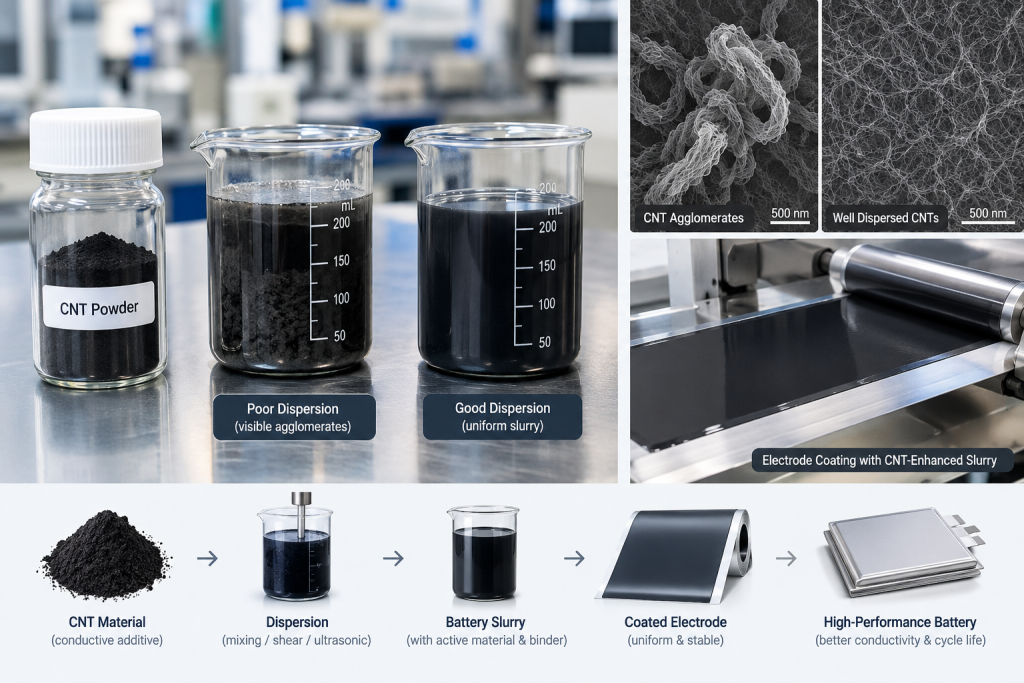
Carbon nanotubes (CNTs) are widely used as conductive additives in lithium-ion batteries because their high aspect ratio allows them to form an efficient conductive network at relatively low addition levels.
However, incorporating CNTs into a battery electrode slurry is not simply a matter of adding CNT powder to a solvent. CNT dispersion challenges in battery manufacturing can strongly affect slurry viscosity, coating stability, electrode uniformity, electrical conductivity, and ultimately cell performance.
CNTs tend to form bundles and agglomerates because of strong van der Waals interactions between individual nanotubes. If these structures are not sufficiently separated during processing, the theoretical conductivity advantage of CNTs may not translate into practical electrode performance.
For battery manufacturers, the key challenge is therefore not only selecting the right CNT, but also achieving a stable, reproducible, and scalable CNT dispersion process.
Why Is CNT Dispersion Difficult in Battery Manufacturing?
CNTs have a very high aspect ratio and a large effective surface area. These characteristics are beneficial for forming conductive networks, but they also make CNTs difficult to disperse.
Several factors contribute to CNT dispersion problems:
- Strong CNT-to-CNT attraction
- Formation of bundles and agglomerates
- High slurry viscosity
- Poor compatibility with the selected solvent or binder system
- Insufficient shear during mixing
- Excessive mechanical treatment that can damage CNT structures
- Inconsistent dispersion from batch to batch
The challenge becomes more significant when battery manufacturers attempt to increase electrode loading, coating speed, or production scale.
A dispersion method that works in a laboratory beaker may not necessarily provide the same result in a production-scale mixing system.
1. CNT Agglomeration
One of the most common problems is CNT agglomeration.
Individual CNTs naturally tend to associate into bundles. Large agglomerates can remain in the electrode slurry even after conventional mixing.
These agglomerates may cause:
- Non-uniform conductive networks
- Localized conductivity differences
- Electrode coating defects
- Increased slurry viscosity
- Poor surface quality
- Reduced utilization of active material
- Potential inconsistencies between cells
The objective of CNT dispersion is not necessarily to separate every nanotube individually. Instead, the process should create a stable and sufficiently distributed CNT network that is compatible with the electrode formulation and manufacturing process.
This distinction is important because excessive dispersion energy can sometimes create new processing problems.
2. Balancing Dispersion and CNT Structure
A major consideration in CNT dispersion is the balance between deagglomeration and CNT preservation.
Higher shear forces can help break up CNT bundles. However, excessive mechanical energy or inappropriate processing conditions may shorten CNTs or alter their structure.
This matters because CNT length and aspect ratio contribute directly to conductive network formation.
A useful dispersion process therefore needs to answer three questions:
- Are large CNT agglomerates effectively removed?
- Is the CNT network sufficiently distributed throughout the slurry?
- Are the CNT structures preserved sufficiently for the intended electrical function?
The optimum process is formulation-dependent rather than simply being the process with the highest mixing energy.
3. CNT Dispersion and Slurry Viscosity
CNTs can have a significant effect on battery slurry rheology.
Even a relatively small CNT concentration may increase viscosity because of the high aspect ratio and network-forming behavior of nanotubes.
This creates a practical manufacturing trade-off.
If CNT dispersion is poor, large agglomerates can create unstable rheological behavior. If CNTs are highly dispersed and form a strong network, viscosity can also increase substantially.
Therefore, CNT dispersion quality and slurry viscosity should be evaluated together.
Important parameters may include:
- Viscosity at different shear rates
- Yield stress
- Thixotropic behavior
- Storage stability
- Sedimentation behavior
- Coating behavior
- Filterability
For high-speed electrode coating, a CNT dispersion that looks acceptable under low-shear laboratory testing may still behave differently under actual coating conditions.
4. Solvent and Binder Compatibility
CNT dispersion cannot be evaluated independently from the rest of the electrode formulation.
The choice of solvent, binder, active material, and other conductive additives can significantly influence dispersion behavior.
For example, a CNT dispersion designed for one binder system may not perform identically in another formulation.
The interaction between CNTs and binder molecules can influence:
- CNT wetting
- Dispersion stability
- Slurry viscosity
- CNT network formation
- Electrode adhesion
- Drying behavior
This is why battery manufacturers should evaluate CNT dispersion within the complete electrode formulation, rather than testing the CNT material only in an isolated solvent system.
5. Dispersion Method Matters
Different CNT dispersion methods can produce different results.
Common approaches include:
High-Shear Mixing
High-shear mixers can provide strong mechanical forces for breaking CNT bundles.
They are useful for:
- Laboratory development
- Pre-dispersion
- Slurry preparation
- Scale-up studies
However, mixing speed, time, temperature, and formulation order need to be controlled.
Ultrasonic Dispersion
Ultrasonication can be useful for laboratory-scale CNT dispersion and formulation screening.
It can help break up CNT agglomerates, but the results may be difficult to directly reproduce at larger production volumes.
Therefore, ultrasonic dispersion is often more useful for R&D and formulation development than as a direct representation of industrial-scale mixing.
Three-Roll or Similar High-Shear Processing
High-shear processing can provide strong deagglomeration forces and may be useful for certain CNT masterbatch or concentrated dispersion systems.
However, the process must be optimized to avoid excessive CNT structural damage and unnecessary energy consumption.
6. Dispersion Sequence Can Be as Important as Mixing Energy
One frequently overlooked factor is the order in which materials are introduced into the slurry.
For example, manufacturers may evaluate different approaches such as:
CNT → solvent → dispersion → binder → active material
or
CNT + binder → pre-dispersion → active material
The optimal sequence depends on the specific CNT, solvent, binder, and active material.
Adding all components simultaneously does not necessarily produce the most stable dispersion.
For process development, it is often useful to compare:
- CNT pre-dispersion
- CNT masterbatch
- Binder-assisted dispersion
- Direct dry mixing
- Different addition sequences
This can reveal whether the main limitation is CNT wetting, agglomeration, rheology, or interaction with other slurry components.
7. CNT Dispersion in Cathode and Anode Slurries
CNT dispersion requirements can differ between cathode and anode formulations.
For cathodes, CNTs may be combined with active materials such as:
- NMC
- NCA
- LCO
- LFP
For anodes, CNTs may be used with materials such as:
- Natural graphite
- Synthetic graphite
- Silicon/graphite composites
- Silicon-based active materials
Silicon-containing anodes can be particularly interesting because CNTs can contribute to conductive network formation and mechanical connectivity.
However, the optimal CNT concentration and dispersion process depend on the electrode chemistry and manufacturing target.
There is therefore no universal “best CNT dispersion process for batteries.”
8. How Can CNT Dispersion Quality Be Evaluated?
Visual inspection alone is not sufficient to evaluate CNT dispersion.
A more reliable development program can combine several characterization methods.
Slurry Characterization
Useful measurements include:
- Viscosity
- Particle/agglomerate size
- Sedimentation stability
- Rheological behavior
- Solid content
- Storage stability
Microscopic Analysis
Optical microscopy, SEM, TEM, or other appropriate techniques can help identify CNT bundles and agglomerates.
Electrode-Level Evaluation
Ultimately, CNT dispersion should also be evaluated after coating and drying.
Relevant parameters can include:
- Electrode resistance
- Sheet resistance
- Electrical conductivity
- Coating uniformity
- Adhesion
- Porosity
- Electrochemical performance
This is important because a dispersion that looks excellent under microscopy does not automatically guarantee superior battery performance.
9. Common CNT Dispersion Problems and Their Possible Causes
| Problem | Possible Cause |
|---|---|
| Large CNT agglomerates | Insufficient shear or poor wetting |
| Excessive slurry viscosity | Strong CNT network or excessive CNT concentration |
| Poor coating quality | Unstable rheology or agglomerates |
| Sedimentation | Poor formulation stability |
| Batch-to-batch variation | Inconsistent mixing conditions |
| Reduced conductivity | Non-uniform CNT distribution |
| Difficult scale-up | Laboratory process not representative of production |
| CNT damage | Excessive mechanical energy |
| Filter blockage | Large agglomerates or poor dispersion |
The important point is that one observed problem can have multiple causes.
For example, high viscosity does not necessarily mean that the CNT content is too high. It may also indicate a highly developed CNT network, strong CNT-binder interactions, or an unsuitable dispersion sequence.
10. How to Improve CNT Dispersion for Battery Manufacturing
A practical optimization strategy should consider the entire formulation and manufacturing process.
Step 1: Define the Target
Determine:
- CNT type
- CNT loading
- Electrode chemistry
- Solvent
- Binder
- Target viscosity
- Coating method
- Required conductivity
Step 2: Develop a Small-Scale Dispersion Process
Compare different:
- Mixing speeds
- Mixing times
- Shear levels
- Addition sequences
- CNT concentrations
Step 3: Characterize the Dispersion
Measure both rheological and structural properties.
Step 4: Validate at Electrode Level
Coat the slurry and evaluate electrical and physical properties.
Step 5: Scale Up
Only after the formulation is sufficiently stable should the process be transferred to larger mixing equipment.
This approach helps separate material-related problems from process-related problems.
CNT Dispersion Is a System-Level Challenge
The most important lesson is that CNT dispersion should not be treated as an isolated material issue.
Battery electrode manufacturing involves a connected system:
CNT material → dispersion → slurry rheology → coating → drying → electrode structure → electrical performance → cell performance
A change at one stage can influence the next stage.
For example, improving CNT dispersion may increase conductive network uniformity but also change slurry viscosity. Increasing shear may reduce agglomerates but potentially affect CNT structure. Increasing CNT loading may improve conductivity but make coating more difficult.
Therefore, successful CNT implementation requires optimization across the entire manufacturing chain.
CNT dispersion challenges in battery manufacturing are closely related to CNT agglomeration, slurry rheology, formulation compatibility, dispersion energy, and scale-up.
The goal is not simply to achieve the strongest possible dispersion. Instead, manufacturers need to develop a stable CNT distribution that provides the required conductive network while maintaining suitable slurry processability and preserving CNT structure.
For battery manufacturers and material developers, the most effective approach is usually to evaluate CNT material selection, dispersion process, slurry formulation, and electrode performance together.
This is particularly important when moving from laboratory-scale CNT dispersion to pilot or mass-production electrode manufacturing.
FAQ: CNT Dispersion for Battery Manufacturing
What is the main challenge of CNT dispersion in battery manufacturing?
The main challenge is breaking up CNT agglomerates while maintaining a stable dispersion, suitable slurry rheology, and the CNT structure required for conductive network formation.
Why do CNTs agglomerate?
CNTs have strong interactions with each other and naturally form bundles. Their high aspect ratio also makes uniform dispersion more difficult.
Does higher mixing speed always improve CNT dispersion?
No. Higher shear can improve deagglomeration, but excessive mechanical energy may increase energy consumption, affect CNT structure, or create undesirable slurry rheology.
How is CNT dispersion quality measured?
A combination of rheology, microscopy, particle/agglomerate analysis, slurry stability, electrode conductivity, coating quality, and electrochemical testing can provide a more complete evaluation.
Can CNT dispersion be scaled directly from laboratory to production?
Not necessarily. Mixing geometry, shear conditions, residence time, heat generation, and material addition sequence can change significantly with scale.
Why is CNT dispersion important for lithium-ion batteries?
A well-distributed CNT network can improve electronic connectivity within the electrode while potentially achieving the desired conductive performance at relatively low conductive-additive loading.