
How Process Stability Impacts Material Commercialization
Advanced materials often attract attention because of their impressive laboratory performance.
Graphene can provide excellent electrical or thermal properties.
Carbon nanotubes can create highly efficient conductive networks.
Advanced battery materials can deliver high capacity or improved rate capability.
Thermal composites can achieve better heat transfer.
Conductive inks can produce functional films with low electrical resistance.
But laboratory performance alone does not determine whether a material can become a commercial product.
A material becomes commercially valuable when its performance can be produced reliably, repeatedly, and economically.
This is where process stability becomes critical.
Process stability determines whether a manufacturing system can produce the same product today, tomorrow, and several months later.
It affects quality, yield, cost, customer qualification, production planning, and ultimately the ability of a material supplier to build a sustainable business.
For advanced materials, process stability is often the hidden factor that separates a promising technology from a commercially scalable product.
What Is Process Stability?
Process stability means that a manufacturing process can operate within a defined range while consistently producing material that meets the required specifications.
A stable process should control important variables such as:
- Temperature
- Mixing conditions
- Pressure
- Flow rate
- Viscosity
- Solid content
- Coating speed
- Film thickness
- Drying conditions
- Curing conditions
The objective is not necessarily to hold every parameter at one exact number.
In real manufacturing, some variation is unavoidable.
The objective is to ensure that normal variation does not cause unacceptable changes in product quality.
This is why a process window is more useful than a single ideal setpoint.
Why Process Stability Matters More as Scale Increases
At laboratory scale, a researcher can often correct process variation manually.
A formulation can be remixed.
A sample can be discarded and prepared again.
Coating speed can be adjusted immediately.
Drying conditions can be changed for the next sample.
Commercial manufacturing does not have the same flexibility.
A production line may process thousands of meters of material or thousands of electrode units before the problem is detected.
This means a small process instability can become a large commercial loss.
The larger the production scale, the more important process stability becomes.
Material Quality and Process Quality Are Different
A high-quality raw material does not guarantee a high-quality finished product.
For example, a graphene supplier may provide material with excellent:
- Purity
- Flake structure
- Conductivity
- Surface area
But if the downstream dispersion process is unstable, the final coating may still show inconsistent performance.
Similarly, a high-performance battery active material may produce inconsistent electrodes if:
- Slurry viscosity drifts
- Coating thickness varies
- Drying changes
- Calendering is unstable
Commercialization therefore requires control of both:
Material quality + Process quality
These two factors are closely connected.
Process Stability Begins With Raw Materials
Manufacturing stability starts before the first process step.
Variation in incoming materials can influence the rest of the production system.
Important parameters may include:
- Particle size
- Moisture
- Purity
- Surface chemistry
- Bulk density
- Morphology
- Functionalization
- Concentration
For graphene and CNT systems, small changes in morphology or surface chemistry can influence dispersion behavior.
For battery materials, particle-size variation can influence slurry rheology, electrode loading, and electrochemical performance.
Therefore, incoming-material specifications should be based on their actual impact on the process.
Dispersion Stability Is a Process Requirement
For advanced carbon materials, dispersion is often one of the first major sources of process variation.
Graphene can restack.
CNTs can form bundles.
Carbon black can agglomerate.
If the dispersion changes during production, downstream properties can change even when the formulation recipe remains the same.
Dispersion stability should therefore be evaluated across:
Mixing → storage → transfer → pumping → filtration → coating
A dispersion that is stable immediately after mixing but changes after several hours is not necessarily suitable for continuous industrial production.
Rheology Drift Can Disrupt Production
Viscosity is another common indicator of process stability.
A formulation may begin production at the desired viscosity but gradually change because of:
- Temperature variation
- Solvent evaporation
- Sedimentation
- Shear history
- Binder interaction
- Concentration changes
Even relatively small viscosity changes can influence coating thickness and flow behavior.
This is particularly important for:
- Slot-die coating
- Gravure printing
- Blade coating
- Battery electrode coating
- Conductive ink production
Therefore, viscosity should be monitored not only at batch release but also during processing when necessary.
Temperature Control Is Critical
Temperature affects many material systems.
It can influence:
- Viscosity
- Reaction rate
- Solvent evaporation
- Dispersion stability
- Cure behavior
- Polymer properties
A laboratory process may remain within a narrow temperature range because of the small batch size.
A larger process can generate significant internal heat during mixing or experience temperature gradients across a vessel.
Pilot manufacturing helps identify whether the temperature-control system is sufficient for the scale of production.
Mixing Stability
Mixing is one of the most important operations in advanced-material processing.
A stable mixing process should provide repeatable:
- Shear
- Circulation
- Temperature
- Residence time
- Material addition
The same RPM does not necessarily produce the same mixing environment when equipment size changes.
Therefore, scale-up should focus on the physical conditions experienced by the material rather than copying laboratory machine settings.
Coating Stability Determines Product Uniformity
For coated materials, process stability is directly visible in the final product.
An unstable process can produce:
- Thickness variation
- Streaks
- Pinholes
- Surface roughness
- Edge defects
- Local conductivity differences
For functional coatings, these defects are not merely cosmetic.
They can affect:
- Electrical performance
- Thermal performance
- Adhesion
- Reliability
- Yield
This is why coating stability is a major component of material commercialization.
Drying Stability Can Change the Material Structure
Drying is often considered a process step rather than a material-development variable.
In reality, drying can alter the final microstructure.
During solvent removal:
- Particles move
- Binder redistributes
- Graphene sheets can restack
- Conductive networks develop
- Porosity changes
If drying conditions vary from one production run to another, the final material can also vary.
This is particularly relevant for:
- Battery electrodes
- Graphene coatings
- Conductive films
- Thermal materials
- Polymer composites
Stable drying conditions are therefore part of product consistency.
Curing Stability Matters for Functional Materials
For polymer-based advanced materials, curing determines much of the final structure.
Changes in:
- Temperature
- Time
- Heating rate
- Atmosphere
- Film thickness
can influence:
- Crosslinking
- Shrinkage
- Adhesion
- Mechanical strength
- Thermal performance
A formulation may therefore be chemically identical but produce different product performance if its curing conditions are not controlled.
Process Stability and Batch-to-Batch Consistency
Customers expect commercial materials to behave consistently.
They do not want:
Batch A → excellent
Batch B → acceptable
Batch C → different viscosity
Batch D → different conductivity
Batch-to-batch variation creates several problems.
It increases customer qualification risk.
It creates additional incoming inspection requirements.
It makes application-process control more difficult.
It may also reduce customer confidence.
Therefore, batch consistency is one of the most important outputs of a stable manufacturing process.
Within-Batch Variation Also Matters
Batch-to-batch variation is not the only concern.
A single production batch can contain variation internally.
For a roll-to-roll coating, the beginning, middle, and end of the roll may behave differently.
For a large dispersion batch, different sampling locations may show different characteristics.
For a composite material, filler distribution may vary from one region to another.
Commercial quality therefore requires both:
Between-batch consistency
and
Within-batch uniformity
Process Capability Is More Important Than Process Perfection
No industrial process is perfectly constant.
A good process is one in which normal variation remains inside the acceptable product specification.
This introduces the concept of process capability.
For example, suppose a product requires a certain coating thickness range.
A stable process should operate well inside that range rather than repeatedly moving close to the specification limits.
The more robust the process, the lower the probability of producing off-specification material.
Why Process Windows Matter
A process window defines the acceptable operating range for important parameters.
For example:
Viscosity → acceptable range
Coating speed → acceptable range
Drying temperature → acceptable range
Mixing time → acceptable range
Curing temperature → acceptable range
A manufacturing process that only works at one exact combination of conditions is fragile.
A process that remains stable across a reasonable range is much easier to commercialize.
This is one of the main reasons pilot production is valuable.
Pilot Manufacturing Creates Process Knowledge
Laboratory work primarily creates material knowledge.
Pilot manufacturing creates process knowledge.
It reveals:
- Which variables matter
- Which variables interact
- Which equipment settings are sensitive
- How long the process can operate
- Where defects originate
- How much material is lost
- How stable the final product is
This information becomes part of the commercial technology.
A pilot line therefore creates intellectual value beyond the physical samples it produces.
Process Stability Reduces Customer Qualification Risk
Customers often spend considerable time validating advanced materials.
They may test:
- Performance
- Reliability
- Compatibility
- Environmental behavior
- Manufacturing integration
A customer may approve a material based on a representative sample.
If production later changes significantly, the customer may need to repeat qualification.
This creates cost and delays.
Stable manufacturing reduces the risk that the commercial product differs materially from the qualified sample.
Stable Processes Protect Customer Trust
Technical performance is only part of a supplier’s value.
Customers also depend on:
- Delivery consistency
- Specification consistency
- Documentation
- Traceability
- Stable lead times
An unstable process can create problems in all of these areas.
For advanced materials, where customers often integrate the material into their own production, process stability becomes part of supplier reliability.
Process Stability and Manufacturing Yield
Stable processes generally improve yield.
An unstable process may create:
- Scrap
- Rework
- Off-specification batches
- Startup losses
- Coating defects
- Equipment downtime
These losses increase cost.
For expensive materials such as graphene, CNTs, specialty conductive additives, or advanced thermal fillers, the economic impact can be significant.
Therefore, process stability has a direct connection with manufacturing economics.
Cost Is Often a Process Problem
Material cost receives significant attention during product development.
However, manufacturing costs can also dominate commercial economics.
Consider a material with excellent technical performance.
If the process requires:
- Very long mixing
- Multiple filtration stages
- Slow coating
- Long drying
- High scrap
- Frequent cleaning
the final product may become too expensive.
Process optimization can therefore reduce cost without changing the material itself.
This is one reason process engineering can create as much commercial value as material development.
Stable Processes Make Scale-Up Easier
A stable laboratory process does not automatically become a stable industrial process.
But a well-understood process makes scale-up significantly easier.
If developers already understand:
- Critical mixing conditions
- Rheological behavior
- Drying sensitivity
- Coating window
- Quality parameters
then larger equipment can be designed around those requirements.
Without this knowledge, commercial scale-up becomes much more dependent on trial and error.
Process Stability and Equipment Selection
Equipment should be selected based on the process requirements.
For example, a coating process may require:
- Precise flow control
- Stable web speed
- Uniform coating width
- Controlled drying
A dispersion process may require:
- High shear
- Strong circulation
- Temperature control
- Controlled addition
The wrong equipment can create instability even when the material itself is suitable.
This is why equipment development and material development should often proceed together.
Long-Duration Production Tests
Short production tests are useful for early process validation.
However, long-duration production tests are necessary before commercialization.
Extended operation can reveal:
- Sedimentation
- Temperature drift
- Filter loading
- Pump wear
- Coating-head contamination
- Viscosity changes
- Equipment fouling
A process that is stable for 30 minutes may not be stable for 8 hours.
Commercial manufacturing requires confidence over the actual operating duration.
Process Monitoring
Modern manufacturing can monitor important process variables in real time.
Examples include:
- Temperature
- Pressure
- Flow
- Viscosity
- Mixing torque
- Coating thickness
- Web speed
- Web tension
- Electrical resistance
Real-time monitoring makes it easier to identify process drift before large quantities of product become off-specification.
Inline and At-Line Quality Control
Traditional quality control often depends heavily on final-product testing.
For continuous processes, earlier detection is valuable.
Inline or at-line measurements can provide rapid information about:
- Thickness
- Surface defects
- Sheet resistance
- Temperature
- Width
- Weight per unit area
This enables faster process correction.
In advanced material production, reducing the time between a process change and its detection can significantly improve yield.
Process Stability Enables Data-Driven Optimization
Once a process is stable enough to produce repeatable data, engineers can begin to understand relationships between variables.
For example:
Mixing energy → dispersion → viscosity → coating quality
or:
Drying profile → electrode structure → resistance → cell performance
These relationships make optimization more scientific.
Instead of relying entirely on trial and error, engineers can identify which parameters actually control final performance.
Process Stability and Product Specifications
A mature manufacturing process should support realistic product specifications.
Specifications should be based on parameters that genuinely influence customer performance.
For example, a graphene dispersion may require controls on:
- Concentration
- Viscosity
- Agglomerate size
- Stability
A thermal coating may require:
- Thickness
- Thermal conductivity
- Adhesion
- Surface uniformity
A battery slurry may require:
- Solid content
- Viscosity
- Dispersion
- Moisture
The goal is to control what matters.
Process Stability Supports Technology Transfer
Many advanced materials eventually need to move between:
- Research laboratories
- Pilot facilities
- Manufacturing sites
- Contract manufacturers
- Customer production lines
Technology transfer is much easier when the process is clearly documented.
A transferable process should define:
- Raw materials
- Equipment
- Critical parameters
- Process sequence
- Acceptance criteria
- Quality-control methods
Without this information, the technology may depend too heavily on individual operators.
Reducing Operator Dependence
Laboratory processes often rely on experienced researchers.
An experienced operator may know:
- When the slurry “looks right”
- When the mixer has reached the correct state
- When a coating is acceptable
- When a batch needs adjustment
Commercial manufacturing cannot rely entirely on intuition.
The process needs objective criteria that allow different operators and shifts to produce consistent results.
Standardization is therefore part of commercialization.
Process Stability Improves Supply Reliability
Customers need more than a technically qualified sample.
They need reliable supply.
An unstable production process can create:
- Delayed shipments
- Repeated rework
- Unexpected shortages
- Batch rejection
- Uncertain lead times
Stable manufacturing supports more predictable production planning and delivery.
This becomes increasingly important as customer volume increases.
Process Stability and Commercial Confidence
A commercial buyer is effectively taking a risk when adopting an advanced material.
They need confidence that:
- The material will remain available
- The specification will remain stable
- Production can increase
- Quality will remain consistent
- Problems can be investigated
Process stability provides evidence that the supplier has moved beyond laboratory experimentation toward industrial manufacturing capability.
When Should Process Stability Be Established?
Process stability does not need to be perfect before the first pilot run.
In fact, pilot manufacturing is often where stability is developed.
A practical sequence is:
Laboratory screening → formulation development → pilot process development → process-window definition → multi-batch validation → commercial scale-up
The key is to progressively reduce uncertainty.
Each stage should produce enough information to support the next stage.
A Practical Process-Stability Framework
A useful framework can examine five areas.
1. Material Stability
Are the incoming materials sufficiently consistent?
2. Process Stability
Can the manufacturing process operate within a defined range?
3. Product Stability
Does the finished product remain within specification?
4. Application Stability
Does the product perform consistently in the customer’s application?
5. Economic Stability
Can the product be manufactured at an acceptable and predictable cost?
Commercialization requires all five.
Process Stability in Different Advanced-Material Applications
Graphene and CNT Dispersion
Focus on:
- Dispersion
- Viscosity
- Stability
- Agglomeration
Conductive Inks
Focus on:
- Rheology
- Surface tension
- Coating
- Sheet resistance
Thermal Coatings
Focus on:
- Thickness
- Thermal conductivity
- Adhesion
- Drying
Battery Materials
Focus on:
- Slurry behavior
- Electrode loading
- Density
- Porosity
- Electrochemical performance
Advanced Composites
Focus on:
- Filler distribution
- Mixing
- Cure
- Mechanical properties
- Thermal properties
The specific process-control strategy changes with the application, but the underlying principle remains the same.
The Role of Pilot Partners
A capable pilot partner can help convert process instability into process knowledge.
The partner should be able to identify:
- Root causes
- Critical parameters
- Equipment limitations
- Process interactions
- Acceptable operating ranges
This is why pilot-partner selection is an important part of commercialization.
The right partner contributes engineering knowledge, not just production capacity.
Common Process-Stability Mistakes
Mistake 1: Optimizing Only the Material
A high-performing material can still produce an unstable manufacturing process.
Mistake 2: Using One Laboratory Recipe
Scale-up requires revalidation of process conditions.
Mistake 3: Testing Only One Batch
One good batch does not prove consistency.
Mistake 4: Ignoring Long-Duration Operation
Short tests may hide drift and contamination.
Mistake 5: Measuring Only Final Properties
Process data is necessary to understand variation.
Mistake 6: Depending on Operator Experience
Commercial processes should be standardized and measurable.
Mistake 7: Optimizing Before Stabilizing
It is difficult to optimize a process that is not yet reproducible.
The Commercialization Value of Stability
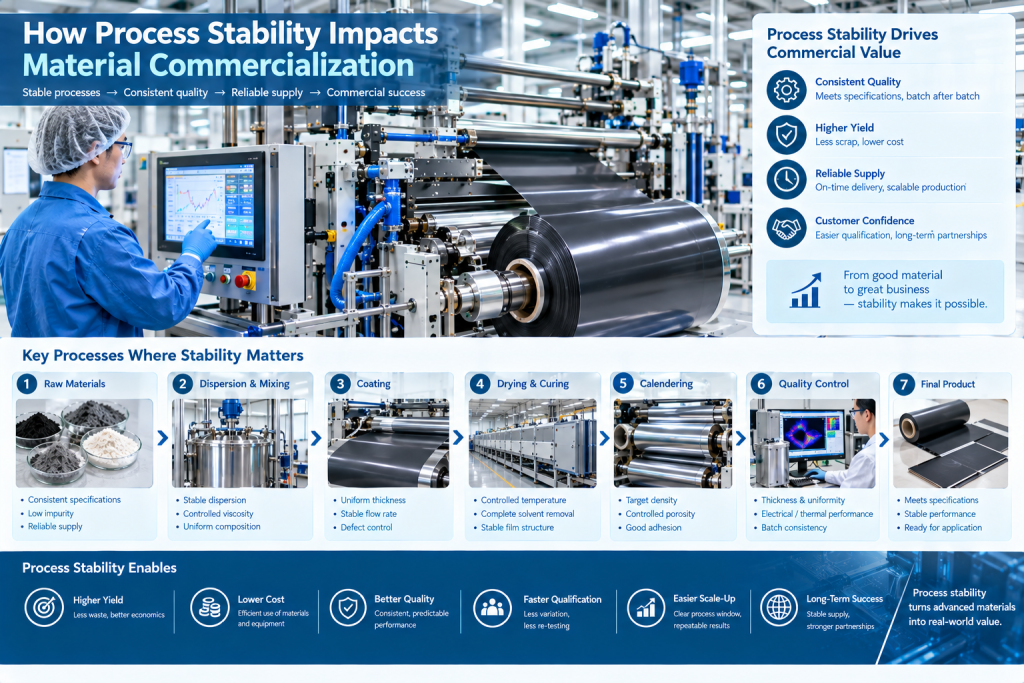
A stable process creates several advantages simultaneously:
Higher Yield
Less scrap and rework.
Lower Cost
Better equipment utilization and material efficiency.
Better Quality
More consistent product properties.
Faster Customer Qualification
Less variation between qualification samples and commercial batches.
Easier Scale-Up
A clear process window can be transferred to larger equipment.
More Reliable Supply
Production becomes easier to plan.
These advantages show why process stability is not simply a manufacturing concern.
It is a commercial asset.
From Process Stability to Product Reliability
Process stability and product reliability are closely related, but they are not identical.
A stable process produces consistent products.
A reliable product maintains its performance during actual use.
Both are necessary.
For example, a thermal coating may have excellent batch consistency but poor long-term thermal cycling performance.
A battery electrode may be highly uniform but degrade rapidly.
Therefore, commercialization requires:
Stable manufacturing + Reliable product performance
The Ultimate Goal: Reproducible Value
Industrial customers do not purchase laboratory potential.
They purchase repeatable performance.
This is the most important reason process stability matters.
A customer should be able to receive:
Batch 1 → expected performance
Batch 2 → expected performance
Batch 3 → expected performance
and continue to receive predictable results as production volume increases.
That is what turns material innovation into commercial value.
Process stability is one of the most important foundations of advanced-material commercialization.
A material may have extraordinary laboratory properties, but those properties only create sustainable commercial value when they can be reproduced consistently through a manufacturing process.
For graphene, CNTs, conductive inks, thermal materials, battery materials, and advanced composites, this requires control of:
Raw Materials → Dispersion → Mixing → Formulation → Coating → Drying → Curing → Quality Control → Final Product
The objective is not to eliminate every source of variation.
It is to understand the critical variables and establish a robust process window in which normal variation does not compromise product performance.
Pilot manufacturing plays a central role in this development.
It transforms laboratory experience into process data.
It reveals sources of variation.
It establishes manufacturing windows.
It provides the evidence needed for customer qualification and commercial scale-up.
Ultimately, a commercially successful advanced material is not simply one that performs well under controlled laboratory conditions.
It is one that can deliver stable, measurable, and repeatable value every time it is manufactured and used.
That is why process stability is not merely a production objective.
It is a fundamental part of material commercialization itself.