
Pilot-Scale Graphene Solutions for Harsh Environments
Graphene has attracted increasing interest for applications where conventional materials must operate under demanding environmental conditions.
Harsh environments may involve:
- High humidity
- Salt spray and marine exposure
- Corrosive chemicals
- Elevated temperatures
- Abrasion
- UV exposure
- Thermal cycling
- Electrical or electrochemical environments
Graphene’s combination of barrier properties, chemical stability, electrical conductivity, thermal properties, and high surface area makes it an attractive material for developing advanced protective and functional systems.
However, demonstrating graphene performance in a laboratory coupon is only the first step.
For industrial applications, the more important question is:
Can a graphene-based solution maintain reliable performance when produced and applied at pilot scale under realistic environmental conditions?
This is where pilot-scale development becomes particularly important.
A successful pilot program connects:
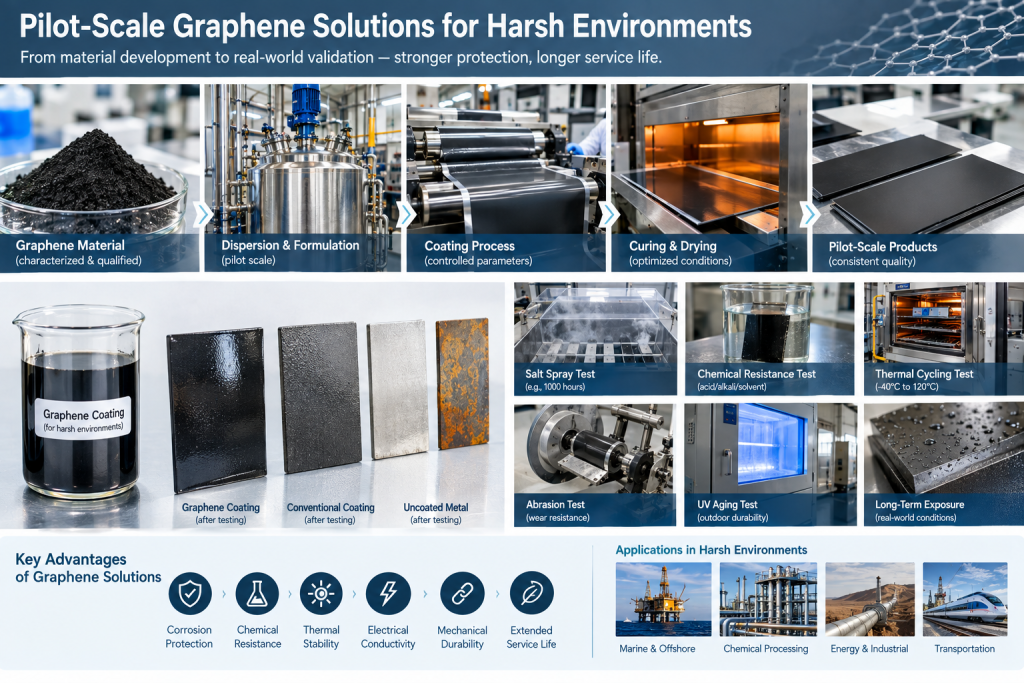
Graphene Material → Formulation → Processing → Application → Environmental Testing → Performance Validation
The objective is not simply to demonstrate that graphene can survive a harsh environment. It is to determine whether a graphene-enabled system can provide repeatable, measurable, and commercially relevant performance.
1. What Makes an Environment “Harsh”?
The definition of a harsh environment depends on the application.
For one product, high humidity may be the primary concern.
For another, the combination of salt, temperature, mechanical stress, and chemicals may be much more challenging.
Typical environmental factors include:
Corrosive Conditions
- Salt spray
- Chloride exposure
- Acidic environments
- Alkaline environments
- Industrial chemicals
- Electrochemical environments
Thermal Conditions
- High operating temperature
- Rapid temperature changes
- Thermal cycling
- Localized heating
Mechanical Conditions
- Abrasion
- Impact
- Vibration
- Repeated mechanical stress
Atmospheric Conditions
- High humidity
- UV radiation
- Outdoor weathering
- Condensation
In many real applications, several of these factors occur simultaneously.
For example:
Marine equipment = salt + humidity + temperature variation + mechanical exposure
Therefore, graphene solutions should be evaluated under application-relevant environmental combinations, rather than relying on a single laboratory test.
2. Why Consider Graphene for Harsh Environments?
Graphene can provide several potentially useful functions depending on its structure, surface chemistry, formulation, and application.
Barrier Protection
Graphene’s layered structure can create a more difficult diffusion pathway for water, oxygen, and corrosive species when properly incorporated into a coating or composite.
Chemical Resistance
Certain graphene-based systems can improve resistance to chemical exposure, although the final performance depends strongly on the surrounding binder and formulation.
Electrical Conductivity
Conductive graphene networks can be useful for:
- Electrostatic dissipation
- Conductive coatings
- Electromagnetic shielding
- Functional surfaces
Thermal Performance
Graphene can contribute to heat transfer in appropriately designed composites and thermal-management systems.
Mechanical Reinforcement
Graphene may improve selected mechanical properties when good interfacial bonding and dispersion are achieved.
The key point is that graphene itself is not automatically a complete harsh-environment solution.
The final performance comes from the entire material system.
3. Graphene Is Usually Part of a System
A common mistake in advanced material development is to treat graphene as a standalone protective material.
In many industrial applications, graphene is incorporated into:
- Polymer coatings
- Epoxy systems
- Elastomers
- Adhesives
- Composite materials
- Conductive formulations
- Thermal materials
- Cementitious systems
The final performance depends on the interaction between:
Graphene + Matrix + Interface + Processing + Environment
For example, adding graphene to a coating does not automatically guarantee corrosion protection.
The producer must consider:
- Graphene type
- Loading level
- Dispersion
- Binder compatibility
- Coating thickness
- Surface preparation
- Curing
- Defect control
This is why pilot-scale validation is essential.
4. Why Laboratory Testing Is Not Enough
Laboratory testing is useful for identifying promising formulations.
However, small test coupons may not represent actual industrial components.
A laboratory sample may have:
- Uniform thickness
- Carefully prepared surfaces
- Controlled curing
- Small dimensions
- Limited environmental exposure
A real component may have:
- Complex geometry
- Welds
- Edges
- Fasteners
- Surface imperfections
- Variable coating thickness
- Different substrate materials
These differences can significantly influence environmental durability.
Therefore, pilot-scale testing should progressively move closer to the real application.
5. Pilot-Scale Graphene Coating Development
Graphene-based protective coatings are one of the most practical areas for pilot-scale development.
A typical development pathway may involve:
Graphene Selection
↓
Dispersion Development
↓
Coating Formulation
↓
Laboratory Coupon Testing
↓
Pilot Coating
↓
Environmental Exposure
↓
Performance Evaluation
The pilot stage helps determine whether a laboratory formulation can be reproduced using larger-scale mixing and coating equipment.
Important process variables may include:
- Mixing speed
- Dispersion time
- Temperature
- Solid content
- Viscosity
- Coating thickness
- Drying conditions
- Curing conditions
A formulation that performs well in the laboratory but cannot be processed consistently at pilot scale requires further optimization.
6. Dispersion Is Critical
One of the most important factors in graphene-based harsh-environment applications is dispersion.
Graphene has a strong tendency to form agglomerates.
Poor dispersion can result in:
- Coating defects
- Uneven barrier properties
- Localized weak points
- Increased viscosity
- Reduced processability
- Inconsistent electrical properties
For corrosion-protection applications, agglomerates can be particularly problematic because they may create defects or discontinuities in the protective structure.
Therefore, pilot-scale development should evaluate dispersion under realistic production conditions.
Important parameters may include:
- Particle/agglomerate size
- Viscosity
- Dispersion stability
- Sedimentation
- Coating uniformity
- Storage stability
7. Graphene Loading Must Be Optimized
More graphene does not necessarily mean better environmental performance.
Increasing graphene content may improve certain properties up to an optimum point.
Beyond that point, excessive loading can cause:
- Higher viscosity
- Poor dispersion
- Agglomeration
- Processing difficulties
- Increased material cost
- Reduced coating uniformity
The optimal graphene concentration therefore depends on:
Material properties + formulation + processing + target environment
Pilot testing can help identify the practical operating window.
8. Corrosion Protection in Marine Environments
Marine environments are particularly challenging because they combine:
- Salt
- Moisture
- Oxygen
- Temperature variation
- Mechanical exposure
Graphene-based coatings may be investigated for:
- Marine structures
- Offshore equipment
- Metal components
- Pipelines
- Storage systems
- Transportation equipment
Testing may include:
- Salt spray
- Humidity exposure
- Immersion
- Electrochemical measurements
- Adhesion testing
- Visual inspection
- Coating thickness measurement
However, laboratory salt-spray performance should not automatically be interpreted as equivalent to long-term field performance.
Pilot testing provides an opportunity to evaluate the coating under more representative conditions.
9. Chemical Exposure Testing
Industrial equipment may encounter acids, alkalis, solvents, fuels, or other aggressive chemicals.
A graphene-based material system can be evaluated for:
- Mass change
- Swelling
- Surface degradation
- Adhesion loss
- Electrical-property changes
- Mechanical-property changes
- Corrosion beneath the coating
The specific chemicals and exposure conditions should be selected according to the customer’s actual operating environment.
This is more meaningful than using generic chemical-resistance testing that does not represent the application.
10. Thermal Cycling Can Reveal Hidden Problems
A material may perform well at a constant temperature but behave differently when temperature changes repeatedly.
Thermal cycling can create:
- Expansion and contraction
- Internal stress
- Interface stress
- Microcracking
- Delamination
- Changes in adhesion
This is especially important for graphene composites and coatings applied to substrates with different thermal expansion coefficients.
A pilot-scale validation program can therefore include:
High Temperature → Low Temperature → High Temperature → Repeated Cycles
followed by evaluation of:
- Surface integrity
- Adhesion
- Electrical properties
- Barrier performance
- Mechanical properties
11. Graphene and Metal Interfaces
Graphene-based systems are often developed for metallic substrates such as:
- Steel
- Aluminum
- Copper
- Stainless steel
- Magnesium alloys
The interface between graphene-containing material and the metal substrate can determine final performance.
Important considerations include:
- Surface preparation
- Roughness
- Oxide layer
- Adhesion
- Coating thickness
- Curing
- Galvanic effects
This last point deserves particular attention.
Because graphene can be electrically conductive, its interaction with different metals and electrolytes needs to be carefully evaluated.
A conductive nanomaterial that improves one property could potentially introduce another electrochemical consideration if the formulation and interface are not properly designed.
Therefore, corrosion testing should be application-specific.
12. High-Temperature Applications
Graphene and graphene-based composites may also be considered for elevated-temperature environments.
Potential applications include:
- Thermal management
- Industrial coatings
- Heating elements
- Automotive components
- Energy systems
- Industrial equipment
However, temperature performance depends on the complete material system.
Important questions include:
- What is the maximum operating temperature?
- Does the polymer matrix degrade first?
- Does graphene remain structurally stable?
- Does electrical conductivity change?
- Does thermal cycling damage the interface?
- Does the coating remain adherent?
The maximum temperature of graphene itself should therefore not be confused with the maximum operating temperature of a graphene-based commercial product.
13. Mechanical Durability Matters
Environmental protection is not only about chemical resistance.
A coating or composite may also experience:
- Abrasion
- Scratching
- Impact
- Vibration
- Repeated loading
If mechanical damage creates defects, environmental protection can be significantly reduced.
Pilot testing should therefore consider whether the graphene-based system can maintain its protective function after mechanical stress.
Potential evaluations include:
- Abrasion resistance
- Scratch resistance
- Impact resistance
- Adhesion
- Flexibility
- Fatigue
The appropriate tests depend on the final application.
14. Pilot-Scale Testing Should Measure More Than One Property
A common mistake is to evaluate a graphene solution using only one performance metric.
For example:
“The coating showed excellent corrosion resistance.”
This statement may not be sufficient for commercial qualification.
A broader evaluation could include:
| Category | Possible Evaluation |
|---|---|
| Physical | Thickness, appearance, surface roughness |
| Mechanical | Adhesion, abrasion, impact |
| Chemical | Chemical resistance |
| Environmental | Humidity, salt spray, immersion |
| Thermal | Thermal cycling, heat exposure |
| Electrical | Surface or volume conductivity |
| Durability | Long-term exposure |
| Processing | Viscosity, curing, coating behavior |
This provides a more complete picture of whether the material is ready for the next development stage.
15. Define the Pilot-Scale Process Window
A successful pilot project should not produce only one successful batch.
It should help identify a process window.
For example:
Mixing speed: acceptable range
Dispersion time: acceptable range
Graphene loading: acceptable range
Viscosity: acceptable range
Coating thickness: acceptable range
Curing temperature: acceptable range
This is important because industrial manufacturing naturally contains some variation.
A robust process is one that remains within specification despite normal manufacturing fluctuations.
16. Environmental Testing Should Be Linked to Failure Analysis
When a sample fails an environmental test, the objective should not simply be to record the failure.
The more valuable question is:
Why did it fail?
For example:
Corrosion appears
Possible causes:
- Poor dispersion
- Coating defects
- Insufficient thickness
- Poor adhesion
- Incorrect surface preparation
- Galvanic interaction
Coating cracks
Possible causes:
- Thermal expansion mismatch
- Excessive filler loading
- Insufficient flexibility
- Curing problems
Conductivity decreases
Possible causes:
- Moisture
- Structural changes
- Network disruption
- Binder degradation
Failure analysis can therefore guide the next formulation or process iteration.
17. Pilot-Scale Validation Reduces Commercial Risk
Moving directly from laboratory testing to mass production can create significant risk.
Pilot-scale development provides an intermediate stage where manufacturers can evaluate:
- Material reproducibility
- Production equipment
- Processing conditions
- Environmental performance
- Yield
- Cost
- Quality control
- Customer application requirements
This can reveal problems while the project is still flexible enough to make technical adjustments.
The pilot stage therefore functions as a risk-reduction platform.
18. What Should a Pilot-Scale Graphene Project Deliver?
A well-designed pilot project should ideally produce more than a sample.
It should generate a technical package containing:
Material Data
- Material specification
- Batch information
- Characterization data
- COA
Process Data
- Mixing conditions
- Dispersion conditions
- Processing parameters
- Coating or forming parameters
Application Data
- Performance testing
- Environmental testing
- Mechanical testing
- Thermal testing
Scale-Up Data
- Batch size
- Yield
- Process stability
- Production cycle
- Preliminary cost
Quality Data
- Batch-to-batch variation
- Critical quality parameters
- Recommended QC methods
This information provides a much stronger foundation for customer qualification and commercial production.
19. From Pilot Project to Commercial Product
The path to commercialization can be structured as:
Material Screening
↓
Laboratory Formulation
↓
Application Testing
↓
Pilot-Scale Production
↓
Harsh-Environment Testing
↓
Failure Analysis
↓
Process Optimization
↓
Customer Qualification
↓
Commercial Manufacturing
At each stage, the objective should be to reduce uncertainty.
By the time the project reaches commercial qualification, the customer should have confidence not only in the material’s performance, but also in its manufacturing consistency and long-term supply capability.
20. Why Application-Specific Graphene Matters
There is no single graphene material that is automatically ideal for every harsh environment.
A graphene grade for:
- Marine corrosion protection
may require different properties from graphene intended for:
- High-temperature thermal management
or:
- Conductive industrial coatings
or:
- Battery applications
The best material is therefore determined by the application requirements.
A practical development approach is:
Define Environment → Define Failure Mode → Define Required Performance → Select Graphene → Develop Formulation → Pilot Test
This is generally more effective than selecting a graphene material first and searching for an application afterward.
Pilot-scale graphene development is an important bridge between laboratory research and industrial commercialization, particularly for harsh-environment applications.
The challenge is not simply demonstrating that graphene can improve a material.
The real objective is to determine whether a graphene-based system can deliver:
Performance + Durability + Processability + Consistency + Cost-effectiveness
under realistic manufacturing and environmental conditions.
For applications involving corrosion, chemicals, temperature variation, abrasion, humidity, or other demanding conditions, pilot-scale testing can reveal problems that laboratory experiments cannot fully capture.
A successful development pathway therefore combines:
Graphene Material Selection → Dispersion/Formulation → Pilot Processing → Environmental Testing → Failure Analysis → Process Optimization → Customer Qualification
This approach allows graphene producers and application developers to move from promising laboratory results toward reliable, scalable solutions for real industrial environments.
FAQ: Pilot-Scale Graphene Solutions
Why is pilot-scale testing important for graphene?
Pilot-scale testing helps determine whether a graphene material and formulation can be reproduced using larger-scale equipment while maintaining the required quality and application performance.
Can graphene improve corrosion protection?
Graphene can contribute to barrier and protective properties in appropriately designed coating systems. However, final corrosion performance depends on graphene type, dispersion, binder chemistry, coating structure, substrate preparation, and environmental conditions.
What harsh environments can graphene-based materials be tested in?
Depending on the application, testing may include salt spray, humidity, chemical immersion, thermal cycling, elevated temperature, UV exposure, abrasion, and mechanical stress.
Is more graphene always better?
No. Excessive graphene loading can increase viscosity, promote agglomeration, complicate processing, increase cost, and potentially reduce final performance. The optimum loading needs to be established experimentally.
Why is graphene dispersion important in harsh-environment coatings?
Uniform dispersion helps reduce agglomeration and coating defects and can improve the consistency of barrier, electrical, mechanical, or other functional properties.
What should be tested during pilot-scale graphene development?
Testing may include material characterization, dispersion stability, viscosity, coating quality, adhesion, mechanical durability, corrosion resistance, chemical resistance, thermal cycling, electrical properties, and long-term environmental exposure.
How does pilot-scale testing reduce commercialization risk?
It identifies scale-dependent problems in processing, material consistency, environmental durability, yield, and cost before the project moves into full commercial production.
How should customers select graphene for harsh-environment applications?
Selection should start with the actual environmental conditions and failure mechanisms. The required graphene properties should then be defined based on the formulation, substrate, processing method, and target performance.