
Why Do Most Battery Materials Fail During Scale-Up?
A battery material can deliver excellent results in a laboratory coin cell and still fail when the project moves toward pilot production or commercial manufacturing.
This is one of the most important challenges in battery technology development.
New materials may demonstrate promising:
- Energy density
- Conductivity
- Cycle life
- Rate capability
- Thermal performance
- Electrochemical stability
under carefully controlled laboratory conditions.
However, commercial battery manufacturing introduces many additional variables.
The material must work within a real production process involving:
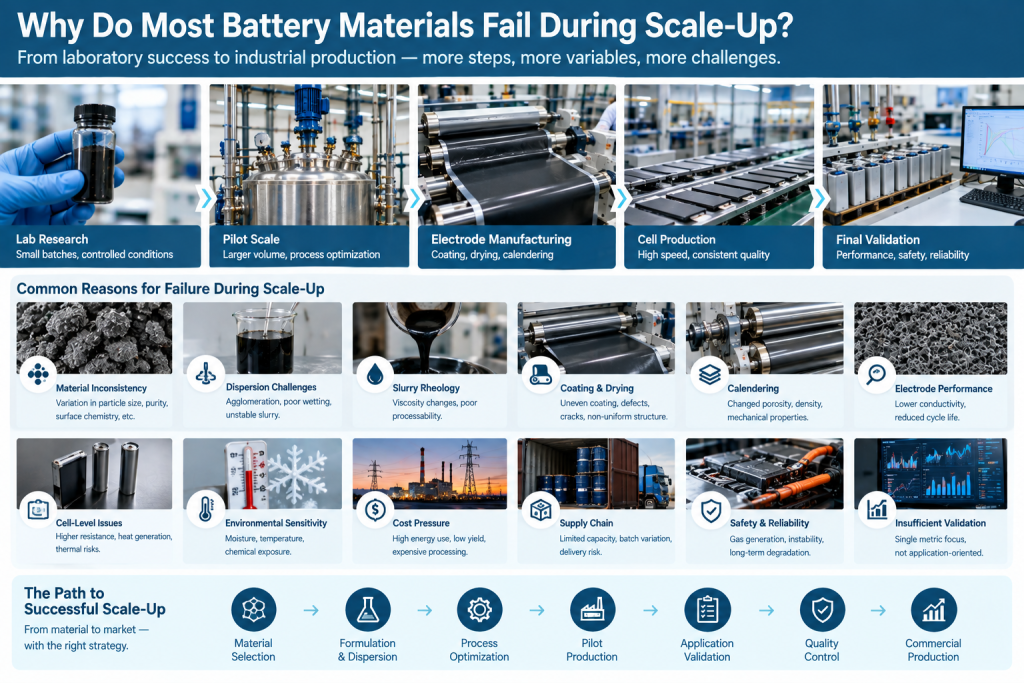
Raw Materials → Mixing → Slurry Preparation → Coating → Drying → Calendering → Cell Assembly → Formation → Testing
At each stage, the material can behave differently from what was observed at laboratory scale.
Therefore, the real challenge is not simply:
Can the material improve battery performance?
It is:
Can the material deliver the same improvement consistently, economically, and reproducibly within a scalable battery manufacturing process?
1. Laboratory Results Are Not the Same as Manufacturing Results
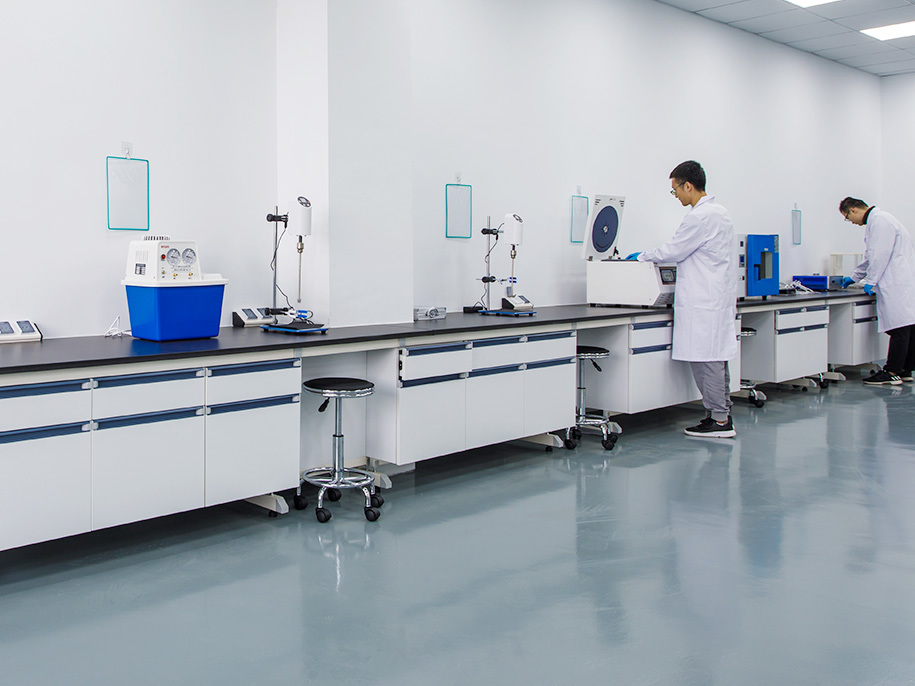
Laboratory battery experiments are designed to isolate material behavior.
Researchers may use:
- Small electrode areas
- Low material quantities
- Carefully controlled mixing
- Low coating speeds
- Highly controlled drying
- Manually prepared electrodes
- Small-format cells
- Highly selected material batches
These conditions are valuable for proving technical feasibility.
Commercial manufacturing is different.
A production line must deal with:
- Large slurry volumes
- Continuous coating
- High line speeds
- Wider electrodes
- Batch-to-batch variation
- Equipment variation
- Drying gradients
- Environmental fluctuations
- Strict yield requirements
A material that performs well in a small laboratory cell therefore has not necessarily demonstrated manufacturing readiness.
2. Scale-Up Changes the Entire Electrode Process
Battery performance depends on more than the active material.
The electrode itself is a complex engineered structure.
A simplified process is:
Active Material + Conductive Additive + Binder + Solvent
↓
Slurry
↓
Coating
↓
Drying
↓
Calendering
↓
Electrode
Small changes in one stage can affect the final electrode.
For example:
Slurry viscosity changes
→ coating behavior changes
→ coating thickness changes
→ electrode density changes
→ ionic transport changes
→ cell performance changes
This is why battery material scale-up needs to consider the complete electrode manufacturing process, not just the powder properties.
3. Material Consistency Becomes Critical
A laboratory project may use one carefully selected material batch.
Commercial production may require hundreds or thousands of batches.
Small differences in:
- Particle size
- Surface area
- Morphology
- Purity
- Moisture
- Surface chemistry
- Bulk density
- Conductivity
can affect processing and electrochemical performance.
This is particularly important for advanced materials such as:
- CNTs
- Graphene
- Conductive carbon
- Silicon-based materials
- High-nickel cathode materials
- Surface-functionalized powders
The material specification therefore needs to identify the critical quality attributes that actually influence battery performance.
4. Dispersion Problems Can Appear During Scale-Up
Conductive additives such as CNTs and graphene can create significant dispersion challenges.
At laboratory scale, a researcher may obtain a uniform dispersion using carefully controlled equipment.
At larger scale, however, the same formulation may experience:
- Agglomeration
- Incomplete wetting
- Non-uniform conductive networks
- Increased viscosity
- Filter blockage
- Coating defects
This can be particularly important for CNT-based conductive systems.
CNTs have high aspect ratios and strong interactions between nanotubes.
The objective is not simply to add CNTs to a slurry.
The process must create a uniform and stable conductive network without making the slurry impossible to process.
5. Higher Loading Can Change Material Behavior
Laboratory studies often explore material performance under specific loading conditions.
Commercial electrodes may use much higher active-material loading and much thicker coatings.
As electrode loading increases:
- Ion transport becomes more difficult.
- Electronic resistance can become more important.
- Drying behavior changes.
- Mechanical stresses increase.
- Electrolyte penetration becomes more challenging.
- Heat generation can become more significant.
A material that performs well in a thin laboratory electrode may therefore behave differently in a high-loading commercial electrode.
This is one reason areal capacity and electrode loading should be considered during scale-up.
6. Slurry Rheology Can Become a Bottleneck
Battery slurry behavior is critical for continuous manufacturing.
Important parameters may include:
- Viscosity
- Yield stress
- Solid content
- Shear response
- Sedimentation stability
- Mixing time
- Storage stability
A material may improve electrochemical performance but simultaneously increase slurry viscosity.
This can affect:
- Pumping
- Filtration
- Coating
- Slot-die behavior
- Coating uniformity
- Line speed
The result is an important trade-off:
Better material performance ≠ better manufacturing performance
The best battery material must provide both.
7. Drying Conditions Can Change the Electrode Structure
Drying is not simply the removal of solvent.
During drying, particles and binder can redistribute within the electrode.
This may influence:
- Binder distribution
- Conductive additive distribution
- Porosity
- Surface composition
- Adhesion
- Electrolyte wetting
At laboratory scale, drying may occur slowly and relatively uniformly.
At production scale, high-speed drying introduces additional complexity.
Temperature gradients, solvent evaporation rate, airflow, and electrode thickness can all influence the final structure.
Therefore, a battery material formulation should be evaluated under representative drying conditions before commercial scale-up.
8. Calendering Can Change the Final Performance
After coating and drying, electrodes are often calendered to achieve the required density and mechanical properties.
Calendering changes:
- Electrode thickness
- Porosity
- Density
- Particle contact
- Conductive pathways
- Mechanical structure
A material that looks excellent before calendering may behave differently after compression.
This is particularly important when introducing new conductive additives or composite materials.
The optimal formulation therefore needs to be evaluated through the complete process:
Mixing → Coating → Drying → Calendering → Cell Assembly
rather than stopping at slurry or electrode testing.
9. Laboratory Cells May Not Represent Commercial Cells
Small laboratory cells are useful for screening materials.
However, they may not reproduce the behavior of larger-format cells.
Differences can include:
- Electrode area
- Electrode thickness
- Current distribution
- Thermal behavior
- Electrolyte distribution
- Mechanical pressure
- Manufacturing tolerances
A material can therefore show excellent performance in a coin cell while providing a much smaller improvement in a larger-format pouch or cylindrical cell.
This does not necessarily mean that the material failed.
It may indicate that the dominant performance limitations changed during scale-up.
10. Cycle Life Can Change With Scale
Battery degradation is influenced by many interacting variables.
At larger scale, differences in:
- Temperature
- Current distribution
- Electrode uniformity
- Mechanical stress
- Electrolyte distribution
- Manufacturing defects
can influence cycle life.
A material that provides strong cycle-life improvement under laboratory conditions needs to be tested under more representative operating conditions before commercialization.
Important validation variables may include:
- Charge/discharge rate
- Temperature
- Depth of discharge
- State-of-charge window
- Electrode loading
- Cell format
- Cycling protocol
11. Thermal Behavior Becomes More Important
Battery materials can behave differently as cell size and energy density increase.
A material may provide good electrochemical performance but create new thermal considerations.
During scale-up, manufacturers need to consider:
- Internal resistance
- Heat generation
- Thermal conductivity
- Temperature distribution
- Thermal cycling
- Safety margins
For graphene or CNT-based materials, improved electrical or thermal properties can be valuable, but their actual benefit needs to be demonstrated at the electrode and cell level.
Material-level conductivity data alone cannot guarantee improved battery thermal performance.
12. Moisture Control Can Become a Major Issue
Many battery materials are sensitive to moisture.
Moisture can affect:
- Slurry stability
- Electrode processing
- Electrochemical reactions
- Interfacial chemistry
- Cell formation
- Long-term stability
Advanced carbon materials can also carry moisture depending on their surface structure and storage conditions.
Therefore, scale-up should include control of:
Material Moisture → Storage → Handling → Mixing Environment → Electrode Processing
A material that performs well when carefully dried in the laboratory may behave differently in normal production conditions.
13. Raw Material Supply Can Become a Commercial Problem
A laboratory project may require only several kilograms of a material.
Commercial production may require:
- Hundreds of kilograms
- Thousands of kilograms
- Continuous annual supply
The supplier must therefore demonstrate:
- Production capacity
- Batch consistency
- Quality control
- Traceability
- Packaging
- Lead-time stability
- Change control
This is particularly important for emerging materials.
A customer may successfully validate a CNT or graphene additive but later discover that the supplier cannot provide the required volume consistently.
Technical qualification and supply-chain qualification therefore need to progress together.
14. Cost Can Eliminate a Successful Material
A new material may improve battery performance significantly but still fail commercial evaluation because the cost increase is too high.
For example, a conductive additive may reduce resistance but require a much higher material cost.
The customer must evaluate:
Material Cost → Processing Cost → Yield → Performance Gain → Cost per kWh
This is more meaningful than simply comparing the price per kilogram of two materials.
A slightly more expensive additive may be commercially attractive if it enables:
- Higher active-material loading
- Lower conductive additive content
- Better cycle life
- Faster charging
- Higher production yield
The economics need to be evaluated at the cell or system level.
15. New Materials Can Affect Existing Equipment
Battery manufacturers have already optimized their production equipment around existing materials.
Introducing a new material may change:
- Mixing requirements
- Slurry viscosity
- Filtration
- Pumping
- Coating conditions
- Drying requirements
- Calendering behavior
If the customer needs major equipment modifications, the adoption barrier becomes much higher.
For this reason, one important commercialization question is:
Can the new material work within the customer’s existing manufacturing window?
A material that delivers slightly lower performance but integrates easily may sometimes be more commercially attractive than a material requiring major process changes.
16. Safety and Reliability Must Be Evaluated Early
Battery commercialization requires more than energy density.
Depending on the application, developers may need to evaluate:
- Thermal stability
- Mechanical integrity
- Gas generation
- Overcharge behavior
- Short-circuit response
- Abuse tolerance
- Long-term degradation
The exact testing requirements depend on the battery chemistry and intended application.
The key principle is that safety and reliability should not be treated as final-stage testing only.
They should be incorporated into the development process as the material moves from laboratory to pilot scale.
17. The Wrong Validation Metric Can Mislead a Project
A new battery material may show:
“20% improvement in conductivity.”
But what matters to the customer may be:
“Can the cell deliver 10% higher power at the same energy density?”
Similarly:
Material-level improvement
may not translate directly into:
Cell-level improvement
or:
Pack-level improvement
The validation hierarchy should therefore progress through:
Material → Electrode → Cell → Module → System
The closer the testing becomes to the customer’s actual application, the more meaningful the commercialization decision becomes.
18. Pilot Production Is the Missing Bridge
Pilot production provides an intermediate stage between laboratory research and mass production.
It allows developers to evaluate:
- Larger slurry volumes
- Production-relevant mixing
- Coating conditions
- Drying
- Calendering
- Electrode uniformity
- Cell assembly
- Batch consistency
- Production yield
Pilot production also creates an opportunity to identify failure modes before committing to full-scale manufacturing.
A good pilot program should therefore answer:
Can we reproduce the laboratory result?
and:
Can we reproduce it using a realistic manufacturing process?
19. A Practical Battery Material Scale-Up Workflow
A robust development pathway can be structured as:
Stage 1 — Material Screening
Identify promising materials and establish baseline properties.
Stage 2 — Formulation Development
Determine compatibility with the battery chemistry and electrode formulation.
Stage 3 — Laboratory Electrode Testing
Evaluate conductivity, loading, adhesion, electrochemical behavior, and other relevant properties.
Stage 4 — Process Validation
Evaluate mixing, coating, drying, and calendering behavior.
Stage 5 — Pilot Production
Produce larger electrode batches using representative equipment.
Stage 6 — Cell Validation
Evaluate the material in a relevant cell format.
Stage 7 — Reliability Testing
Assess cycling, thermal behavior, storage, and other application-specific requirements.
Stage 8 — Cost and Supply Validation
Evaluate production cost, yield, supplier capacity, and quality consistency.
Stage 9 — Customer Qualification
Confirm that the material meets technical, manufacturing, commercial, and quality requirements.
20. What Should Battery Material Suppliers Validate?
A battery material supplier should ideally provide information beyond a basic datasheet.
Depending on the material, customers may need:
Material Data
- Particle size
- Surface area
- Purity
- Moisture
- Morphology
- Conductivity
- Chemical characteristics
Processing Data
- Recommended dispersion method
- Mixing conditions
- Slurry compatibility
- Loading range
- Storage stability
Application Data
- Electrode performance
- Cycle life
- Rate capability
- Thermal behavior
- Relevant cell data
Quality Data
- COA
- Batch consistency
- Traceability
- QC methods
- Change-control procedures
This helps customers determine whether the material is suitable not only for laboratory testing but also for further scale-up.
21. Why CNT and Graphene Additives Need Special Attention
CNTs and graphene are increasingly investigated as conductive or functional additives in battery electrodes.
Their high aspect ratio and network-forming behavior can provide advantages at relatively low loading levels.
However, the same characteristics can create processing challenges.
Potential issues include:
- Agglomeration
- High slurry viscosity
- Difficult wetting
- Dispersion instability
- Filtration problems
- Coating defects
Therefore, CNT and graphene development should consider:
Material Grade + Dispersion Strategy + Loading + Slurry Rheology + Electrode Structure
rather than evaluating the powder independently.
This is especially important when moving from laboratory batches to pilot-scale electrode production.
22. What Does Successful Battery Material Scale-Up Look Like?
Successful scale-up means more than producing a larger amount of material.
A successful material should demonstrate:
Technical Performance
The required improvement remains measurable.
Manufacturing Compatibility
The material can be processed using a realistic production process.
Consistency
Multiple batches produce comparable results.
Reliability
Performance remains stable under relevant operating conditions.
Economics
The improvement justifies the additional cost.
Supply
The material can be produced at the required volume with stable quality.
The ultimate goal is:
Predictable Material → Predictable Process → Predictable Cell Performance
Most battery materials do not fail during scale-up because the underlying material is necessarily ineffective.
They fail because the manufacturing system around the material has changed.
Laboratory testing may prove that a material can deliver a specific electrochemical benefit.
Scale-up must prove something much more difficult:
Can that benefit be reproduced consistently in a real electrode, cell, and manufacturing process at an acceptable cost?
The major challenges include:
- Material variability
- Dispersion
- Slurry rheology
- Coating
- Drying
- Calendering
- Electrode loading
- Cell format
- Thermal behavior
- Moisture control
- Supply chain
- Cost
- Quality consistency
For advanced battery materials such as CNTs, graphene, conductive additives, silicon-based materials, and other functional materials, the transition from laboratory research to industrial production should therefore follow a progressive validation pathway:
Material → Formulation → Electrode → Pilot Process → Cell → Reliability → Cost → Commercial Qualification
The strongest battery material is not necessarily the one that produces the best laboratory result.
It is the one that can deliver repeatable performance within a scalable, reliable, and economically viable manufacturing process.
FAQ: Battery Material Scale-Up
Why do battery materials fail during scale-up?
Common reasons include material inconsistency, dispersion problems, changes in slurry rheology, coating and drying difficulties, electrode non-uniformity, cell-level effects, cost, and insufficient supply-chain reliability.
Why can a battery material work in a coin cell but fail in a larger cell?
Larger cells can introduce differences in electrode area, thickness, current distribution, thermal behavior, electrolyte transport, mechanical conditions, and manufacturing tolerances.
Why are CNTs difficult to scale up in battery electrodes?
CNTs can form strong agglomerates and significantly influence slurry rheology. Maintaining uniform dispersion at larger batch sizes can therefore become a major processing challenge.
Is laboratory electrochemical performance enough to qualify a battery material?
No. Laboratory electrochemical testing is an important first step, but commercial qualification also requires manufacturing compatibility, consistency, reliability, cost validation, and supply capability.
What is the role of pilot production?
Pilot production bridges laboratory development and commercial manufacturing. It allows developers to test larger batches under more realistic mixing, coating, drying, calendering, and cell-production conditions.
How should battery material suppliers support scale-up?
Suppliers can provide material specifications, COA, batch data, processing guidance, dispersion support, application data, technical troubleshooting, and information about production capacity and quality-control systems.
What is the most important lesson in battery material scale-up?
The material cannot be evaluated independently from the manufacturing process. Successful commercialization requires the material, formulation, electrode structure, production process, and cell performance to work together.