

Why Material Repeatability Is Critical for Industrial Adoption
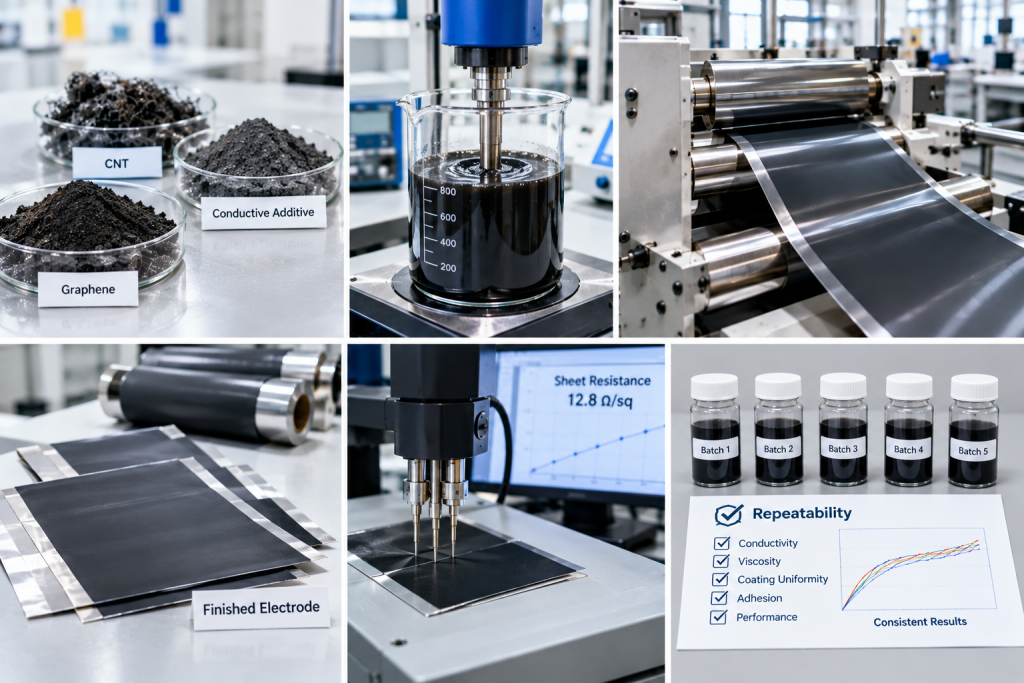
Advanced materials often demonstrate promising performance in laboratory testing. Graphene may improve electrical conductivity or barrier properties. Carbon nanotubes (CNTs) may help establish conductive networks in battery electrodes and functional coatings. Other engineered materials may offer improved thermal management, mechanical strength, or chemical resistance.
However, promising results from a single experiment are rarely enough to secure industrial adoption.
Manufacturers need materials that deliver predictable performance across different batches, production runs, and operating conditions. A material that performs exceptionally well once but inconsistently afterward can create significant challenges for formulation development, manufacturing control, product qualification, and long-term reliability.
Material repeatability is the ability to reproduce consistent material properties and application performance under defined preparation, testing, and manufacturing conditions.
For industrial users, repeatability is not simply a laboratory quality indicator. It is a fundamental requirement for moving advanced materials from experimental evaluation to reliable commercial production.
1. What Does Material Repeatability Mean?
Material repeatability is sometimes confused with material quality or manufacturing consistency. Although these concepts are closely related, they address different aspects of performance.
- Material quality describes whether a material meets its defined specifications.
- Manufacturing consistency describes how consistently a production process operates.
- Material repeatability concerns whether the material and its relevant performance characteristics can be reproduced under defined conditions.
For example, a graphene powder may meet a basic specification for carbon content and particle size. However, if its dispersion behavior varies significantly between batches, the resulting coating may exhibit inconsistent electrical resistance.
Similarly, CNTs may have comparable nominal purity and dimensions but produce different slurry viscosities or conductive-network structures when their surface chemistry or dispersion characteristics vary.
These differences can become commercially significant even when the materials appear similar on a specification sheet.
Industrial repeatability therefore requires more than checking whether a product falls within a general specification. It requires understanding which material properties influence the final application and establishing reliable methods to control them.
2. Why Industrial Customers Need Repeatable Materials
Industrial manufacturing depends on predictable inputs. Production equipment, formulation parameters, quality-control procedures, and finished-product specifications are typically designed around a defined range of material behavior.
When a material changes unexpectedly, the manufacturer may need to adjust the process, repeat validation, or investigate product failures.
2.1 Stable Formulation and Processing
A formulation developed around one material batch may not behave identically when a new batch is introduced.
Differences in surface chemistry, particle morphology, moisture content, impurities, or agglomeration can influence dispersion, viscosity, wetting, and processing behavior.
For conductive coatings, these variations may affect coating uniformity and electrical resistance. For battery electrodes, they may influence slurry stability, coating quality, electrode density, and downstream cell performance.
Repeatable material properties allow manufacturers to establish a more stable formulation and reduce the need for repeated adjustments.
2.2 Predictable Finished-Product Performance
Industrial customers generally qualify a material for a specific function, not merely for its intrinsic properties.
A coating manufacturer may care about sheet resistance, adhesion, corrosion protection, or durability. A battery developer may prioritize electrode processability, internal resistance, rate performance, and cycle life. A thermal-management manufacturer may focus on thermal conductivity, interface resistance, and mechanical stability.
If material batches behave differently, finished-product performance may vary even when the manufacturing process remains unchanged.
Repeatability helps establish a dependable relationship between incoming material properties and the performance of the final component.
2.3 Lower Manufacturing Risk
Material variation can generate costs that are not immediately visible in the material purchase price.
Potential consequences include:
- Additional incoming inspection and formulation testing
- More frequent process adjustments
- Increased scrap and rework
- Longer production qualification cycles
- Unplanned downtime
- Greater risk of customer complaints or product returns
Repeatable materials reduce uncertainty in these operations. Although repeatability may require more disciplined manufacturing controls and testing, it can lower the total cost and risk of using the material.
3. Why Advanced Materials Can Be Difficult to Reproduce
Advanced materials frequently involve complex relationships between raw materials, processing conditions, material structure, and application performance.
For graphene, CNTs, and other functional materials, several factors can contribute to batch-to-batch variation.
3.1 Raw Material Variability
The characteristics of starting materials can influence the final product.
For graphene, relevant factors may include the graphite feedstock, flake-size distribution, defect structure, layer characteristics, and surface chemistry, depending on the production route.
For CNTs, important parameters may include diameter, length distribution, purity, catalyst residues, and surface functionalization.
Even relatively small changes in these characteristics can influence dispersion, electrical behavior, or interaction with other formulation components.
3.2 Process Conditions
Manufacturing processes can introduce variation through changes in temperature, reaction time, mixing energy, shear conditions, purification, drying, or other operating parameters.
A laboratory process may appear stable within a small batch, while larger production volumes introduce differences in heat transfer, mass transfer, mixing efficiency, and residence time.
Repeatability requires identifying the process variables that have the greatest influence on material properties and controlling them within appropriate operating ranges.
3.3 Dispersion and Agglomeration
Dispersion is a particularly important factor for graphene and CNT applications.
A conductive additive may have favorable intrinsic electrical properties but perform poorly if it is not distributed appropriately within the host formulation.
Agglomeration, sedimentation, or changes in dispersion during storage can affect the formation of conductive pathways and produce inconsistent electrical performance.
Dispersion behavior may also depend on the binder, solvent, dispersant, mixing sequence, equipment, and energy input.
Consequently, repeatability must be evaluated in the intended formulation and process—not only by examining the material in isolation.
3.4 Testing and Measurement Differences
Apparent material variation does not always originate from manufacturing.
Differences in sample preparation, conditioning, instrument settings, measurement geometry, or testing procedures can produce inconsistent results.
For example, electrical resistance measurements may differ because of film thickness, contact conditions, substrate effects, or the position at which the sample is tested.
Reliable repeatability assessment therefore requires standardized testing methods and clearly defined measurement conditions.
4. Material Repeatability Across Different Applications
The practical importance of repeatability depends on how the material is used.
| Application | Critical repeatability factors | Potential consequence of variation |
|---|---|---|
| Conductive coatings | Dispersion, film thickness, conductivity, adhesion | Uneven electrical performance or coating defects |
| Battery electrodes | Slurry rheology, conductive-network formation, electrode loading | Process instability or inconsistent cell performance |
| Thermal-management materials | Thermal conductivity, interface behavior, composition | Variable heat-transfer performance |
| Anticorrosion coatings | Dispersion, film integrity, adhesion, barrier properties | Inconsistent protection and premature failure |
| Functional films | Thickness, optical properties, resistance, surface uniformity | Variable product quality |
| Composite materials | Filler distribution, interfacial compatibility, mechanical properties | Inconsistent strength or durability |
The same material may therefore require different repeatability criteria for different customers.
A graphene grade used in a conductive ink may need close control of dispersion and sheet resistance. The same nominal material used in a polymer composite may require greater attention to filler distribution, interface compatibility, and mechanical properties.
The correct question is not simply whether a material is repeatable. It is whether the material can consistently meet the requirements of its intended application.
5. How to Establish a Practical Repeatability Framework
Repeatability should be built into material development and supplier qualification from the beginning.
Step 1: Define Application-Relevant Specifications
Start by identifying the properties that directly influence the finished product.
Depending on the application, these may include particle-size distribution, purity, moisture, surface chemistry, dispersion stability, viscosity, electrical resistance, thermal conductivity, or mechanical properties.
Not every measurable property needs to become a critical specification. The priority should be parameters with a demonstrated relationship to application performance.
Step 2: Establish Standardized Testing Methods
Material batches should be evaluated using comparable methods.
Testing procedures should define sample preparation, conditioning, equipment, measurement settings, sampling locations, and reporting formats where relevant.
Without standardized methods, it becomes difficult to distinguish real material variation from measurement noise.
Step 3: Compare Multiple Production Batches
A single passing batch cannot demonstrate reliable repeatability.
Testing should cover multiple representative batches and, where appropriate, different production dates or operating conditions. Results should be reviewed for both compliance with specifications and the amount of variation within those limits.
For higher-risk applications, additional pilot-scale or application-level validation may be necessary.
Step 4: Link Material Properties to Application Performance
A material specification becomes more useful when it predicts how the material will behave in the customer’s process.
For example, if CNT surface characteristics influence slurry viscosity and electrode conductivity, those relationships should be investigated during formulation development.
Similarly, if graphene dispersion quality influences coating resistance and adhesion, material characterization should be connected to coating-level results.
This approach helps identify which parameters deserve tighter control and which have limited practical significance.
Step 5: Establish Change Control and Traceability
Industrial customers need confidence that qualified material will not change unexpectedly.
Manufacturers should maintain appropriate batch identification, production records, test results, and procedures for reviewing significant changes in raw materials, processes, equipment, or specifications.
When a change could affect application performance, its impact should be assessed before the material is introduced into an established production process.
6. Repeatability Must Be Validated Beyond the Laboratory
Laboratory testing is an essential starting point, but it cannot always capture the effects of industrial processing.
A material may appear stable in a small dispersion vessel yet behave differently in a larger mixing system. A conductive coating may meet its resistance target on a small coupon but show uneven performance during roll-to-roll production.
For this reason, repeatability should be evaluated at several levels.
Material level: Confirm that the relevant physical, chemical, and structural properties remain within defined ranges.
Formulation level: Verify dispersion, viscosity, stability, and compatibility with the intended ingredients.
Process level: Determine whether the material can be processed consistently using representative equipment and operating conditions.
Component level: Evaluate finished-product properties, including uniformity, conductivity, adhesion, or other application-specific requirements.
Application level: Confirm that the component delivers the required performance under representative operating conditions.
For battery materials, this may mean progressing from powder and slurry characterization to electrode manufacturing and cell testing. For conductive coatings, it may involve moving from laboratory drawdowns to pilot coating trials and functional-component evaluation.
The objective is to identify variation before it becomes a costly manufacturing or product-reliability problem.
7. How Material Suppliers Can Support Industrial Repeatability
Material repeatability is not solely the responsibility of the customer or the supplier. It requires a clear understanding of how the material will be processed and evaluated.
Suppliers can support industrial customers by providing:
- Defined product specifications and suitable test methods
- Batch-specific certificates of analysis where available
- Information about relevant material characteristics
- Guidance on dispersion, handling, and storage
- Clear identification of the formulation or processing conditions used in performance testing
- Advance communication about significant product or process changes
- Technical cooperation during pilot-scale validation
Where application performance depends strongly on formulation, material suppliers should also help customers distinguish between intrinsic material properties and results obtained under specific processing conditions.
For example, a conductivity result measured on a laboratory film should be accompanied by relevant information about the sample preparation and testing method. Otherwise, customers may incorrectly assume that the same result will automatically be achieved in their own manufacturing process.
Transparent technical communication helps both parties establish realistic expectations and shorten the path toward qualification.
8. Repeatability and the Total Cost of Ownership
A material with a lower purchase price is not necessarily the more economical option.
If one supplier delivers inconsistent batches, the customer may need additional testing, more formulation adjustments, or tighter process monitoring. Higher defect rates and reduced production yield can further increase the effective cost.
A more useful evaluation considers the total cost of using the material.
This includes:
- Purchase price and material consumption
- Incoming inspection and testing
- Formulation and process adjustments
- Manufacturing yield and scrap
- Equipment cleaning and maintenance where relevant
- Qualification and revalidation costs
- Product reliability and warranty exposure
The economic value of repeatability becomes particularly important when a material is used at scale, when production tolerances are tight, or when the consequences of a defective component are significant.
Repeatability does not eliminate all production variation. Instead, it makes variation more predictable, measurable, and manageable.
9. From Repeatable Materials to Industrial Adoption
Industrial adoption is usually a staged process rather than a single purchasing decision.
A typical progression includes:
- Initial material screening
- Laboratory formulation and testing
- Comparison of representative material batches
- Pilot-scale process validation
- Component or cell-level evaluation
- Supplier and quality-system qualification
- Controlled commercial production
At each stage, the evidence requirements become more demanding.
During initial screening, a promising result may justify further investigation. During pilot production, however, customers need evidence that the material can be processed consistently. Before commercial adoption, they may also require reliable supply, defined quality controls, traceability, and a practical cost structure.
Material repeatability connects these stages. It gives customers a basis for trusting that the results achieved during qualification can be reproduced during routine manufacturing.
For advanced-material suppliers, demonstrating repeatability can therefore be more valuable than presenting a single exceptional performance result.
Conclusion: Repeatability Turns Material Performance into Manufacturing Confidence
Advanced materials can offer significant advantages, but industrial customers need more than promising laboratory data.
They need predictable material properties, stable formulation behavior, repeatable processing, and finished products that consistently meet application requirements.
Achieving this requires application-relevant specifications, standardized testing, multi-batch evaluation, process control, traceability, and validation under representative manufacturing conditions.
For graphene, CNTs, and other functional materials, these practices are especially important because dispersion, surface characteristics, and process conditions can strongly influence the final result.
Repeatability is what allows a material’s potential to become a dependable manufacturing capability.
For material developers, suppliers, and industrial users, the goal is not simply to produce a high-performing batch. It is to establish a controlled process that delivers the required performance again and again.
Frequently Asked Questions
What is material repeatability?
Material repeatability is the ability to reproduce consistent material characteristics or application performance under defined preparation, testing, and manufacturing conditions.
Why is material repeatability important for industrial adoption?
It helps manufacturers maintain stable processes, reduce quality variation, improve production yield, and reproduce qualified product performance across different production runs.
How is repeatability different from consistency?
The terms overlap. Repeatability emphasizes reproducing results under defined conditions, while manufacturing consistency often refers more broadly to controlling variation across batches, production runs, or operating conditions.
How can manufacturers test material repeatability?
They can compare multiple representative batches using standardized material characterization, formulation tests, process trials, and application-level performance measurements. The test plan should reflect the material’s intended use.
Why can graphene and CNT materials show batch-to-batch variation?
Potential causes include raw-material differences, particle morphology, surface chemistry, impurities, dispersion behavior, and changes in manufacturing or post-processing conditions.
Can a certificate of analysis guarantee application performance?
No. A certificate of analysis can document selected material properties and test results, but it cannot automatically guarantee performance in every customer formulation or production process. Application-specific validation remains necessary.