
What Challenges Occur During Graphene Industrialization?
Graphene has attracted significant attention across energy storage, thermal management, conductive coatings, corrosion protection, polymer composites, sensors, and other advanced material applications.
Its combination of electrical conductivity, thermal properties, mechanical strength, high specific surface area, and tunable surface chemistry creates opportunities for developing new functional materials and improving existing industrial products.
However, demonstrating graphene’s potential in a laboratory is very different from establishing a commercially viable industrial product.
Many graphene projects encounter difficulties when moving from small-scale synthesis to pilot production, and from pilot validation to consistent commercial supply.
The challenges are not limited to manufacturing capacity. They involve material quality, process repeatability, dispersion, formulation compatibility, application performance, cost structure, quality assurance, and customer qualification.
Successful graphene industrialization requires the entire value chain to work together, from material production to final product integration.
This article examines the major challenges that occur during graphene industrialization and explains how manufacturers and technology developers can address them.
1. The Challenge of Defining Graphene Quality
One of the first obstacles is that graphene is not a single standardized material.
Different production methods generate materials with different structures, properties, and application suitability.
Common graphene-related materials include:
- Single-layer and few-layer graphene
- Graphene nanoplatelets (GNPs)
- Graphene oxide (GO)
- Reduced graphene oxide (rGO)
- Functionalized graphene
- CVD graphene films
These materials cannot be treated as interchangeable products.
For example, graphene produced through liquid-phase exfoliation may have different lateral dimensions, layer distributions, defect levels, and surface characteristics from material produced through chemical reduction or CVD.
Even products described using the same commercial name may differ significantly between suppliers.
1.1 Inconsistent Material Specifications
Industrial customers need specifications that can be measured, reproduced, and linked to application performance.
Important characterization parameters may include:
- Layer number and thickness
- Lateral size distribution
- Carbon and oxygen content
- Defect density
- Electrical conductivity
- Thermal conductivity
- Specific surface area
- Purity and residual impurities
- Moisture content
- Bulk density
- Dispersion behavior
Not every parameter is equally important for every application.
For conductive coatings, electrical conductivity and dispersion behavior may be critical. For GO-based water treatment, oxygen-containing functional groups, surface chemistry, and interaction with the supporting substrate may be more relevant.
The challenge is to establish application-specific specifications rather than relying on a generic graphene quality label.
1.2 Measurement and Characterization Differences
Different testing methods may produce results that are difficult to compare directly.
For example, Raman spectroscopy, XPS, AFM, SEM, TEM, and electrical measurements provide different types of information.
Results may also vary depending on sample preparation, measurement conditions, and data interpretation.
Without standardized testing procedures, manufacturers may struggle to determine whether a batch meets the same quality level as previous production.
Industrial implication: A reliable graphene supply chain requires consistent sampling, agreed testing methods, clear acceptance criteria, and traceable quality records.
2. Scaling Up Graphene Production
Moving from laboratory synthesis to industrial production is another major challenge.
A laboratory process may work well with small quantities because reaction conditions, mixing, temperature, and material handling can be controlled relatively easily.
When production volume increases, these conditions become more difficult to maintain.
2.1 Process Uniformity
Different graphene production routes have different scale-up limitations.
For liquid-phase exfoliation, manufacturers must manage:
- Solvent or dispersant selection
- Mixing and shear conditions
- Exfoliation efficiency
- Temperature control
- Separation and classification
- Material recovery
For GO production, important factors may include:
- Oxidation uniformity
- Reaction temperature
- Mixing and mass transfer
- Washing efficiency
- Residual ion removal
- Reduction and post-treatment conditions
For CVD graphene, scale-up may involve substrate quality, gas distribution, temperature uniformity, film growth, transfer, and defect control.
Each production route requires its own engineering strategy.
2.2 Yield and Production Efficiency
A process that produces high-quality graphene in a laboratory may have a much lower effective yield at industrial scale.
Some material may be lost during separation, purification, washing, drying, classification, or transfer.
The final commercial yield depends not only on how much material is synthesized but also on how much meets the required specifications.
Manufacturers must therefore evaluate:
- Total production yield
- Qualified product yield
- Energy consumption
- Solvent recovery
- Water consumption
- Waste treatment
- Equipment utilization
- Production cycle time
Increasing output without controlling qualified yield may increase costs without improving the amount of saleable material.
3. Batch-to-Batch Consistency
Industrial customers rarely evaluate a material based on one successful sample.
They need confidence that future deliveries will perform consistently.
This is particularly important when graphene is used as a functional additive in coatings, batteries, polymers, or other manufacturing processes.
Small variations in material properties may affect downstream formulation and processing.
For example:
- Changes in lateral size can influence conductive network formation.
- Differences in surface chemistry can affect dispersion stability.
- Variations in moisture content can influence slurry formulation.
- Changes in impurity levels may affect electrochemical or electrical performance.
- Different defect levels may influence conductivity and structural integrity.
3.1 Establishing a Repeatable Quality Control System
A practical quality control system should include:
- Defined raw material specifications
- Controlled production parameters
- In-process sampling and inspection
- Final product characterization
- Batch identification and traceability
- Standardized certificates of analysis
- Retained reference samples
- Customer feedback and corrective action
Manufacturers should also distinguish between critical quality attributes and parameters that have limited influence on the intended application.
The objective is not to measure everything unnecessarily. It is to control the characteristics that determine product consistency and customer performance.
4. Dispersion and Formulation Compatibility
Graphene’s intrinsic properties do not automatically translate into improved performance in a finished product.
One of the most common industrial challenges is incorporating graphene into a compatible formulation.
Graphene materials tend to interact through surface forces, and some forms can form aggregates or restack during processing.
This is particularly relevant when graphene is used in:
- Water-based coatings
- Solvent-based coatings
- Polymer composites
- Battery electrode slurries
- Conductive inks
- Thermal interface materials
- Corrosion protection systems
4.1 Why Dispersion Is Difficult
Graphene nanoplatelets have large surface areas and strong interactions between adjacent sheets.
GO and functionalized graphene may offer better compatibility with certain polar media, but their behavior depends on surface chemistry and formulation conditions.
A dispersion that remains stable in water may not perform equally well in an organic solvent or polymer matrix.
Important variables include:
- Solvent polarity
- Surface functional groups
- pH
- Dispersant selection
- Solid content
- Mixing energy
- Sonication conditions
- Temperature
- Storage conditions
4.2 Balancing Dispersion and Material Integrity
Stronger mixing does not always produce a better material.
Excessive mechanical or ultrasonic treatment may reduce lateral dimensions or alter the structure of graphene sheets.
This can affect the properties that the manufacturer originally intended to preserve.
The objective is to achieve sufficient dispersion without unnecessarily damaging the material.
Industrial formulations should therefore be evaluated using both dispersion quality and final application performance.
5. Maintaining Performance During Downstream Processing
Even when graphene is produced with consistent quality and successfully dispersed, downstream processing can introduce additional challenges.
The final performance depends on how graphene behaves during coating, drying, curing, molding, electrode production, or other manufacturing operations.
5.1 Coating Applications
In conductive or anti-corrosion coatings, graphene distribution influences coating uniformity and functional performance.
Potential problems include:
- Agglomeration
- Uneven film thickness
- Poor substrate adhesion
- Incomplete coverage
- Increased coating viscosity
- Cracking during drying
- Inconsistent electrical conductivity
The coating formulation must balance graphene loading, binder compatibility, viscosity, adhesion, and protective performance.
5.2 Battery Applications
In battery electrodes, graphene and related carbon materials may contribute to conductive networks or electrode modification.
However, performance depends on the entire electrode formulation and manufacturing process.
Important factors include:
- Active material compatibility
- Conductive additive distribution
- Binder system
- Slurry rheology
- Coating uniformity
- Drying conditions
- Calendering
- Electrode porosity
- Electrochemical validation
A graphene material that performs well in a small laboratory experiment may not deliver the same benefits in a high-loading or pilot-scale electrode.
5.3 Polymer Composites
In polymer composites, graphene may improve electrical, thermal, or mechanical properties under suitable conditions.
However, achieving uniform distribution and effective interfacial compatibility can be difficult.
High filler loading may increase viscosity, reduce processability, or affect the mechanical properties of the final composite.
Material selection must therefore consider the processing method, polymer chemistry, filler structure, and required performance balance.
6. Cost and Commercial Viability
Graphene industrialization is not successful simply because a manufacturer can produce large quantities.
The product must also be commercially viable.
Graphene manufacturing costs may include:
- Raw materials
- Energy consumption
- Solvents and chemicals
- Water and wastewater treatment
- Equipment depreciation
- Labor
- Quality control
- Packaging
- Storage and transportation
- Yield losses
- Environmental and safety compliance
The cost per kilogram is only one part of the commercial equation.
For many applications, customers are more interested in the cost of achieving a specific functional improvement.
For example, a higher-priced graphene product may still be commercially attractive if it reduces the required additive loading, improves component performance, or increases product lifetime.
Conversely, a low-cost graphene product may provide little economic value if it requires extensive reformulation or cannot deliver consistent results.
6.1 Application-Based Cost Evaluation
A more useful approach is to evaluate graphene based on its contribution to the final product.
Relevant indicators may include:
- Cost per unit of conductivity improvement
- Cost per unit of thermal resistance reduction
- Cost per treated coating area
- Cost per unit of electrode capacity
- Cost per component
- Total cost of ownership
This shifts the discussion from material price alone to actual industrial value.
7. Environmental, Health, and Safety Requirements
Industrial graphene production and processing also require appropriate environmental, health, and safety management.
The relevant risks depend on the material form, particle characteristics, production route, and exposure conditions.
Potential considerations include:
- Inhalation exposure to airborne fine particles
- Handling of powders and dispersions
- Solvent exposure
- Chemical handling during GO production
- Wastewater treatment
- Residual chemical management
- Dust control and housekeeping
- Packaging and transportation
Dry graphene powders may require particular attention to dust generation during weighing, transfer, and mixing.
Liquid dispersions can reduce certain airborne powder-handling risks, but they introduce other considerations related to solvent or carrier chemistry.
Manufacturers should establish suitable engineering controls, personal protective equipment, handling procedures, and waste management practices based on material-specific risk assessments and applicable regulations.
Environmental performance also matters commercially, especially when customers require information about manufacturing practices, chemical compliance, and supply chain responsibility.
8. Customer Qualification and Application Validation
A major obstacle in graphene industrialization is the gap between material performance and customer acceptance.
Industrial customers do not usually purchase graphene simply because it has attractive laboratory properties.
They need evidence that the material can improve their existing product or manufacturing process.
This requires application-specific validation.
8.1 From Material Testing to Component Testing
A structured validation pathway may include:
Stage 1: Material evaluation
Confirm the material’s basic characteristics and compatibility with the intended application.
Stage 2: Formulation development
Evaluate loading, dispersion, binder compatibility, processing conditions, and stability.
Stage 3: Laboratory validation
Test relevant performance indicators using controlled laboratory samples.
Stage 4: Pilot-scale validation
Evaluate processability, production consistency, coating or component quality, and repeatability at a larger scale.
Stage 5: Customer qualification
Test the material in the customer’s actual product or manufacturing environment.
Stage 6: Commercial production
Confirm specifications, production capacity, quality documentation, delivery consistency, and technical support.
Each stage reduces a different category of technical or commercial risk.
8.2 Why Laboratory Results Are Not Enough
A laboratory result may demonstrate that a graphene-containing formulation performs better under specific conditions.
However, industrial customers also need to know:
- Can the formulation be manufactured repeatedly?
- Does it work with existing equipment?
- Can the required coating thickness or electrode loading be achieved?
- Does performance remain stable after aging?
- Is the material available in sufficient quantity?
- Can the supplier maintain the same specifications?
- Is the total cost acceptable?
These questions cannot be answered by a single laboratory measurement.
9. Supply Chain and Technical Support Challenges
Graphene industrialization requires more than a material producer.
The commercial supply chain may involve:
- Raw material suppliers
- Graphene manufacturers
- Dispersion and formulation specialists
- Testing laboratories
- Pilot production facilities
- Component manufacturers
- End users
If these participants work independently without clear technical coordination, development projects may experience delays and inconsistent results.
For example, a graphene producer may supply a material that meets its own specifications, while the customer’s formulation team may require a different particle size distribution or surface chemistry.
Without a clear technical feedback process, it can be difficult to identify whether the problem originates from the material, formulation, processing conditions, or application design.
9.1 The Importance of Technical Coordination
A practical industrialization model should connect material supply with downstream technical evaluation.
This includes:
- Translating customer requirements into material specifications
- Selecting suitable graphene grades
- Coordinating sample evaluation
- Identifying formulation and processing requirements
- Organizing laboratory and pilot testing
- Reviewing test results
- Defining improvement actions
- Establishing commercial supply conditions
Technical coordination helps reduce the gap between material suppliers and industrial customers.
It also prevents manufacturers from investing in extensive development work before the application requirements and commercial objectives are sufficiently clear.
10. How to Build a More Effective Graphene Industrialization Strategy
Graphene industrialization should be approached as a staged engineering and commercialization process.
A practical strategy can be organized around five key areas.
10.1 Start with the Application
Define the intended function before selecting the graphene material.
Is the objective to improve electrical conductivity, thermal management, corrosion resistance, mechanical performance, or electrochemical behavior?
Different applications require different material structures and specifications.
10.2 Select the Appropriate Material Route
Choose between graphene, GO, rGO, GNPs, CVD graphene, or functionalized graphene according to the application requirements.
Avoid assuming that the most expensive or highest-purity material is automatically the best choice.
10.3 Establish Measurable Technical Targets
Define the required material and product performance indicators.
Examples include conductivity, thermal resistance, adhesion, corrosion resistance, dispersion stability, electrode performance, or mechanical durability.
These targets should be measurable and linked to the customer’s actual requirements.
10.4 Validate at Increasing Production Scales
Move from laboratory testing to pilot production through clearly defined stages.
Each stage should have agreed inputs, testing methods, acceptance criteria, deliverables, and decision points.
This helps identify problems before they become expensive manufacturing issues.
10.5 Build Repeatable Supply and Quality Systems
Once the application is validated, establish:
- Approved material specifications
- Batch consistency requirements
- Production and inspection procedures
- Technical documentation
- Packaging and storage standards
- Delivery schedules
- Change-control procedures
- Ongoing customer feedback
Commercial success depends on the ability to reproduce the required performance over time.
Conclusion
Graphene industrialization involves much more than increasing production volume.
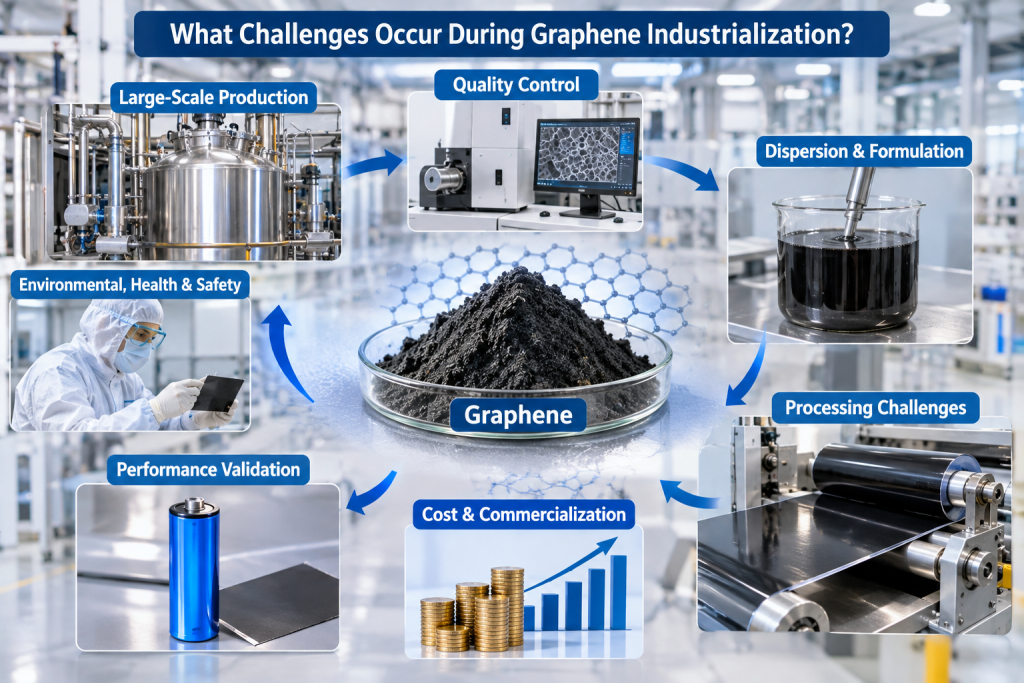
The major challenges occur across the entire development chain: defining material quality, scaling up production, maintaining batch consistency, achieving reliable dispersion, adapting to downstream processing, controlling costs, meeting safety requirements, and obtaining customer qualification.
A graphene material may demonstrate excellent properties in a laboratory, but industrial adoption requires those properties to remain relevant and repeatable under real manufacturing conditions.
The most effective industrialization strategy is therefore application-driven.
Manufacturers should begin with the customer’s actual requirements, select the appropriate graphene material, establish measurable performance targets, validate processing conditions, and gradually move toward pilot and commercial production.
Graphene’s industrial value will ultimately depend not only on what the material can achieve in theory, but on whether it can deliver consistent, measurable, and economically justified improvements in real products.
Frequently Asked Questions
1. What is the biggest challenge in graphene industrialization?
There is no single universal challenge. However, consistent material quality, scalable manufacturing, reliable dispersion, and application-specific validation are among the most important barriers.
2. Why is graphene quality difficult to standardize?
Different production methods create graphene materials with different layer numbers, lateral dimensions, defect levels, surface chemistry, and impurity profiles. Application-specific testing is therefore essential.
3. Why is graphene dispersion important for industrial applications?
Poor dispersion can create agglomeration and non-uniform material distribution, reducing the effectiveness of graphene in coatings, battery electrodes, polymers, and other composite systems.
4. Can graphene be mass-produced today?
Yes. Various graphene-related materials are commercially manufactured at industrial or pilot scales. However, production capacity, material specifications, consistency, and application suitability vary significantly between production routes and suppliers.
5. Why do graphene projects fail during commercialization?
Common reasons include unsuitable material selection, inconsistent batches, poor formulation compatibility, insufficient pilot validation, high processing costs, and a lack of alignment between material performance and customer requirements.
6. How can manufacturers reduce the risks of graphene industrialization?
They can use a staged development process that combines application-driven material selection, standardized characterization, formulation development, pilot-scale validation, and repeatable quality control.
7. Is graphene industrialization only a challenge for material producers?
No. Material producers, formulation developers, component manufacturers, testing laboratories, and end users all influence the outcome. Successful industrialization requires coordination across the entire value chain.