
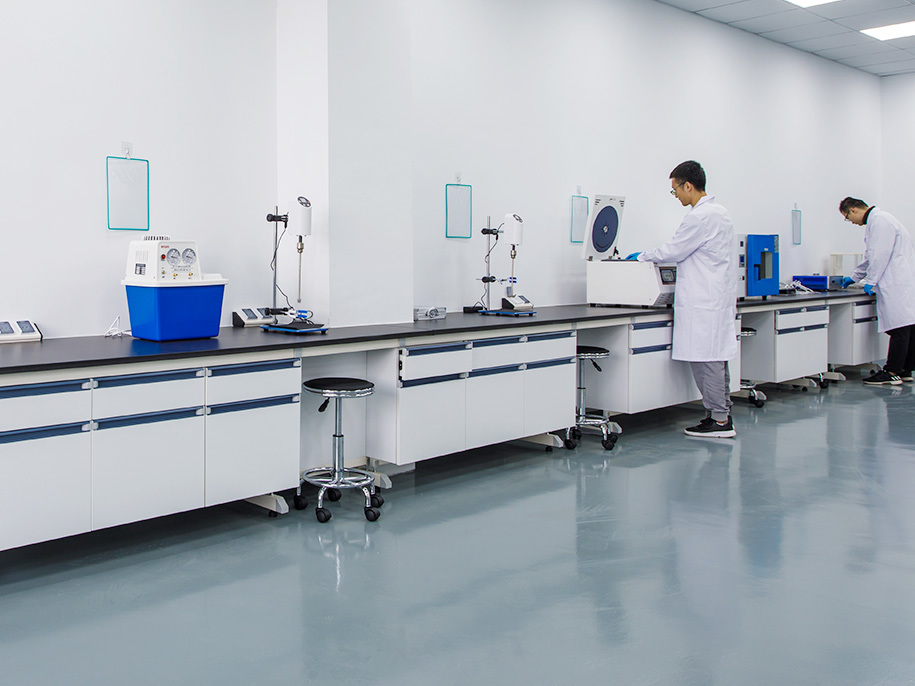
What a Pilot Line Actually Solves
Why pilot production is more than just “a smaller factory.”
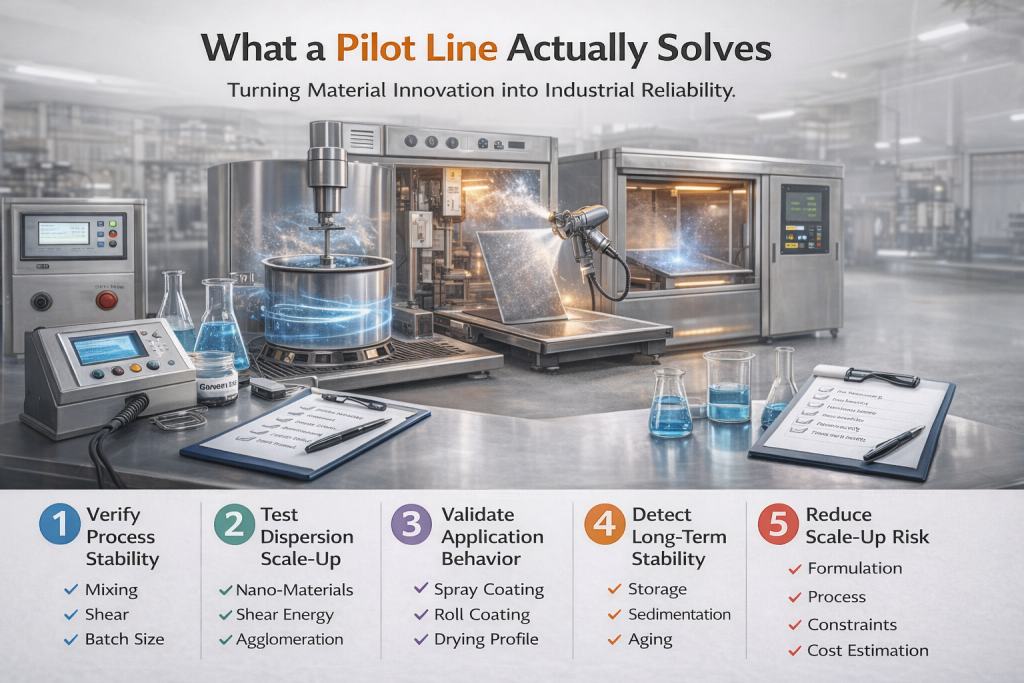
In many advanced material projects, the concept of a pilot line is often misunderstood. Some see it as a temporary step before large-scale manufacturing. Others view it simply as a larger laboratory.
In reality, a pilot line solves a very specific problem:
it connects material innovation with industrial reliability.
For advanced coatings, graphene systems, and CNT-based formulations, this stage is often where the true engineering work happens.
1️⃣ Verifying Process Stability
In the laboratory, materials are typically produced in small batches under controlled conditions. But industrial production introduces many variables:
-
Larger batch volumes
-
Different mixing equipment
-
Variable shear environments
-
Longer processing times
A pilot line allows engineers to test whether the formulation remains stable when processed with industrial-type equipment.
Many issues that never appear in the lab become visible at this stage.
2️⃣ Testing Dispersion at Realistic Scale
For nano-material systems such as:
-
Graphene
-
Carbon nanotubes
-
Hybrid carbon fillers
dispersion quality determines performance.
At small scale, dispersion can often be achieved with high-energy lab mixers.
But industrial systems use different equipment and mixing dynamics.
Pilot lines help determine:
-
Whether dispersion can be maintained
-
How much shear energy is required
-
Whether agglomeration reappears during scale-up
This is one of the most common bottlenecks in advanced coating systems.
3️⃣ Validating Application Behavior
A material can perform perfectly in a lab test but still fail during real application.
Pilot production allows testing under realistic coating conditions:
-
Spray application
-
Roll coating
-
Dip coating
-
Film thickness control
-
Drying and curing behavior
Engineers can evaluate:
-
Viscosity stability
-
Flow and leveling
-
Surface uniformity
-
Process repeatability
Without this stage, application risks remain unknown.
4️⃣ Detecting Long-Term Stability Issues
Another critical function of pilot production is evaluating time-dependent behavior.
This includes:
-
Storage stability
-
Sedimentation
-
Phase separation
-
Rheology drift
These effects often appear only after weeks or months — something short laboratory experiments cannot reveal.
5️⃣ Reducing Scale-Up Risk
Perhaps the most important role of a pilot line is risk reduction.
Instead of immediately investing in full-scale production, companies can:
-
Optimize formulations
-
Adjust process parameters
-
Identify engineering constraints
This prevents costly failures when transitioning directly from laboratory success to industrial production.
6️⃣ Creating Engineering Data
Pilot production generates the type of data required for real commercialization:
-
Process parameters
-
Equipment compatibility
-
Quality consistency
-
Cost estimation
This data allows both suppliers and customers to move forward with confidence.
A pilot line is not simply a smaller version of a factory.
It is the stage where materials are transformed into engineered products.
For advanced coatings and nanomaterial systems, pilot production helps answer the most important question:
Not “Does the material work?”
But “Will the system work reliably at scale?”
That difference determines whether a technology remains a laboratory concept — or becomes an industrial solution.