
What a Battery Materials Pilot Line Actually Does
A Practical Bridge Between Lab Discovery and Battery Manufacturing
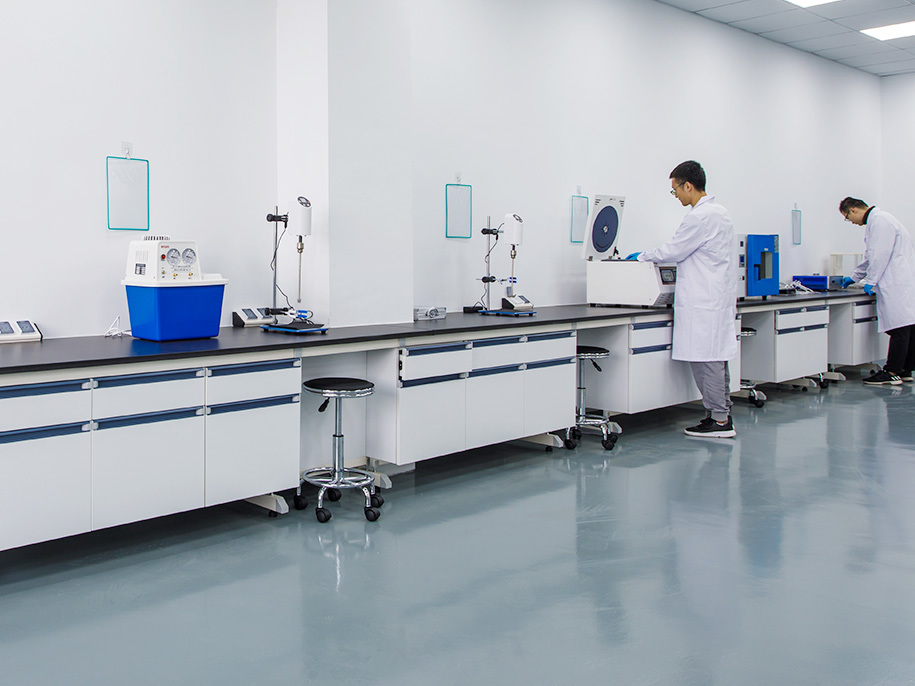
In the battery industry, many promising materials never reach commercial deployment. Laboratories constantly report breakthroughs in conductive additives, graphene composites, electrode coatings, and next-generation battery chemistries. Yet only a small fraction of these materials ever make it into real battery packs.
The missing step between research and mass manufacturing is the pilot line.
A battery materials pilot line is not simply a small factory. It is a technology translation platform that converts laboratory discoveries into scalable, manufacturable solutions. Companies like GrapheneRich focus on this critical stage—helping advanced materials move from early research to real industrial applications.
Understanding what a pilot line actually does helps clarify why it has become a key element in the modern battery materials ecosystem.
The Gap Between Lab Innovation and Industrial Production
Most new battery materials begin their life in a research lab. Scientists synthesize materials such as graphene, carbon nanotubes, silicon anodes, or advanced conductive carbons in gram-scale quantities. These materials may show impressive electrochemical performance in coin cells.
However, a lab experiment does not represent a real battery manufacturing environment.
In industry, materials must meet multiple requirements simultaneously:
-
Stable performance across large batches
-
Compatibility with electrode slurry processing
-
Mechanical stability during coating and calendaring
-
Long-term cycling reliability
-
Scalable and cost-efficient production
This transition from laboratory demonstration to industrial viability is often referred to as “the valley of death” in materials innovation.
Pilot lines exist to bridge that gap. Their mission is to validate materials and processes under conditions that closely resemble real manufacturing environments.
The Core Role of a Battery Materials Pilot Line
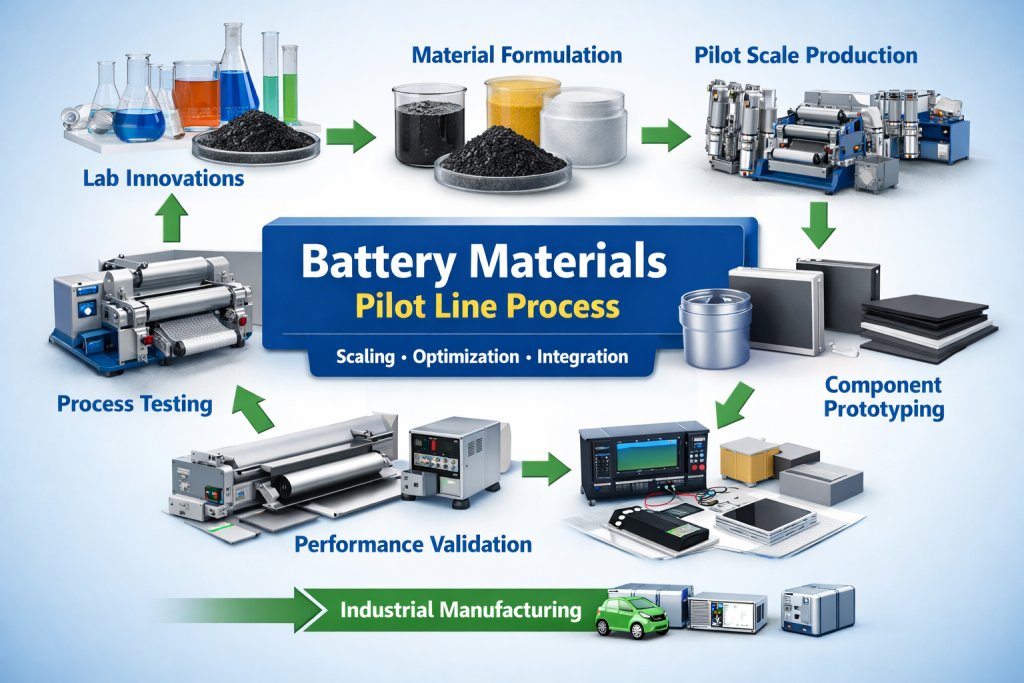
At its core, a battery materials pilot line performs three essential functions:
-
Process Validation
-
Material Engineering
-
Application Integration
Together, these activities transform promising materials into deployable technologies.
Rather than producing large commercial volumes, pilot lines focus on repeatability, scalability, and engineering validation.
1. Material Formulation and Engineering
One of the first tasks of a pilot line is to transform raw materials into practical battery formulations.
For example, graphene powders or carbon nanotubes rarely work directly in battery electrodes. They must be engineered into usable forms such as:
-
conductive dispersions
-
electrode additives
-
composite powders
-
coating formulations
-
functional films
A pilot line evaluates how these materials behave during:
-
slurry mixing
-
dispersion stability
-
rheology control
-
binder compatibility
-
electrode coating
For advanced conductive additives like graphene, controlling dispersion and percolation networks is particularly critical. Even a small change in formulation can dramatically affect electrical conductivity and electrode performance.
Through pilot-scale testing, engineers optimize these formulations for manufacturability rather than just laboratory performance.
2. Scaling Up Production Processes
Another major responsibility of a pilot line is scaling production processes.
A material synthesized in a laboratory may require completely different equipment and process parameters when produced at kilogram or ton scale.
Typical pilot-line activities include:
-
scaling chemical synthesis
-
optimizing reaction parameters
-
improving yield and purity
-
controlling particle size distribution
-
developing continuous processing methods
The goal is not yet full industrial production but rather a stable intermediate scale where materials can be produced consistently.
This step is essential because many materials behave differently when scaling up from grams to kilograms.
Without pilot-scale validation, large-scale manufacturing risks unpredictable quality variations.
3. Prototyping Battery Components
A pilot line also enables battery component prototyping.
Instead of testing materials only in small research cells, pilot facilities can fabricate components closer to real industrial battery formats.
These may include:
-
electrode sheets
-
current collector coatings
-
thermal interface materials
-
conductive films
-
battery module thermal structures
For example, graphene-based materials can be integrated into:
-
electrode conductive networks
-
thermal management layers
-
EMI shielding components
-
composite structural materials
This step allows engineers to evaluate performance in realistic operating conditions.
4. Process Compatibility Testing
Battery manufacturing is a complex chain of processes. Even if a material performs well electrochemically, it must still be compatible with industrial equipment.
Pilot lines therefore test materials in processes such as:
-
slurry mixing
-
slot-die coating
-
drying systems
-
calendaring
-
lamination
-
module assembly
Compatibility testing answers critical questions:
-
Will the material disperse evenly in large mixers?
-
Does it clog coating equipment?
-
Does it survive high-pressure calendaring?
-
Can it maintain conductivity after mechanical compression?
These engineering realities often determine whether a material can actually enter production.
5. Performance Validation Under Real Conditions
Pilot-scale validation also involves performance testing in realistic battery systems.
This may include:
-
thermal cycling
-
high-power discharge
-
long-term aging tests
-
vibration and mechanical stress
-
safety validation
Such testing is especially important for applications like:
-
EV battery packs
-
large energy storage systems
-
high-power electronics
According to industry experience, many promising materials fail during these validation stages, not because of chemistry limitations but because of manufacturing integration challenges.
Pilot lines help uncover these issues early—before companies commit to expensive industrial deployment.
6. Supporting Industrial Transfer
Once materials and processes are validated, pilot lines support the final step: technology transfer to full manufacturing.
This stage includes:
-
process documentation
-
scale-up guidelines
-
equipment specifications
-
quality control standards
-
supply chain preparation
In advanced materials ecosystems, pilot lines often function as technology incubators, enabling companies to bring innovations from research to real products faster.
This approach has been widely adopted in graphene and other advanced materials industries, where pilot facilities help translate new materials into manufacturable technologies.
Why Pilot Lines Matter for Graphene and Advanced Carbon Materials
Graphene and other advanced carbon materials are known for exceptional properties:
-
high electrical conductivity
-
high thermal conductivity
-
mechanical strength
-
lightweight structures
However, these materials are also notoriously difficult to integrate into industrial systems.
Challenges include:
-
aggregation of nanosheets
-
dispersion stability
-
process compatibility
-
consistent large-scale production
Pilot lines allow engineers to solve these challenges systematically.
Companies such as GrapheneRich focus specifically on helping customers integrate graphene and conductive carbon materials into real products—from thermal management systems to battery components and conductive coatings.
From Material Innovation to Real Battery Systems
Ultimately, the purpose of a battery materials pilot line is simple:
turning promising materials into reliable industrial solutions.
Without pilot-scale validation, innovations often remain stuck in academic papers or laboratory prototypes.
With the right pilot infrastructure, however, new materials can progress through a structured path:
Research → Prototype → Pilot Validation → Industrial Manufacturing
This pathway significantly reduces risk for battery manufacturers and accelerates the commercialization of advanced materials.
In the battery industry, breakthroughs rarely happen through chemistry alone. Successful innovation requires a combination of materials science, process engineering, and manufacturing validation.
A battery materials pilot line sits precisely at this intersection.
By enabling material formulation, process scaling, prototype manufacturing, and industrial integration, pilot lines play a crucial role in bringing next-generation battery technologies to market.
As battery systems continue to evolve—toward higher energy density, faster charging, and improved thermal stability—the importance of pilot-scale engineering will only grow.
For advanced materials such as graphene and engineered carbon composites, pilot lines are not just helpful.
They are essential.