

Carbon Nanotubes Explained: Structure, Types and Properties
A Practical Guide to One of the Most Important Advanced Carbon Materials
Carbon nanotubes (CNTs) are among the most important nanomaterials developed in modern materials science. Known for their exceptional electrical, mechanical, and thermal properties, CNTs have become a key component in industries such as energy storage, electronics, composites, and conductive systems.
Despite their widespread use, many misunderstand CNTs as a single uniform material. In reality, carbon nanotubes exist in multiple forms, each with distinct structures, properties, and application pathways.
This article provides a clear and practical explanation of carbon nanotubes, focusing on their structure, types, and key properties, with a view toward real industrial applications.
What Are Carbon Nanotubes?
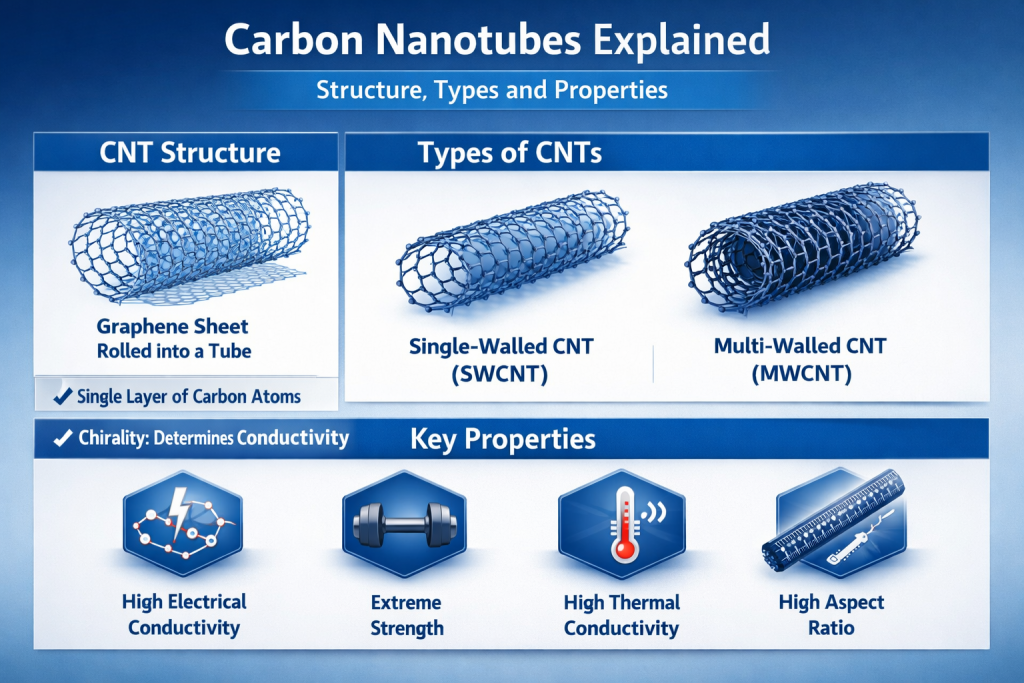
Carbon nanotubes are cylindrical nanostructures made entirely of carbon atoms arranged in a hexagonal lattice, similar to graphene.
They can be thought of as graphene sheets rolled into tubes.
Key structural features include:
- nanometer-scale diamete
- high aspect ratio (length-to-diameter)
- hollow cylindrical structure
- strong sp² carbon-carbon bonds
These characteristics give CNTs a unique combination of properties that are difficult to achieve with conventional materials.
Understanding CNT Structure
The structure of carbon nanotubes determines many of their properties.
Graphene-Based Origin
CNTs originate from graphene. When a graphene sheet is rolled into a cylinder, the way it is rolled defines the nanotube’s structure.
This is described by a parameter known as chirality.
Chirality and Its Importance
Chirality refers to the angle and direction in which the graphene sheet is rolled.
It determines whether a carbon nanotube behaves as:
- a metallic conductor
- a semiconductor
This is a unique feature not found in most materials.
Although chirality control is still challenging in large-scale production, it plays a key role in advanced electronic applications.
Types of Carbon Nanotubes
Carbon nanotubes are generally classified into two main categories.
1. Single-Walled Carbon Nanotubes (SWCNTs)
Single-walled carbon nanotubes consist of a single graphene cylinder.
Key Features
- diameter typically ~1–2 nm
- very high electrical conductivity
- excellent flexibility
- high surface area
Advantages
- superior electrical performance
- suitable for advanced electronics
- strong quantum effects
Limitations
- high production cost
- more difficult to scale
- sensitive to defects
Typical Applications
- transparent conductive films
- sensors
- high-performance electronics
- advanced research applications
2. Multi-Walled Carbon Nanotubes (MWCNTs)
Multi-walled carbon nanotubes consist of multiple concentric graphene cylinders.
Key Features
- larger diameter (5–50+ nm)
- multiple layers
- more robust structure
Advantages
- easier to produce at scale
- lower cost
- good mechanical strength
- stable performance
Limitations
- lower electrical performance compared to SWCNTs
- less tunable electronic properties
Typical Applications
- conductive additives
- structural composites
- EMI shielding
- battery electrodes
Key Properties of Carbon Nanotubes
1. Electrical Conductivity
CNTs are among the best conductive materials known.
- SWCNTs can behave like metals or semiconductors
- MWCNTs provide stable conductive networks
Their high aspect ratio allows them to form percolation networks at very low loading levels, which is highly valuable in composites and coatings.
2. Mechanical Strength
CNTs exhibit extremely high tensile strength.
- stronger than steel (per weight basis)
- high elasticity
- excellent fatigue resistance
This makes them useful for:
- reinforcement in polymers
- structural composites
- lightweight engineering materials
3. Thermal Conductivity
CNTs also have high thermal conductivity along their length.
- efficient heat transport
- useful in thermal management systems
However, similar to graphene, real-world performance depends on:
- dispersion
- alignment
- interface resistance
4. High Aspect Ratio
One of the most important characteristics of CNTs is their very high aspect ratio.
This enables:
- network formation at low concentrations
- improved electrical pathways
- efficient stress transfer in composites
5. Chemical Stability
CNTs are chemically stable and resistant to many environmental conditions.
However, they can also be:
- functionalized for better compatibility
- modified for specific applications
CNTs vs Other Carbon Materials
Carbon nanotubes are often compared with other advanced carbon materials such as graphene and carbon black.
Compared to Carbon Black
- much higher conductivity
- lower loading required
- better network formation
Compared to Graphene
- CNTs provide 1D conductive pathways
- graphene provides 2D conductive surfaces
In many applications, CNTs and graphene are used together to create hybrid conductive systems.
Industrial Applications of Carbon Nanotubes
1. Energy Storage (Batteries & Supercapacitors)
CNTs are widely used as conductive additives in battery electrodes.
They help:
- improve electron transport
- enhance rate performance
- stabilize electrode structure
They are particularly valuable in:
- lithium-ion batteries
- silicon anodes
- high-power systems
2. Conductive Composites
CNTs are used to make polymers electrically conductive.
Applications include:
- antistatic materials
- EMI shielding
- conductive plastics
Because of their efficiency, CNTs can achieve conductivity at very low loading levels, preserving mechanical properties.
3. Thermal Management
CNTs contribute to thermal conductivity in:
- thermal interface materials
- heat dissipation systems
They are often combined with graphene or other fillers.
4. Structural Reinforcement
CNTs enhance:
- strength
- stiffness
- durability
They are used in:
- aerospace materials
- automotive components
- high-performance composites
5. Coatings and Films
CNTs are used in:
- conductive coatings
- flexible electronics
- transparent films
Challenges in Using CNTs
Despite their advantages, CNTs present several challenges.
Dispersion
CNTs tend to agglomerate due to strong interactions.
Poor dispersion leads to:
- reduced performance
- inconsistent results
Cost
- SWCNTs remain expensive
- cost-performance optimization is critical
Process Compatibility
CNTs must be compatible with:
- mixing processes
- coating systems
- composite manufacturing
The Role of Engineering and Pilot Validation
As with graphene, the success of CNT applications depends on more than material properties.
Key factors include:
- dispersion quality
- formulation design
- process conditions
- system integration
Pilot-scale validation is essential to ensure:
- scalability
- consistency
- real-world performance
Future Outlook
Carbon nanotubes continue to evolve as manufacturing technologies improve.
Key trends include:
- hybrid systems (CNT + graphene)
- improved dispersion technologies
- cost reduction through scale
- integration into next-generation batteries and electronics
Carbon nanotubes are a versatile and powerful class of advanced materials with unique structural and functional properties.
From their graphene-based structure to their exceptional electrical, mechanical, and thermal performance, CNTs offer solutions across a wide range of industries.
However, their real value lies not just in their intrinsic properties, but in how they are engineered, processed, and integrated into practical systems.
As industries move toward higher performance and greater efficiency, CNTs will continue to play a critical role—especially when combined with other advanced materials and supported by proper engineering and pilot-scale validation.