
Advanced Carbon Materials for Next-Generation Electronics
Enabling Performance Beyond Silicon Limits
As electronics continue to evolve—becoming faster, smaller, and more power-dense—the limitations of traditional materials are becoming increasingly apparent.
From AI processors and high-frequency communication devices to electric vehicles and advanced sensors, next-generation electronics demand:
- Higher thermal conductivity
- Better electrical performance
- Lower weight
- Greater reliability
In this context, advanced carbon materials are emerging as key enablers of the next wave of innovation.
What Are Advanced Carbon Materials?
Advanced carbon materials go beyond conventional graphite and include engineered nanostructures such as:
Graphene
- 2D single-layer carbon sheets
- Exceptional thermal and electrical conductivity
Carbon Nanotubes (CNTs)
- 1D tubular nanostructures
- High aspect ratio and excellent network-forming ability
Graphene Nanoplatelets (GNPs)
- Few-layer graphene structures
- Scalable and cost-effective
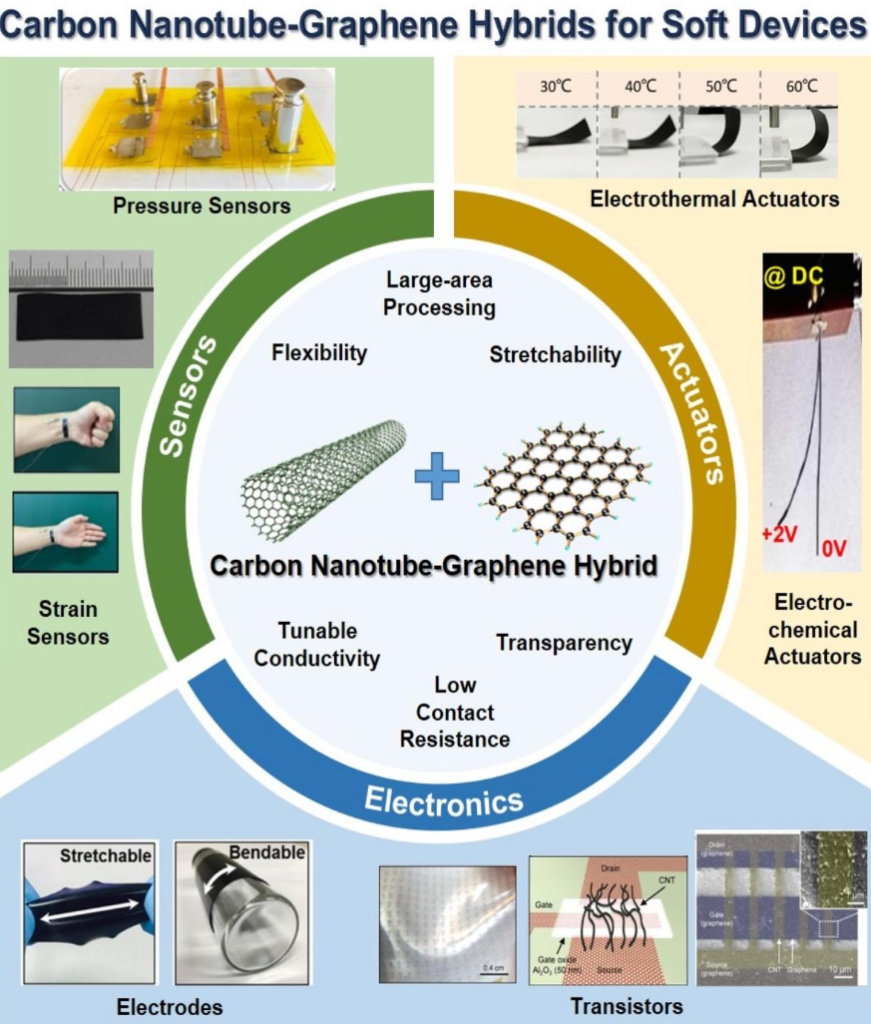
Hybrid Carbon Systems
- Combinations of graphene, CNTs, and other conductive materials
- Designed for optimized performance
👉 These materials are not just “better fillers”—they are functional building blocks for advanced electronic systems.
Why Electronics Need Advanced Carbon Materials
1. Thermal Management Is Now Critical
Modern chips generate enormous heat due to:
- Increased transistor density
- Higher power consumption
- Compact system design
Traditional materials struggle to dissipate heat efficiently.
Advanced carbon materials enable:
- Faster heat spreading
- Lower thermal resistance
- Improved system stability
2. Electrical Performance at Smaller Scales
As device dimensions shrink:
- Conductive pathways become more critical
- Contact resistance becomes a bottleneck
Carbon nanomaterials help by:
- Forming efficient conductive networks
- Reducing percolation thresholds
- Maintaining performance in complex structures
3. Lightweight and Flexible Electronics
Emerging applications require:
- Flexible substrates
- Wearable electronics
- Thin and lightweight systems
Carbon materials provide:
- Mechanical flexibility
- High strength-to-weight ratio
- Stable performance under deformation
4. Integration into Complex Systems
Next-generation electronics are no longer simple components—they are integrated systems:
- AI hardware
- Energy storage + electronics integration
- Smart devices
Advanced carbon materials can be engineered to function across multiple roles:
- Conductive pathways
- Thermal management
- Structural reinforcement
Key Application Areas
AI and High-Performance Computing
- Thermal interface materials (TIMs)
- Heat spreaders
- Advanced packaging
👉 Carbon materials help manage extreme heat loads.
Electric Vehicles and Power Electronics
- Battery systems
- Inverters and converters
- Charging infrastructure
👉 Need for both thermal and electrical optimization.
Flexible and Wearable Electronics
- Sensors
- Flexible circuits
- Smart textiles
👉 CNT networks are particularly valuable here.
5G / 6G and High-Frequency Devices
- RF components
- Antennas
- Signal transmission systems
👉 Low resistance and stable performance are critical.
From Material Properties to System Performance
A key shift in the industry is:
Moving from “material selection” to “system design”
Why This Matters
Having a material with excellent properties is not enough.
Performance depends on:
- Dispersion
- Network formation
- Interface behavior
- Processing conditions
👉 This is especially true for:
- Graphene
- CNTs
Their real value comes from how they function inside systems, not just their intrinsic properties.
The Rise of Hybrid Carbon Systems
In real applications, single materials are often not sufficient.
Hybrid Systems Combine Strengths
- CNTs → network connectivity
- Graphene → conductivity and heat spreading
- Other fillers → structural support
Result
- More robust performance
- Better process compatibility
- Improved scalability
👉 Hybrid design is becoming the industry trend.
Manufacturing and Scale Challenges
Despite strong potential, advanced carbon materials face challenges:
- Consistent material quality
- Dispersion and processing control
- Cost-performance balance
- Integration into existing manufacturing lines
The Real Bottleneck
Not the material itself—but:
👉 how to use it at scale
The Role of Pilot Lines and Engineering
Bridging the gap between lab and industry requires:
- Process optimization
- Equipment compatibility
- Real-condition testing
Pilot lines enable:
- Validation of material behavior
- Optimization of formulations
- Risk reduction before full-scale production
👉 This is where many projects succeed—or fail.
Future Outlook
Advanced carbon materials are expected to play a central role in:
- High-density electronics
- Integrated energy systems
- Smart and flexible devices
As the industry evolves, the focus will shift toward:
- Material-process integration
- Hybrid system design
- Scalable manufacturing solutions
Advanced carbon materials are not just incremental improvements—they represent a fundamental shift in how electronic systems are designed and optimized.
Their true value lies in:
- Enabling new performance levels
- Supporting complex system integration
- Bridging thermal, electrical, and mechanical functions
However, success depends not only on the material itself, but on the ability to integrate it into real-world manufacturing and applications.