
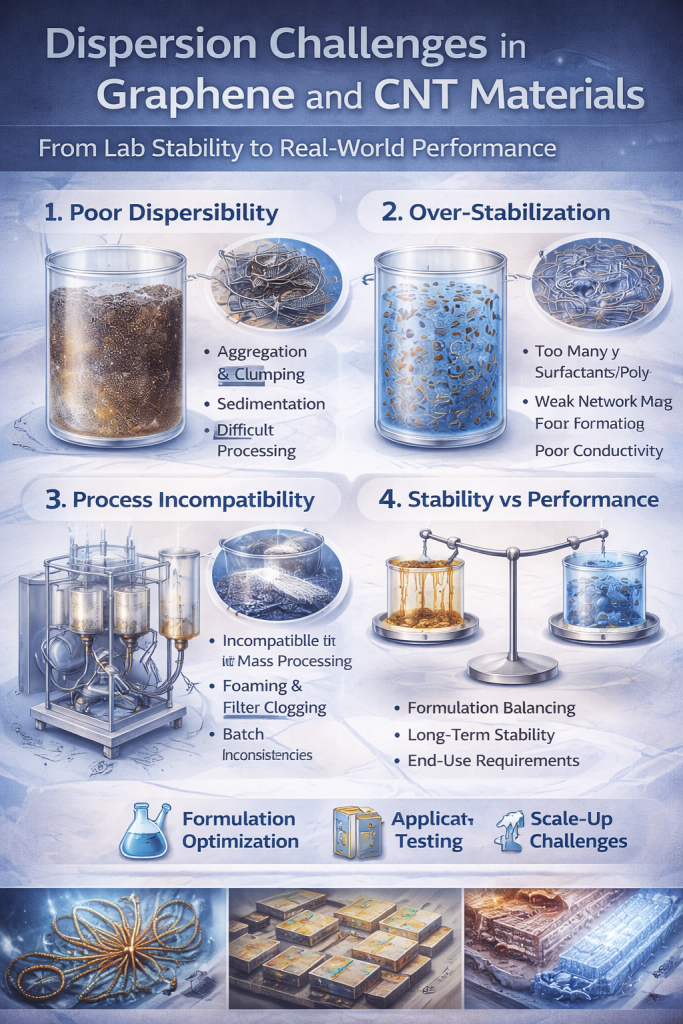
Dispersion Challenges in Graphene and CNT Materials
Why Material Handling Is as Critical as Material Properties
Graphene and carbon nanotubes (CNTs) are often praised for their exceptional electrical, thermal, and mechanical properties. However, realizing these properties in real-world applications is not as simple as just adding the materials to a system.
The key challenge is dispersion: how the nanomaterials are distributed and integrated into a matrix or device. Dispersion issues are often the limiting factor in translating lab-scale material performance into industrial-scale systems.
This article explores the major dispersion challenges for graphene and CNTs, why they matter, and strategies to overcome them.
Why Dispersion Matters
The performance of graphene and CNTs depends heavily on how well they form networks in real systems.
Poor dispersion can lead to:
- Agglomeration of particles
- Non-uniform conductive networks
- Reduced mechanical reinforcement
- Localized thermal bottlenecks
Even materials with excellent intrinsic properties can underperform if dispersion is inadequate.
Types of Dispersion Challenges
1. Agglomeration and Entanglement
- CNTs naturally tend to form bundles due to van der Waals forces.
- Graphene sheets stack and aggregate.
- Agglomerated particles fail to form effective conductive networks.
2. Solvent Compatibility
- Graphene oxide disperses well in water, but reduced graphene or GNPs require organic solvents or surfactants.
- CNTs may require specialized dispersants to maintain uniformity.
- Solvent choice affects both performance and process safety.
3. Viscosity Constraints
- High aspect ratio materials increase the viscosity of slurries or polymer composites.
- This can hinder coating, mixing, or extrusion processes.
4. Shear Sensitivity
- Excessive mechanical shear can break CNTs or graphene sheets.
- Insufficient shear fails to break agglomerates.
- Optimizing shear is critical for maintaining both dispersion and material integrity.
Impact of Poor Dispersion
Electrical Conductivity
- Non-uniform networks increase percolation thresholds.
- Localized gaps reduce current paths.
- Performance in batteries, coatings, and electronics suffers.
Thermal Conductivity
- Dispersed graphene or CNTs form continuous thermal pathways.
- Aggregates or clusters introduce thermal bottlenecks.
Mechanical Reinforcement
- CNT bundles or stacked graphene sheets provide less stress transfer.
- Composites fail to achieve designed mechanical properties.
Strategies for Improving Dispersion
1. Surface Functionalization
- Introducing chemical groups on graphene or CNTs improves compatibility with the matrix.
- Enhances bonding with polymers, electrodes, or coatings.
2. Use of Dispersants and Surfactants
- Helps maintain stability in liquid systems.
- Must be optimized to avoid interfering with performance.
3. Mechanical Processing
- Ultrasonication, high-shear mixing, ball milling, or extrusion.
- Balancing energy input to break agglomerates without damaging the material.
4. Hybrid Material Design
- Combining CNTs and graphene can leverage synergistic effects.
- CNTs maintain network connectivity while graphene spreads conductivity or heat.
Industrial Considerations
In laboratory settings, achieving uniform dispersion is feasible, but real-world manufacturing introduces additional challenges:
- Scale-up changes shear, mixing, and drying conditions.
- Material handling equipment must maintain uniformity.
- Batch-to-batch variation can impact performance.
Role of Pilot Production
Pilot lines play a critical role in translating dispersion strategies from lab to industry:
- Test dispersibility under industrial mixing conditions.
- Validate formulations in real electrodes, composites, or coatings.
- Optimize process parameters before mass production.
Applications Most Sensitive to Dispersion
- Battery electrodes: electrical pathways and thermal conductivity depend on CNT/graphene networks.
- Thermal interface materials (TIMs): heat transfer efficiency is highly sensitive to filler distribution.
- Conductive coatings and polymers: electrical percolation thresholds depend on homogeneous dispersion.
- Composites for structural reinforcement: mechanical properties require uniform filler distribution.
Key Takeaways
- Dispersion is as critical as material properties for performance.
- Poor dispersion leads to suboptimal electrical, thermal, and mechanical behavior.
- Successful application requires surface engineering, optimized processing, and pilot-scale validation.
- Hybrid systems (CNT + graphene) can mitigate dispersion challenges and improve network formation.
Graphene and CNT materials have incredible potential, but their success depends on how they are integrated into systems.
- Material properties alone do not guarantee performance.
- Effective dispersion is the bridge between lab-scale promise and industrial reality.
- Combining advanced dispersion strategies with pilot-scale validation ensures that materials perform as expected in real applications.