
Functionalized Graphene for Industrial Applications
Graphene has attracted global attention for its exceptional electrical, thermal, and mechanical properties. However, in its pristine form, graphene is often difficult to disperse, integrate, and scale in real-world industrial systems.
This is where functionalized graphene becomes critical. By chemically or physically modifying graphene, industries can unlock enhanced compatibility, processability, and performance, making it suitable for a wide range of applications—from coatings and composites to energy storage and electronics.
What Is Functionalized Graphene?
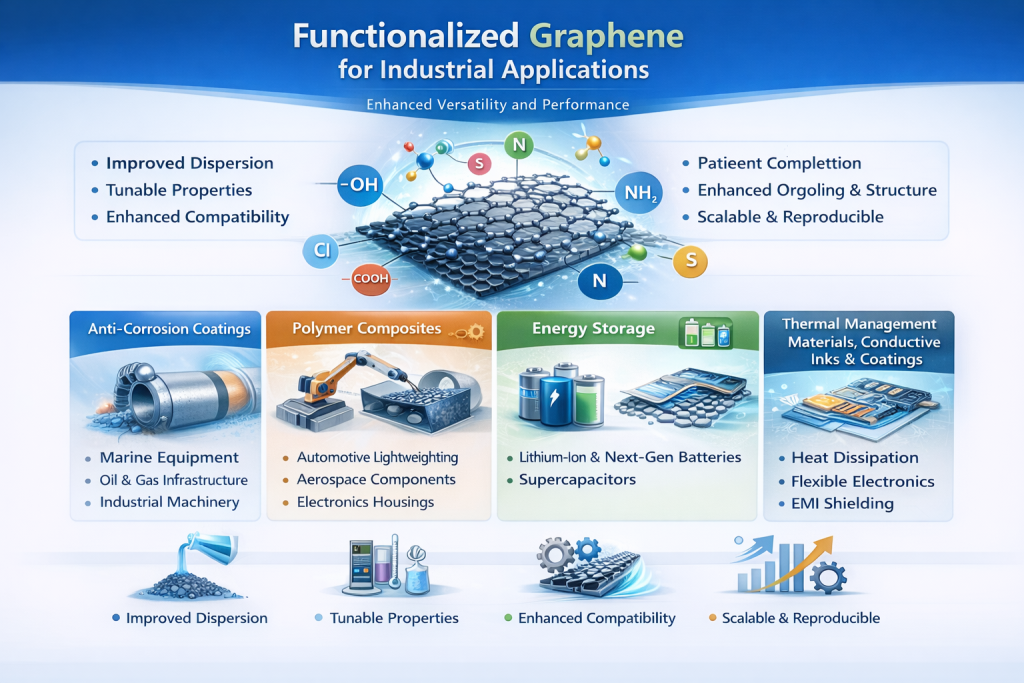
Functionalized graphene refers to graphene materials that have been modified with specific chemical groups or structures to tailor their properties.
Common functionalization methods include:
- Covalent functionalization
Introducing chemical groups (e.g., –OH, –COOH) onto the graphene surface - Non-covalent functionalization
Using surfactants, polymers, or π–π interactions to stabilize graphene - Doping
Incorporating elements such as nitrogen, boron, or sulfur to modify electrical behavior
These modifications enable graphene to interact more effectively with matrices, solvents, or other materials.
Why Functionalization Is Essential for Industrial Use
1. Improved Dispersion
Pristine graphene tends to agglomerate due to strong van der Waals forces. Functionalization helps:
- Achieve stable dispersions in water or solvents
- Ensure uniform distribution in composites or coatings
2. Enhanced Interfacial Compatibility
In industrial systems, graphene is rarely used alone. It must integrate into:
- Polymers
- Metals
- Ceramics
Functional groups improve interfacial bonding, leading to better mechanical and electrical performance.
3. Tunable Properties
Functionalization allows precise control over:
- Electrical conductivity
- Surface energy
- Chemical reactivity
- Thermal stability
This makes graphene adaptable to application-specific requirements.
Key Industrial Applications of Functionalized Graphene
1. Anti-Corrosion Coatings
Functionalized graphene enhances coatings by:
- Creating barrier effects against moisture and oxygen
- Improving adhesion to substrates
- Extending service life in harsh environments
Widely used in:
- Marine equipment
- Oil & gas infrastructure
- Industrial machinery
2. Polymer Composites
Incorporating functionalized graphene into polymers leads to:
- Increased mechanical strength
- Enhanced thermal conductivity
- Improved electrical properties
Applications include:
- Automotive components
- Aerospace materials
- Consumer electronics housings
3. Energy Storage Systems
Functionalized graphene plays a role in:
- Lithium-ion and next-generation batteries
- Supercapacitors
Benefits include:
- Improved electrode conductivity
- Better ion transport pathways
- Enhanced cycle stability
4. Thermal Management Materials
Graphene’s high thermal conductivity can be better utilized when functionalized:
- Improved dispersion in thermal interface materials (TIMs)
- Enhanced heat dissipation in electronics
Used in:
- Power electronics
- Data centers
- EV battery systems
5. Conductive Inks and Coatings
Functionalized graphene enables:
- Printable conductive formulations
- Flexible and stretchable electronics
Applications include:
- RFID antennas
- Flexible circuits
- EMI shielding layers
Processing Considerations
To successfully implement functionalized graphene at scale, several factors must be controlled:
Functionalization Degree
- Over-functionalization can reduce conductivity
- Under-functionalization may limit compatibility
Dispersion Stability
- Long-term stability is critical for industrial formulations
Scalability
- Functionalization methods must be cost-effective and reproducible
Environmental & Safety Aspects
- Selection of chemicals and processes must meet regulatory standards
Challenges in Industrial Adoption
Despite its potential, several challenges remain:
- Cost-performance balance
- Standardization of materials and specifications
- Consistency across large batches
- Integration into existing manufacturing processes
Addressing these requires collaboration across material suppliers, process engineers, and end-users.
Future Trends
Functionalized graphene is evolving toward:
- Application-specific customization
- Hybrid material systems (e.g., graphene + CNTs, graphene + ceramics)
- Scalable green functionalization methods
- Integration with AI-driven material design
These trends will accelerate its adoption in high-performance and large-scale industrial applications.
Functionalized graphene transforms graphene from a laboratory material into an industrial solution. By enabling better dispersion, compatibility, and tunability, it opens the door to real-world applications across multiple sectors.
For companies looking to leverage graphene, the focus should not only be on the material itself, but on how it is functionalized and integrated into the final system—this is where true value is created.