
Carbon-Based Thermal Solutions for Power Electronics: Enhancing Efficiency and Reliability
Power electronics—such as inverters, converters, and EV motor controllers—are critical in modern energy and automotive systems. As power densities increase, thermal management becomes a key factor in device performance, reliability, and longevity. Carbon-based thermal solutions are emerging as highly effective approaches due to their unique combination of high thermal conductivity, lightweight properties, and chemical stability.
Why Carbon-Based Thermal Solutions Matter
Traditional thermal management materials (aluminum, copper, standard TIMs) face limitations in high-power-density systems:
- Bulk metals add weight and volume
- Limited flexibility in complex geometries
- Thermal interface materials may degrade over time
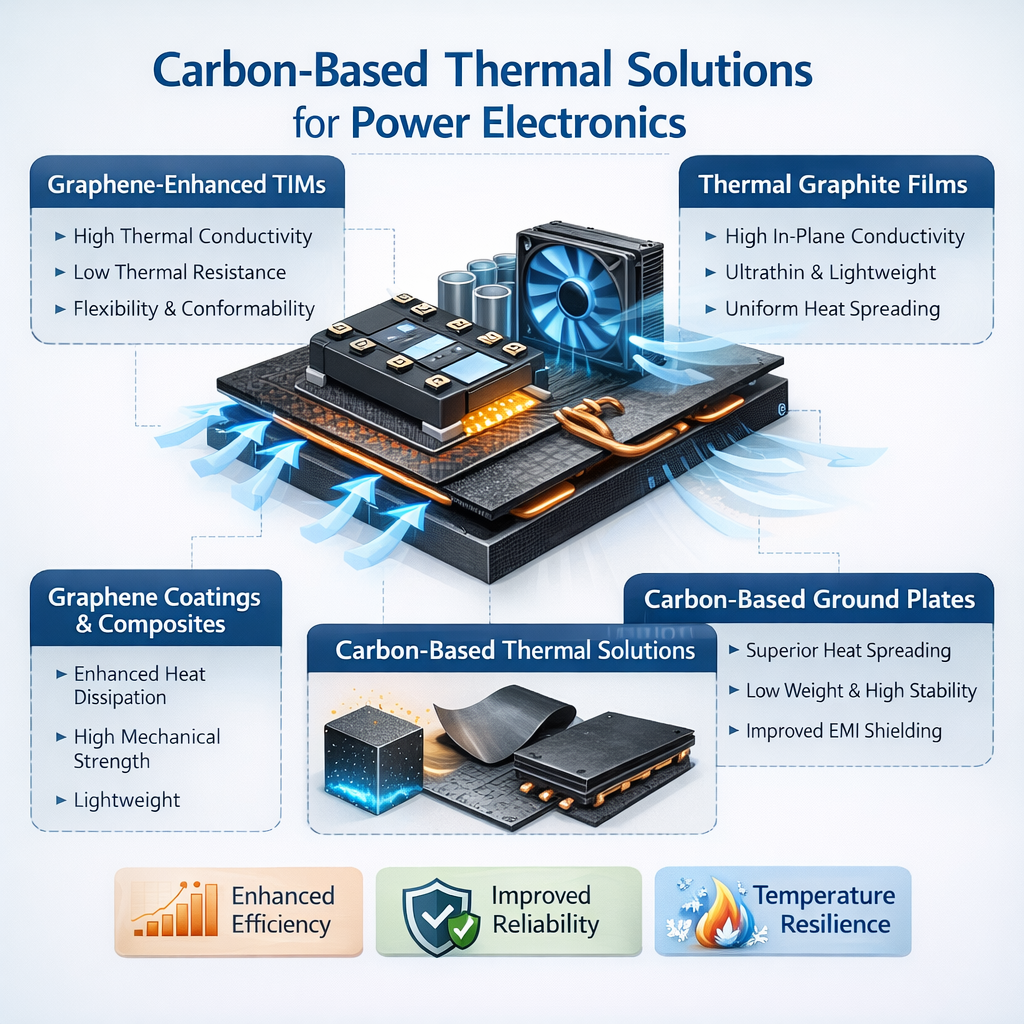
Carbon-based materials—including graphene, carbon nanotubes (CNTs), and graphite composites—offer:
- Ultra-high thermal conductivity (graphene: up to 5000 W/m·K)
- Low coefficient of thermal expansion
- Lightweight and adaptable form factors
- High chemical and thermal stability
Key Carbon-Based Thermal Solutions
1. Graphene-Enhanced Thermal Interface Materials (TIMs)
Overview:
Graphene-filled pads, pastes, and adhesives improve heat transfer between power electronic devices and heat sinks.
Advantages:
- Reduces thermal resistance
- Thin form factor for compact designs
- Stable performance over wide temperature ranges
Applications:
Power modules in EVs, renewable inverters, high-frequency converters
2. Carbon Nanotube (CNT) Heat Spreaders
Overview:
CNT arrays or sheets efficiently spread heat laterally across surfaces, preventing hotspots.
Advantages:
- Extremely high thermal conductivity
- Flexible and mechanically robust
- Integrates with 3D geometries
Applications:
Motor controllers, high-power RF devices, aerospace electronics
3. Graphite-Based Plates and Foils
Overview:
Flexible or laminated graphite sheets serve as heat spreaders and structural layers.
Advantages:
- Lightweight, low-cost alternative to copper
- Conforms to irregular surfaces
- Can be integrated into multi-layer assemblies
Applications:
Power semiconductors, battery management electronics, LED modules
4. Carbon Composites for Direct Cooling
Overview:
Carbon fibers or composites combined with polymers or metals create tailored thermal pathways.
Advantages:
- Optimized anisotropic thermal conductivity
- Mechanical reinforcement of assemblies
- Combines thermal and structural functionality
Applications:
High-density power converters, aerospace electronics, industrial drives
Design Considerations for Carbon-Based Solutions
- Thermal Conductivity Alignment
- Match in-plane and through-plane conductivity to device geometry
- Use anisotropic designs for directed heat flow
- Electrical Isolation
- Ensure carbon layers do not short electronic circuits
- Incorporate insulating coatings or laminates as needed
- Integration with Cooling Systems
- Works alongside liquid or air cooling
- Reduces hotspot temperature, lowering cooling system load
- Reliability Under Thermal Cycling
- Carbon solutions maintain conductivity under repeated heating and cooling cycles
- Minimizes thermal stress on solder joints and components
Emerging Trends
- Hybrid Carbon Solutions: Combining graphene, CNTs, and graphite for optimized heat management
- 3D Printing of Carbon Composites: Custom heat spreaders for complex geometries
- AI-Driven Thermal Modeling: Simulation-guided carbon material placement for maximum efficiency
- Integration with Lightweight Chassis Materials: Reduces total system weight while improving thermal performance
Carbon-based thermal solutions offer a transformative approach for managing heat in power electronics. By leveraging graphene, CNTs, and graphite composites, engineers can design lighter, more efficient, and reliable systems that handle higher power densities and extreme operational conditions.
These materials not only enhance thermal performance but also enable flexible, compact, and innovative electronic packaging for the next generation of high-performance devices.