

Graphene Conductive Coatings for EMI Shielding
With the rapid growth of electronics, electric vehicles, and wireless communication systems, electromagnetic interference (EMI) has become a critical challenge. Uncontrolled EMI can disrupt device performance, reduce reliability, and even cause system failure.
Graphene conductive coatings are emerging as a next-generation solution for EMI shielding, offering a unique combination of high conductivity, lightweight structure, corrosion resistance, and process flexibility.
What Is EMI Shielding?
EMI shielding refers to the use of materials that block or attenuate electromagnetic waves to protect electronic devices and systems.
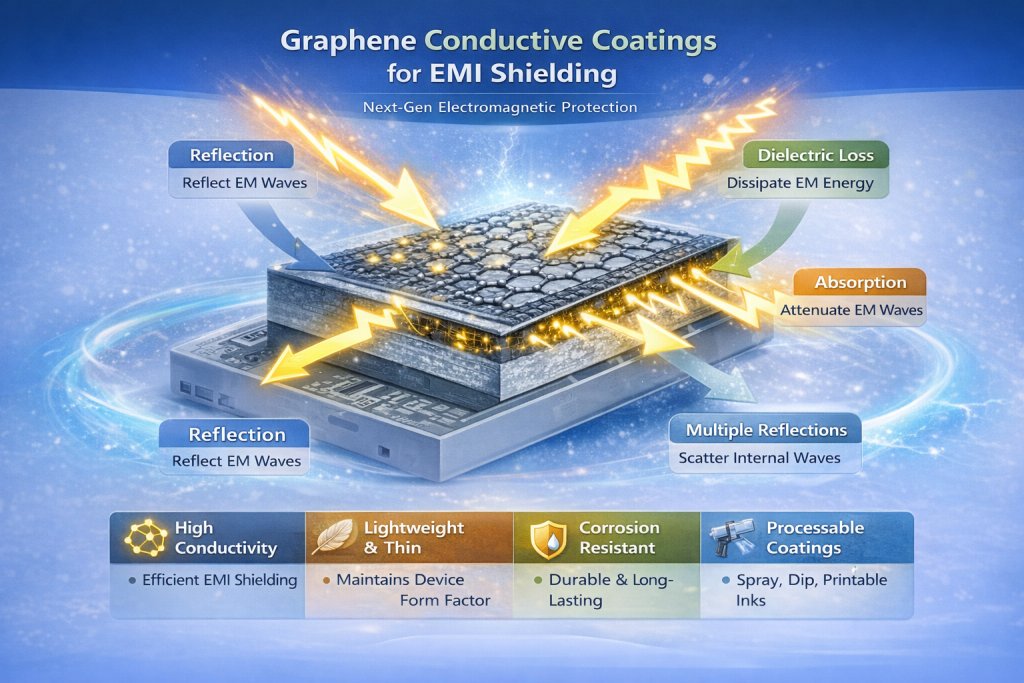
Shielding effectiveness (SE), typically measured in decibels (dB), depends on three main mechanisms:
- Reflection – Deflecting electromagnetic waves via conductive surfaces
- Absorption – Dissipating energy within the material
- Multiple reflections – Scattering waves within layered or porous structures
Graphene coatings can contribute to all three mechanisms.
Why Graphene for EMI Shielding Coatings?
1. High Electrical Conductivity
Graphene provides excellent electron mobility, enabling:
- Strong reflection of electromagnetic waves
- Formation of continuous conductive networks in coatings
2. Lightweight and Thin Structure
Compared to traditional metal-based shielding:
- Graphene coatings are significantly lighter
- Can achieve high performance at micron or even nanometer thickness
This is critical for applications like aerospace and portable electronics.
3. Corrosion Resistance
Unlike metals, graphene-based coatings:
- Resist oxidation and environmental degradation
- Maintain long-term performance in harsh conditions
4. Process Compatibility
Graphene can be formulated into:
- Spray coatings
- Dip coatings
- Printable inks
This enables easy integration into existing industrial processes.
Mechanisms of EMI Shielding in Graphene Coatings
Conductive Network Formation
Functionalized graphene or graphene-based fillers form percolated conductive pathways, enabling efficient reflection of EM waves.
Dielectric Loss and Absorption
Graphene structures contribute to:
- Polarization losses
- Energy dissipation within the coating
Especially effective in multi-layer or hybrid systems.
Layered and Hybrid Architectures
Combining graphene with other materials (e.g., polymers, CNTs, metals) enhances:
- Broadband shielding performance
- Mechanical stability
- Tunable electrical properties
Key Application Areas
1. Consumer Electronics
- Smartphones, laptops, wearables
- Protection of sensitive circuits
- Thin, lightweight shielding layers
2. Electric Vehicles (EVs)
- Battery management systems (BMS)
- Power electronics and inverters
- High-voltage cable shielding
Graphene coatings help reduce weight while maintaining performance.
3. Aerospace and Defense
- Avionics systems
- Radar shielding
- Lightweight structural components
4. Telecommunications (5G/6G)
- Base stations
- Signal integrity protection
- High-frequency EMI mitigation
5. Industrial Equipment
- Control systems
- Sensors and automation devices
- Harsh environment protection
Performance Advantages vs Traditional Materials
| Property | Graphene Coatings | Metal Coatings |
|---|---|---|
| Weight | Very low | High |
| Thickness | Ultra-thin | Thicker layers required |
| Corrosion Resistance | Excellent | Often requires protection |
| Flexibility | High | Limited |
| Processability | High (spray/print) | More complex |
Processing Considerations
To achieve optimal EMI shielding performance:
Dispersion Quality
- Uniform graphene distribution is critical
- Prevent agglomeration for consistent conductivity
Loading Level
- Must exceed percolation threshold
- Balanced to maintain coating properties
Binder Selection
- Impacts adhesion, flexibility, and conductivity
- Needs compatibility with graphene surface chemistry
Layer Design
- Multi-layer coatings can enhance absorption
- Hybrid structures improve broadband performance
Challenges
- Cost vs performance optimization
- Scalable, stable dispersion systems
- Standardized EMI testing methods
- Balancing conductivity with mechanical properties
Future Trends
Graphene EMI shielding coatings are evolving toward:
- Hybrid conductive systems (Graphene + CNTs + metallic fillers)
- Ultra-thin, high-frequency shielding solutions
- Flexible and wearable EMI protection
- Integration with multifunctional coatings (thermal + corrosion + EMI)
Graphene conductive coatings represent a next-generation EMI shielding solution, combining high performance with lightweight and flexible design.
As electronic systems become more complex and compact, graphene-based coatings provide a scalable pathway to efficient, durable, and multifunctional electromagnetic protection.