
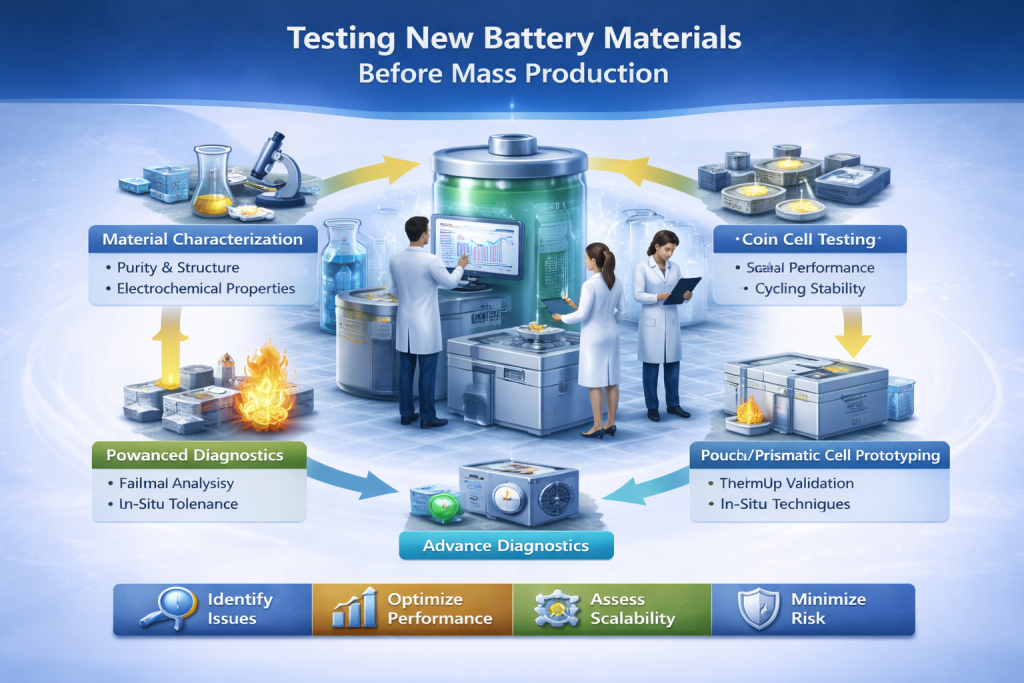
Testing New Battery Materials Before Mass Production
The development of next-generation batteries—such as lithium-ion, solid-state, and sodium-ion—relies heavily on the successful translation of lab-scale materials into industrial-scale production. However, new materials often behave differently at scale, which can lead to unexpected performance issues or manufacturing challenges.
Therefore, rigorous testing of new battery materials before mass production is a critical step to ensure reliability, efficiency, and safety.
Why Pre-Production Testing Matters
- Performance Validation
- Confirms electrochemical performance under realistic conditions
- Evaluates capacity, cycle life, and rate capability
- Ensures materials meet target specifications
- Safety Assurance
- Detects thermal runaway risks
- Evaluates gas evolution, swelling, and decomposition
- Supports compliance with safety standards
- Process Compatibility
- Ensures materials are compatible with electrodes, electrolytes, and separators
- Tests coating, drying, and calendaring behavior
- Reduces risk of scaling issues in manufacturing
- Cost and Yield Optimization
- Identifies material waste points
- Optimizes precursor usage and processing conditions
- Supports efficient scale-up planning
Key Testing Stages
1. Material Characterization
- Morphology Analysis – SEM, TEM, particle size
- Structural Analysis – XRD, Raman spectroscopy
- Surface Chemistry – XPS, FTIR
This ensures the material meets design specifications at the molecular and structural level.
2. Electrochemical Testing
- Half-Cell Tests – Evaluate material vs. standard reference electrodes
- Full-Cell Tests – Assess performance in realistic battery configurations
- Rate Capability – Charge/discharge at various currents
- Cycling Stability – Long-term performance assessment
3. Pilot-Scale Production Trials
- Small batches using pilot lines or semi-industrial setups
- Test coating uniformity, drying, densification, and assembly
- Identify scalability challenges before full production
4. Environmental and Mechanical Testing
- Temperature and Humidity Exposure – Performance under extreme conditions
- Vibration and Shock – Mechanical integrity during transportation and usage
- Aging Tests – Predict long-term stability
5. Safety and Regulatory Tests
- Overcharge and Short-Circuit Tests
- Thermal Stability and Abuse Tests
- Compliance with UN, IEC, and local safety standards
Benefits of Thorough Pre-Production Testing
- Reduced Risk of Failure
- Identifies potential issues before committing to mass production
- Improved Product Reliability
- Ensures consistent performance across batches
- Cost Savings
- Minimizes waste and rework during scaling
- Faster Time-to-Market
- Streamlines the transition from lab to industrial production
- Enhanced Collaboration
- Provides data for engineers, suppliers, and OEMs to align on materials and processes
Common Challenges
- Material Variability – Batch-to-batch differences can affect performance
- Scaling Artifacts – Lab results may not directly translate to industrial processes
- Time and Resource Constraints – Extensive testing requires dedicated facilities and skilled personnel
- Data Integration – Collecting and analyzing multi-parameter test data efficiently
Best Practices
- Start Small, Scale Gradually – Use pilot lines before mass production
- Multidisciplinary Approach – Combine chemistry, materials science, and process engineering
- Continuous Monitoring – Integrate sensors and data collection in pilot runs
- Iterative Optimization – Use test results to refine materials and processes before scaling
Future Trends
- AI and Machine Learning – Predict material behavior and optimize testing protocols
- High-Throughput Screening – Rapidly test multiple materials and formulations
- Digital Twins – Simulate scaling and production scenarios virtually
- Sustainable Testing – Reduce waste and energy consumption in testing processes
Testing new battery materials before mass production is essential to ensure safety, reliability, and manufacturability. By integrating rigorous material characterization, electrochemical evaluation, pilot-scale trials, and safety testing, companies can confidently scale up innovations from the lab to commercial production, reducing risk, cost, and time-to-market.