
Advanced Thermal Materials for AI Servers and Electronics
Managing Heat in the Age of Extreme Computing
As artificial intelligence continues to scale, the demand for computing power is growing exponentially.
From large language models to real-time data processing, AI servers are pushing hardware to its limits—especially in terms of heat generation.
👉 The challenge is no longer just computing performance.
👉 It is thermal management at extreme densities.
Why Thermal Materials Matter More Than Ever
Rising Power Density
Modern AI chips (GPUs, ASICs) now operate at:
- Extremely high power densities
- Localized hot spots
- Continuous heavy workloads
The Consequence
Without effective thermal management:
- Performance throttling occurs
- System reliability drops
- Hardware lifespan shortens
👉 Thermal materials are no longer passive components—they are performance enablers.
Key Thermal Challenges in AI Systems
1. Chip-Level Heat Flux
- High heat flux from small chip areas
- Requires ultra-efficient heat transfer
2. Interface Resistance
Thermal bottlenecks often occur at:
- Chip → TIM → Heat sink interfaces
Even small gaps or poor contact can cause:
- Significant temperature rise
3. System-Level Heat Accumulation
- Dense server racks
- Limited airflow space
- Increasing cooling complexity
👉 Thermal design must evolve from component-level → system-level optimization
Types of Advanced Thermal Materials
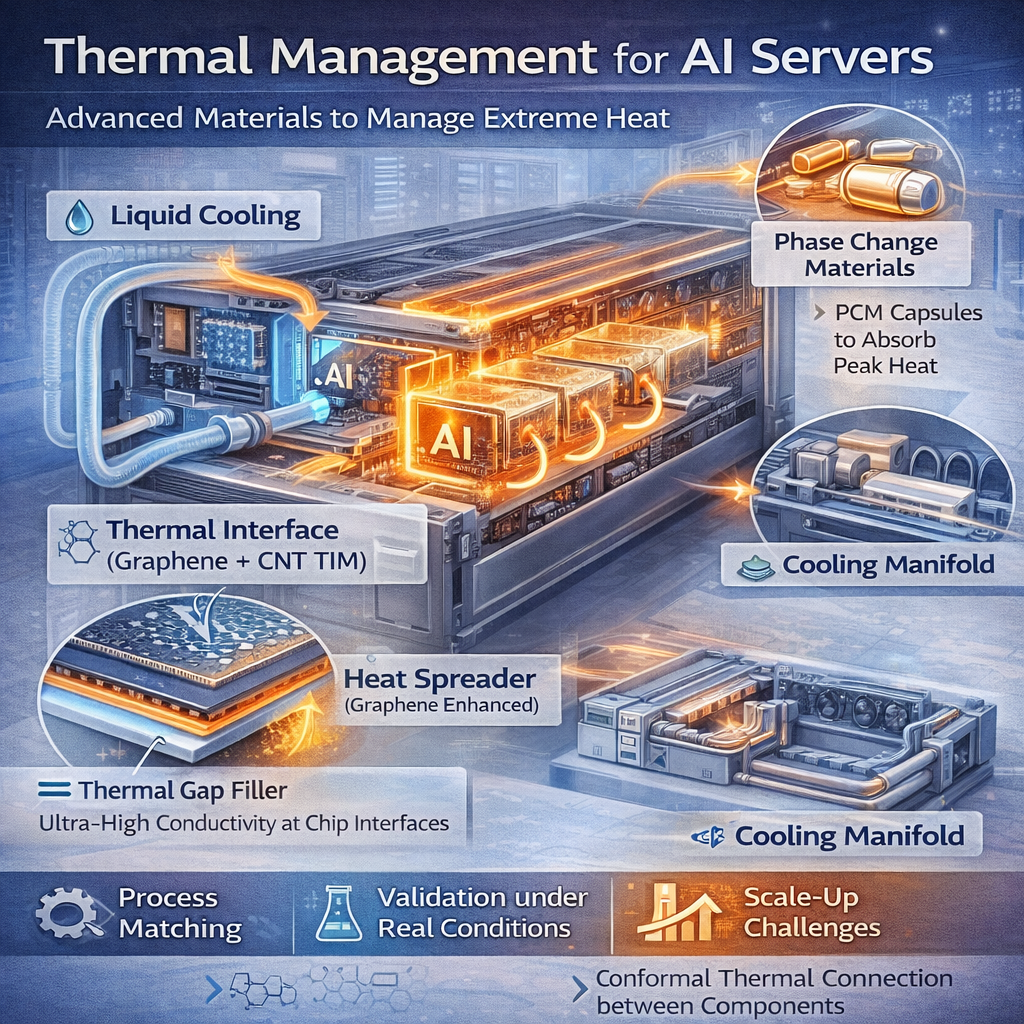
Thermal Interface Materials (TIMs)
Used between:
- Chips and heat sinks
- Modules and cooling plates
Key Requirements:
- High thermal conductivity
- Low contact resistance
- Good conformability
Thermal Gap Fillers
- Fill uneven surfaces
- Maintain contact under pressure
Heat Spreaders
- Distribute heat laterally
- Reduce hot spots
Phase Change Materials (PCMs)
- Absorb peak heat loads
- Stabilize temperature fluctuations
👉 Each material plays a different role in the thermal path.
The Role of Advanced Carbon Materials
Carbon-based materials are becoming critical in AI thermal systems.
Graphene
- Extremely high in-plane thermal conductivity
- Ideal for heat spreading
Carbon Nanotubes (CNTs)
- Excellent network formation
- Improve interface thermal pathways
Hybrid Carbon Systems
- Combine graphene + CNTs + polymers
- Balance conductivity and processability
👉 These materials enable next-generation TIMs and heat spreaders.
Air Cooling vs Liquid Cooling
Air Cooling (Traditional)
- Simpler
- Lower cost
But:
- Limited heat dissipation capacity
- Struggles with high-density AI workloads
Liquid Cooling (Emerging Standard)
- Much higher cooling efficiency
- Supports higher power densities
Includes:
- Cold plate cooling
- Direct-to-chip liquid cooling
👉 Advanced thermal materials are essential in both systems, especially at interfaces.
From Materials to Thermal Systems
A key shift in AI infrastructure:
Thermal performance is no longer defined by a single material
but by the entire thermal pathway
Critical Factors:
- Material conductivity
- Interface quality
- Mechanical compliance
- Long-term stability
👉 A high-performance material alone is not enough.
The Importance of Processing and Integration
Thermal materials must be:
- Easily applied
- Compatible with manufacturing
- Stable over time
Common Challenges:
- Poor dispersion of fillers
- Inconsistent thickness
- Pump-out or dry-out issues
👉 This is where engineering and pilot validation become critical.
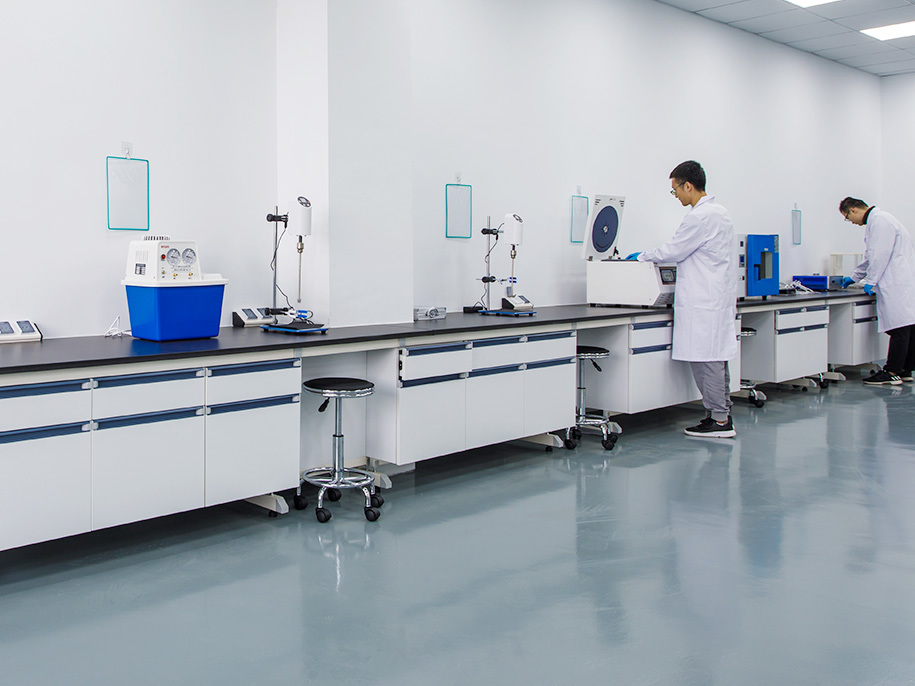
Pilot Validation for Thermal Materials
Before large-scale deployment, materials must be tested under:
- Real operating temperatures
- Mechanical stress
- Long-term cycling
Pilot Capabilities Enable:
- Formulation optimization
- Coating and application testing
- Interface performance validation
- Reliability testing
👉 This reduces risk in high-value AI infrastructure.
Future Trends
Higher Thermal Conductivity Materials
- Moving beyond traditional fillers
- Increasing use of nanocarbon systems
Integrated Thermal Solutions
- Materials + structure + cooling combined
AI-Driven Thermal Design
- Simulation and optimization tools
- Data-driven material selection
Liquid Cooling Expansion
- Becoming mainstream in AI data centers
As AI systems continue to scale, thermal management becomes a defining factor in performance and reliability.
Advanced thermal materials play a critical role by:
- Enabling efficient heat transfer
- Reducing thermal resistance
- Supporting high-density system design
👉 But real success depends on more than material properties:
It requires:
- System-level thinking
- Process compatibility
- Pilot-scale validation
In the age of AI, thermal materials are no longer supporting components—
they are core infrastructure.