
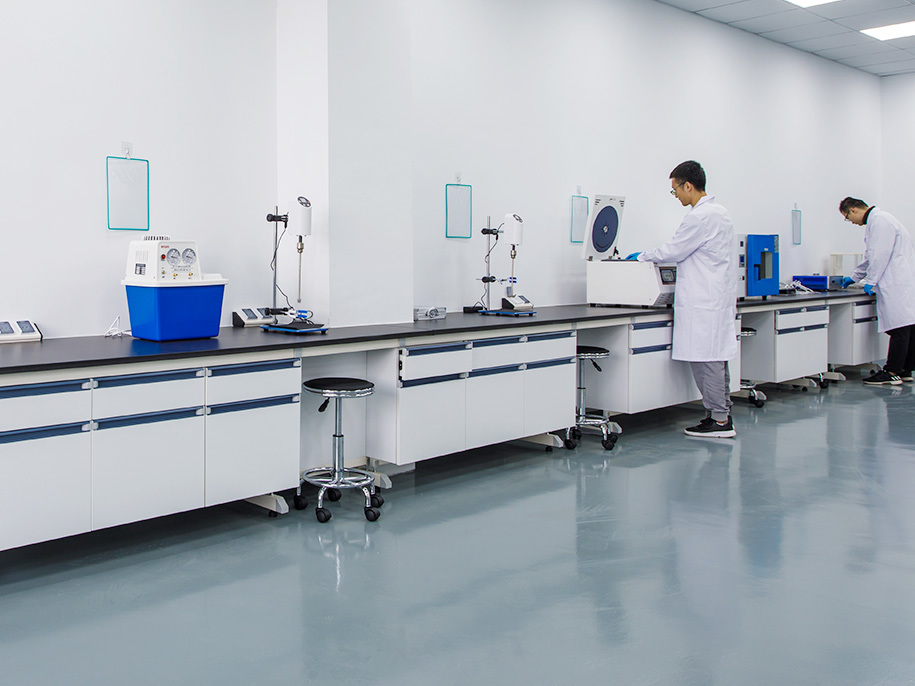
Battery Prototyping and Pilot-Scale Manufacturing: From Material Design to B-Sample Industrialization
Why Battery Formulations Cannot Be Industrialized Overnight
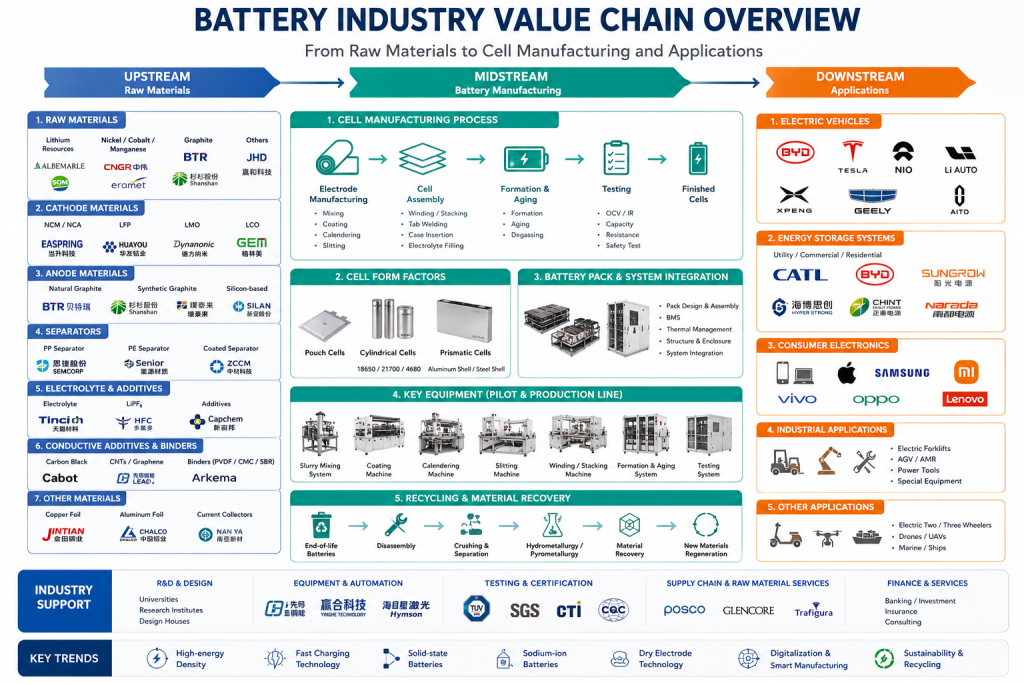
In the battery industry, promising laboratory results do not automatically translate into manufacturable products.
A material system that performs exceptionally well in gram-scale laboratory testing may still fail during pilot production or mass manufacturing.
This is one of the most important realities in lithium-ion battery development, sodium-ion battery engineering, and next-generation solid-state battery commercialization.
The gap between electrochemical theory and industrial manufacturing is far larger than many early-stage teams initially expect.
This is why battery prototyping and pilot-scale validation play such a critical role in modern battery industrialization.
Battery prototyping is not simply a “larger laboratory experiment.”
It is an iterative engineering process that continuously aligns:
- Electrochemical behavior
- Material characteristics
- Mechanical processing
- Manufacturing automation
- Process stability
- Cost control
- Yield optimization
before a technology can move toward scalable production.
In many cases, pilot-scale engineering determines whether a battery technology becomes commercially viable — or remains permanently trapped inside the laboratory.
The Three Core Missions of Battery Prototyping
1. Validating Material and Performance Boundaries
Pilot-scale testing helps engineers determine the realistic performance limits of:
- Cathode materials
- Anode materials
- Conductive additives
- Electrolytes
- Separator systems
under manufacturing-oriented conditions.
Laboratory data alone often cannot reveal:
- Thermal instability
- High-loading electrode collapse
- Slurry instability
- Coating inconsistency
- Mechanical stress sensitivity
- Long-term cycling degradation
Many electrochemical systems only begin to show their weaknesses after entering pilot-scale production environments.
2. Establishing Stable Process Windows
A battery formulation is only useful if it can operate inside a manufacturable process window.
For example:
- A slurry viscosity range may need to remain stable between 2000–4000 mPa·s
- Coating thickness tolerance may require ±1.5% consistency
- Drying temperatures must avoid binder migration
- Calendering density must balance porosity and energy density
Pilot-scale engineering converts material characteristics into repeatable manufacturing parameters.
Without this process stabilization, mass production becomes extremely risky.
3. Reducing Industrialization Risk
One of the biggest financial dangers in battery commercialization is scaling too quickly without sufficient pilot validation.
Directly moving immature technologies onto large-scale production lines can result in:
- Massive scrap rates
- Equipment contamination
- Production shutdowns
- Unstable quality control
- Multi-million-dollar losses
This is especially critical for:
- High-nickel cathodes
- Silicon-carbon anodes
- Sodium-ion systems
- Dry electrode technologies
- Solid-state batteries
Pilot-scale manufacturing acts as a risk control layer between research and gigafactory-scale production.
Part I — Material Foundations: How Advanced Battery Materials Behave During Prototyping
Conductive Network Engineering: CNT, Graphene, and Carbon Black
Modern battery electrodes increasingly rely on advanced conductive networks to improve:
- Fast charging capability
- High areal loading
- Cycle life
- Electronic conductivity
- Structural stability
However, these materials introduce significant manufacturing complexity during pilot-scale processing.
Carbon Nanotubes (CNT)
CNTs form one-dimensional conductive pathways that can dramatically improve electron transport efficiency.
But during slurry preparation, CNTs also introduce serious engineering challenges:
- Agglomeration
- Entanglement
- Difficult dispersion
- High viscosity sensitivity
Single-wall CNTs and multi-wall CNTs behave differently during:
- Mixing
- Shear processing
- Coating
- Drying
Excessive shear force may damage conductive structures, while insufficient mixing may leave conductive pathways incomplete.
As electrode solid loading increases, maintaining homogeneous CNT distribution becomes increasingly difficult.
This is one of the major reasons why many fast-charging formulations succeed in laboratories but struggle during scale-up.
Graphene
Graphene offers exceptional theoretical conductivity and high surface area advantages.
In theory, graphene can:
- Improve rate capability
- Enhance conductivity
- Increase mechanical stability
- Support high-power applications
However, pilot-scale processing often reveals a different reality.
Graphene’s extremely high oil absorption behavior may lead to:
- Slurry gelation
- Poor rheology
- Coating instability
- Dispersion inconsistency
This creates a major conflict between theoretical electrochemical performance and practical manufacturability.
In many pilot projects, the key challenge is not proving graphene works — but proving graphene can work consistently under manufacturing conditions.
Active Material Sensitivity During Pilot Processing
Battery active materials also behave differently under industrial processing conditions.
For example:
- High-nickel cathodes are sensitive to moisture and microcracking
- Large-particle graphite may suffer structural damage under excessive shear
- LFP systems require optimized conductive distribution at high loading
- Sodium-ion hard carbon systems show strong environmental sensitivity
Pilot-scale mixing and coating processes must carefully balance:
- Shear force
- Dispersion energy
- Temperature control
- Moisture exposure
- Residence time
Otherwise, electrochemical performance may deteriorate long before cell assembly begins.
Material Grade, Purity, and Hidden Industrialization Costs
One of the most underestimated risks in battery prototyping is material-grade transition.
A formulation developed with laboratory-grade materials may perform very differently when switching to industrial-grade raw materials.
For example:
- Trace metallic impurities such as Fe or Cu
- Moisture variation
- Particle size distribution inconsistency
- Surface treatment differences
can significantly impact:
- Self-discharge behavior
- K-value stability
- Cycle life
- Safety performance
In many cases, pilot-scale engineering must establish a balance between:
- Performance
- Material purity
- Supply-chain scalability
- Commercial cost
This is where industrialization strategy becomes just as important as electrochemical performance itself.
Why China Has Become the Global Center of Battery Pilot Manufacturing
China currently possesses one of the world’s most complete battery industrial ecosystems.
This includes:
- Cathode material supply chains
- Anode material manufacturing
- Separator production
- Electrolyte ecosystems
- Coating equipment suppliers
- Pilot-line integrators
- Gigafactory-scale manufacturing infrastructure
More importantly, China’s battery ecosystem allows pilot-scale teams to rapidly iterate between:
- Materials
- Equipment
- Process engineering
- Production feedback
This dramatically shortens development cycles for:
- Lithium-ion batteries
- Sodium-ion batteries
- Cylindrical cells
- Prismatic cells
- Pouch cells
- Solid-state battery systems
As global demand for EV batteries and energy storage systems continues to grow, pilot-scale manufacturing capability is becoming one of the most strategically important assets in battery industrialization.
Part II — From Lab Cells to B-Sample Validation: The Full Lifecycle of Battery Prototyping
Why Battery Development Is a Multi-Stage Engineering Process
In the battery industry, successful commercialization rarely happens in a single step.
A battery system that performs well in laboratory coin cells still faces a long journey before entering EV platforms, energy storage systems, or industrial applications.
Between electrochemical research and gigafactory-scale production lies a highly complex engineering transition process:
battery prototyping and pilot-scale validation.
This process is commonly divided into:
- A-Sample Development
- B-Sample Engineering Validation
- C-Sample Production Verification
Each stage represents a completely different level of manufacturing maturity.
Understanding these stages is critical for:
- Battery startups
- Material suppliers
- Universities
- EV companies
- Energy storage developers
- Advanced material engineering teams
because many failures occur not during laboratory research — but during scale-up.
A-Sample Development — Proving the Electrochemical Concept
A-sample development is typically the first stage of battery prototyping.
The primary goal is simple:
to prove whether a material system or cell design can function electrochemically.
At this stage, engineers focus on:
- Basic cycle performance
- Initial energy density
- Rate capability
- Electrochemical stability
- Preliminary safety evaluation
A-sample production volumes are usually relatively small:
- Dozens of cells
- Hundreds of cells
- Small laboratory pilot batches
The manufacturing process is often semi-manual or partially automated.
Because the objective is rapid iteration rather than production efficiency.
Why Many Technologies Appear Successful During A-Sample Testing
At the A-sample stage, many battery systems show extremely promising performance.
This is because:
- Laboratory conditions are highly controlled
- Material consistency is often optimized
- Small-batch production reduces process variation
- Engineers can manually compensate for instability
However, these conditions do not accurately represent industrial manufacturing reality.
This is why many technologies that appear successful during early-stage testing later encounter severe industrialization challenges.
B-Sample Validation — The Real Engineering Battlefield
If A-sample development proves electrochemical feasibility,
B-sample validation determines whether the technology can survive real manufacturing conditions.
This is one of the most critical stages in battery industrialization.
Because at the B-sample stage:
- Process parameters become stricter
- Automation increases
- Yield expectations rise
- Safety requirements become much more demanding
- Consistency becomes essential
This is where battery engineering transitions from “scientific possibility” into “manufacturing reality.”
What Makes B-Sample Validation So Difficult?
Unlike laboratory research,
B-sample production attempts to replicate future mass-manufacturing environments.
This means engineers must now solve:
- Slurry consistency problems
- Coating uniformity instability
- Drying behavior variation
- Electrode expansion and rebound
- Welding defects
- Electrolyte filling precision
- Gas generation during formation
- Yield loss and scrap-rate control
Many electrochemical systems that appear stable in small quantities begin to fail once process repetition increases.
The Hidden Cost of Process Variation
One of the biggest challenges during B-sample validation is process sensitivity.
A small change in:
- Mixing speed
- Coating tension
- Drying temperature
- Calendering pressure
- Moisture exposure
- Alignment accuracy
may significantly impact:
- Capacity retention
- Internal resistance
- Fast charging performance
- Cycle life
- Safety stability
This is why battery manufacturing is fundamentally an engineering discipline — not only a materials science discipline.
Why Pilot Lines Matter Before Mass Production
Modern battery pilot lines serve as the transition layer between laboratory research and gigafactory manufacturing.
Their role is not only to “produce cells.”
Instead, pilot lines are designed to:
- Build process repeatability
- Identify hidden failure modes
- Optimize production parameters
- Improve yield consistency
- Reduce industrialization risk
Without pilot validation, scaling directly into large-scale manufacturing becomes extremely dangerous financially.
Battery Scrap Rates: The Brutal Reality of Prototyping
One of the least discussed topics in battery development is scrap rate.
In laboratory environments, extremely high scrap ratios are common.
During early-stage A-sample production:
- Scrap rates may reach 30–50%
- Large material losses occur during coating adjustments
- Electrode edges are discarded
- Improper drying causes coating defects
- Assembly errors remain frequent
This is considered normal during early prototyping.
However, by the B-sample stage, manufacturing stability must improve significantly.
Typical B-sample targets require:
- Scrap rates reduced toward 10–15%
- Improved coating consistency
- Stable assembly precision
- Better process repeatability
For comparison:
commercial gigafactory operations often target total scrap rates below 3–5%.
This difference illustrates how difficult the industrialization process truly is.
Material Flow and Cross-Contamination Control
Battery pilot lines constantly switch between:
- Different chemistries
- Different conductive systems
- Different electrolytes
- Different cathode formulations
- Different process parameters
This creates major contamination risks.
For example:
- Residual metallic particles
- CNT residue
- Moisture exposure
- Cross-material contamination
may significantly impact cell reliability.
Therefore, pilot-scale manufacturing requires:
- Strict cleaning procedures
- Controlled material flow management
- Environmental isolation
- Moisture monitoring
- Cleanroom protocols
especially for sodium-ion and solid-state battery systems.
Why B-Sample Validation Is So Expensive
Many external observers underestimate the true cost of battery prototyping.
In reality, B-sample production may cost dozens or even hundreds of times more than future mass-manufactured cells.
Why?
Because pilot-scale manufacturing combines:
- Expensive engineering labor
- High material waste
- Low yield rates
- Continuous machine adjustment
- Strict environmental control
- High electricity consumption
- Frequent process iteration
In many pilot facilities:
- Dry rooms operate 24/7
- Dew point control remains below -40°C or even -60°C
- Formation cabinets consume massive electricity
- Long drying ovens remain continuously active
Even when production temporarily pauses,
the facility itself often cannot stop operating.
This creates extremely high hidden operating costs.
The Purpose of Battery Prototyping Is Not Speed — It Is Stability
One of the biggest misunderstandings in battery industrialization is assuming faster scale-up automatically leads to success.
In reality, premature scaling often increases:
- Scrap rates
- Safety risks
- Process instability
- Financial losses
Pilot-scale engineering exists to slow down failure before mass production accelerates it.
Because the true goal of battery prototyping is not only to build a working battery.
It is to build a battery manufacturing process that can survive industrial reality.
(To be continued) Contact us