
CNT + Graphene Systems for Thermal and Electrical Applications
Modern industries are facing increasingly complex performance requirements.
Electronic systems require better heat dissipation.
Energy storage systems require improved electrical pathways.
Advanced materials must provide higher performance while maintaining lightweight structures and manufacturing compatibility.
Single-material solutions often cannot satisfy all requirements simultaneously.
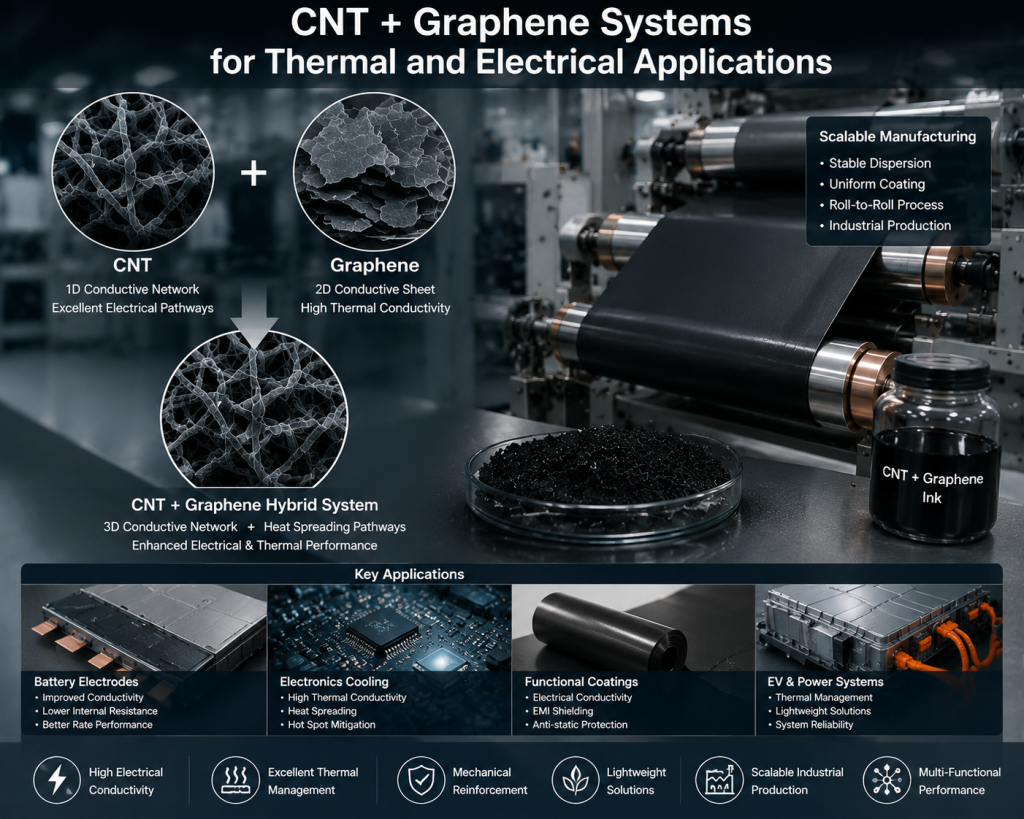
This has created growing interest in hybrid carbon systems combining carbon nanotubes (CNTs) and graphene.
By integrating the one-dimensional network structure of CNTs with the two-dimensional sheet structure of graphene, engineers can develop multifunctional materials with enhanced:
- Electrical conductivity
- Thermal transport
- Mechanical reinforcement
- Process adaptability
These hybrid carbon architectures are becoming increasingly important in batteries, electronics, thermal management systems, and functional coatings.
Understanding the Roles of CNT and Graphene
Although both materials are carbon-based, they contribute different advantages.
CNT: Building Electrical Networks
Carbon nanotubes are cylindrical carbon structures with extremely high aspect ratios.
Their unique geometry allows CNTs to create interconnected conductive pathways.
Key advantages include:
- Excellent electrical conductivity
- Low percolation threshold
- Mechanical reinforcement
- Flexible network formation
CNTs act like nanoscale conductive wires connecting separated particles and structures.
Graphene: Providing Large-Area Conductive Pathways
Graphene consists of thin carbon layers with two-dimensional structures.
Its advantages include:
- Large surface area
- Excellent in-plane thermal conductivity
- Strong mechanical properties
- Barrier performance
Graphene acts as a conductive and thermal spreading platform.
Why Combine CNT and Graphene?
Using CNT or graphene individually can provide excellent performance, but each material also has limitations.
Graphene Limitation
Graphene sheets may have difficulty forming continuous three-dimensional networks inside some composite systems.
CNT Limitation
CNT networks may provide excellent electrical connections but have limited large-area heat spreading capability.
Hybrid Solution
Combining CNT and graphene creates a complementary structure:
CNT:
Three-dimensional conductive bridges
Graphene:
Two-dimensional thermal and electrical platforms
Together they form a more complete carbon network.
Electrical Applications
Battery Conductive Networks
Battery electrodes contain active materials that often have limited electrical conductivity.
CNT + graphene systems can improve electron transport by creating interconnected conductive pathways.
Potential benefits include:
- Lower internal resistance
- Improved charge transfer
- Better high-rate performance
- Enhanced electrode stability
Applications include:
- Lithium-ion batteries
- Sodium-ion batteries
- Silicon-based electrodes
- Advanced energy storage systems
Conductive Coatings
Modern industries increasingly require functional surfaces.
CNT + graphene coatings can provide:
- Surface conductivity
- Static control
- EMI shielding
- Flexible conductive layers
Potential applications include:
- Electronic housings
- Sensors
- Industrial components
- Smart surfaces
Thermal Management Applications
As computing power increases, thermal management becomes a critical engineering challenge.
Applications include:
- AI servers
- Data centers
- Power electronics
- Electric vehicles
Graphene Contribution in Thermal Systems
Graphene helps:
- Spread heat across surfaces
- Reduce localized hot spots
- Improve thermal uniformity
It is particularly valuable in:
- Thermal films
- Heat spreading coatings
- Interface materials
CNT Contribution in Thermal Networks
CNTs help create interconnected pathways through composite materials.
They can improve:
- Thermal transport between particles
- Interface connections
- Mechanical durability
Hybrid Thermal Performance
CNT + graphene systems can provide:
- Faster heat transfer pathways
- Improved thermal stability
- Lightweight thermal solutions
This combination is especially attractive where both heat spreading and mechanical flexibility are required.
Applications in AI Infrastructure
The rapid development of AI computing is increasing thermal challenges in data centers.
High-power GPUs generate concentrated heat loads.
Future thermal solutions may require:
- Lightweight materials
- High thermal conductivity
- Thin functional coatings
- Reliable manufacturing processes
CNT + graphene hybrid materials may support:
- Thermal interface materials
- Heat spreading layers
- Conductive thermal coatings
Applications in Functional Coatings
Hybrid carbon coatings can provide multiple functions simultaneously.
Possible functions include:
Electrical Function
- Conductive pathways
- EMI shielding
- Anti-static protection
Thermal Function
- Heat dissipation
- Temperature uniformity
Protective Function
- Corrosion resistance
- Mechanical reinforcement
This multifunctionality makes hybrid carbon systems attractive for industrial applications.
Manufacturing Challenges
Although CNT + graphene systems show strong potential, industrial implementation requires solving several challenges.
Dispersion Control
CNT and graphene naturally tend to aggregate.
Poor dispersion can lead to:
- Uneven conductivity
- Performance variation
- Coating defects
Stable dispersion technology is essential.
Material Ratio Optimization
The CNT-to-graphene ratio strongly affects performance.
Too much CNT may increase cost.
Too much graphene may reduce network connectivity.
Optimization depends on the target application.
Process Compatibility
Hybrid carbon materials must be compatible with manufacturing processes such as:
- Slurry mixing
- Slot-die coating
- Roll-to-roll coating
- Spray coating
- Composite processing
The Importance of Pilot Validation
Laboratory results cannot fully represent industrial production.
Pilot manufacturing helps evaluate:
- Dispersion stability
- Coating uniformity
- Electrical performance
- Thermal performance
- Process repeatability
Pilot platforms allow engineers to optimize hybrid carbon systems before commercial production.
Future Development Trends
Multifunctional Materials
Future materials will increasingly combine:
- Electrical conductivity
- Thermal management
- Mechanical reinforcement
- Environmental protection
Advanced Energy Storage
CNT + graphene systems may support:
- Higher power batteries
- Faster charging
- More durable electrodes
Smart Manufacturing
Future production will use:
- Automated process control
- Digital monitoring
- AI-assisted optimization
to improve manufacturing consistency.
CNT and graphene represent two complementary advanced carbon materials.
CNT provides:
- Conductive network formation
- Mechanical reinforcement
- Particle connectivity
Graphene provides:
- Large-area conductivity
- Thermal spreading
- Structural enhancement
When combined, these materials create hybrid carbon systems capable of addressing both electrical and thermal challenges.
However, industrial success depends not only on material properties but also on formulation engineering, manufacturing compatibility, and pilot-scale validation.
The future of advanced carbon materials will increasingly depend on designing complete material systems that combine performance, scalability, and practical industrial application.