

CNTs in Concrete and Construction Materials – Strength, Durability, and Smart Functionality
Carbon nanotubes (CNTs) are rapidly gaining attention in the construction materials industry due to their exceptional mechanical strength, electrical conductivity, and nanoscale reinforcement capability. As global infrastructure faces rising demands for longer life cycles, higher resilience, and smart monitoring capabilities, CNT-enhanced concrete and building materials offer transformative potential.
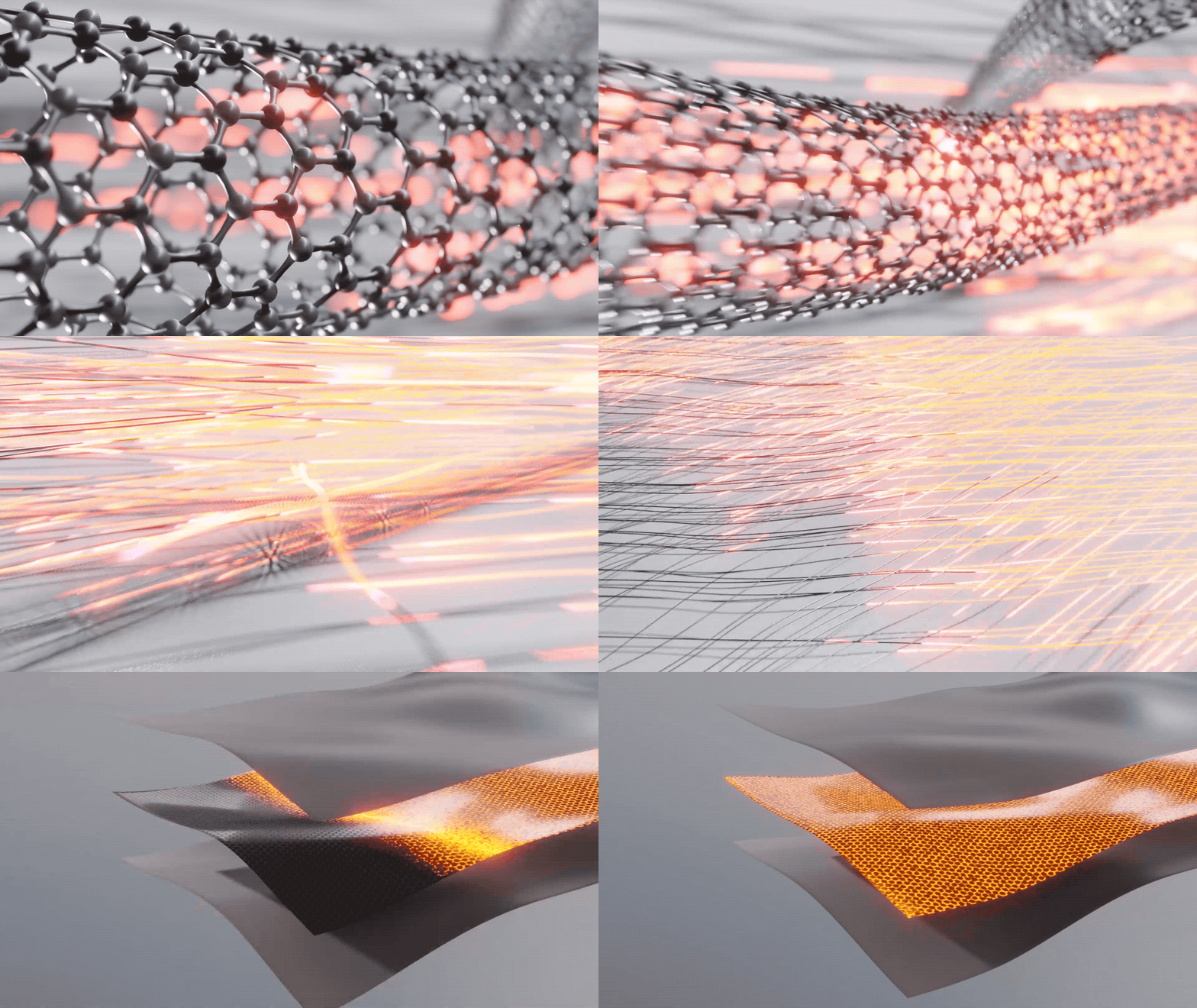
This article explores how CNTs improve concrete performance, how they enable new smart functions, current research progress, commercial applications, and real-world challenges.
1. Why Construction Needs Nano-Reinforcement
Traditional concrete, despite being the world’s most widely used building material, suffers from several inherent limitations:
-
Cracking due to shrinkage or thermal stress
-
Low tensile strength compared to compressive strength
-
Weakness in harsh environments (chloride, freeze–thaw, sulfate)
-
Poor durability for long-term heavy-load structures
-
Difficulty detecting internal damage until failure occurs
CNTs, with their superior mechanical strength (Young’s modulus >1 TPa) and electrical/thermal conductivity, provide a unique pathway for next-generation high-performance cementitious materials.
2. How CNTs Improve Concrete Performance
CNTs modify cement at the nanoscale, acting as reinforcement and crack inhibitors.
2.1 Enhanced Mechanical Strength
CNTs bridge micro-cracks during hydration and strengthen the cement matrix.
Typical improvements reported:
-
+20–50% compressive strength
-
+40–200% tensile/flexural strength
-
Improved early-stage strength
CNTs fill nanoscale voids, increasing density and decreasing porosity.
2.2 Crack Inhibition and Toughness
CNTs act as a nano-bridge across micro-cracks.
Result:
-
Delayed crack initiation
-
Reduced crack propagation
-
Improved ductility and fracture toughness
This is especially important in dams, tunnels, large-span bridges, and industrial floors.
2.3 Durability and Environmental Resistance
CNT-enhanced concrete shows:
-
Lower water absorption
-
Better chloride penetration resistance (marine structures)
-
Improved freeze–thaw stability
-
Better sulfate resistance
-
Reduced permeability
This extends the service life of critical infrastructure.
2.4 Electrical Conductivity
Even at low loadings (0.05–0.5 wt%), CNTs generate conductive networks in concrete.
This enables new smart and functional capabilities, discussed below.
3. Smart Concrete Enabled by CNTs
CNTs transform concrete from a passive structural material into an intelligent, responsive one.
3.1 Self-Sensing Concrete (Structural Health Monitoring)
CNTs allow concrete to detect:
-
stress
-
cracks
-
strain
-
deformation
-
vibration
-
load distribution
Electrical resistance changes correspond to structural changes—a built-in sensor network.
Applications:
-
Smart bridges
-
Rail transit
-
Earthquake-prone buildings
-
High-rise structures
-
Tunnels
This reduces long-term maintenance cost and improves safety.
3.2 Self-Heating Concrete for Snow and Ice Removal
CNT networks generate Joule heating under low voltage.
Benefits:
-
Melts snow/ice on roads and runways
-
Prevents freeze–thaw damage
-
Reduces use of de-icing chemicals
-
Low energy consumption due to CNT efficiency
Ideal for airport runways, highways, bridges, and parking structures.
3.3 Electromagnetic Shielding (EMI Protection)
CNT-infused concrete can:
-
block electromagnetic waves
-
protect sensitive electronic equipment
-
secure government or military facilities
CNT concrete is lighter and more durable than metal shielding structures.
3.4 Self-Curing and Improved Hydration
CNTs improve water retention and accelerate cement hydration, enhancing:
-
early strength
-
curing uniformity
-
long-term durability
4. CNT Loading Levels and Dispersion Requirements
Typical CNT content:
0.05–0.5 wt% of cementitious material.
Key requirement:
Proper dispersion is essential to prevent agglomeration.
Successful approaches:
-
surfactant-assisted mixing
-
ultrasonic dispersion
-
functionalized CNTs (COOH/OH groups)
-
pre-dispersed CNT slurries
Poor dispersion dramatically reduces performance gains.
5. Commercial Applications and Case Studies
CNT concrete is moving from labs to real-world infrastructure.
5.1 Smart Bridges
Pilot projects in China, Europe, and the U.S. use CNT-modified concrete to monitor stress and crack development.
5.2 High-Performance Industrial Flooring
CNT concrete has improved toughness and abrasion resistance for:
-
warehouses
-
factories
-
logistics centers
5.3 Airport Runways and Roads
CNT-based self-heating concrete is being tested for:
-
snow/ice melting
-
minimizing winter maintenance
-
extending pavement life
5.4 Marine and Offshore Structures
Enhanced durability in:
-
ports
-
offshore platforms
-
seawalls
5.5 Precast Structural Components
CNT integration into precast beams, columns, and panels improves quality and consistency.
6. Advantages Over Other Nanomaterials
Compared with graphene, nano-silica, or carbon fibers:
| Property | CNTs | Graphene | Nano-silica | Carbon fibers |
|---|---|---|---|---|
| Crack bridging (nano-scale) | ⭐⭐⭐⭐⭐ | ⭐⭐⭐⭐ | ⭐ | ⭐⭐⭐ |
| Electrical conductivity | ⭐⭐⭐⭐⭐ | ⭐⭐⭐⭐ | ⭐ | ⭐ |
| Toughness | ⭐⭐⭐⭐⭐ | ⭐⭐⭐ | ⭐⭐ | ⭐⭐⭐⭐⭐ |
| Dispersion challenge | High | Medium | Low | Low |
| Cost | Medium-high | Medium | Low | Medium |
CNTs remain the strongest choice for smart functionality + mechanical improvement.
7. Challenges and Industry Adoption Barriers
1. Cost
CNTs are still more expensive than traditional admixtures, but:
-
demand growth
-
global capacity expansion
-
improved production efficiency
are reducing costs year by year.
2. Dispersion Difficulty
Agglomeration reduces performance. Pre-dispersed CNT slurries are the most reliable approach.
3. Standardization
Lack of unified standards for:
-
CNT loading ratios
-
mechanical property benchmarks
-
smart sensing calibration
is slowing large-scale adoption.
4. Construction Industry Conservatism
Construction companies require:
-
long-term durability data
-
regulatory certification
-
large-scale validation
before switching from traditional materials.
8. Future Outlook
CNTs will play a major role in next-generation infrastructure:
• Smart cities with self-sensing concrete
• Long-lasting bridges, tunnels, and highways
• Energy-efficient heated pavements
• Carbon-neutral construction with higher longevity
• Lightweight, high-strength prefabricated components
As material costs drop and standards mature, CNT-enhanced cementitious materials will enter mainstream engineering.
Carbon nanotubes provide a powerful nanotechnology solution to enhance and transform concrete and construction materials. Beyond mechanical reinforcement, CNTs introduce entirely new functionalities—structural health monitoring, heating, EMI shielding, and improved durability. With growing global infrastructure needs, CNT concrete is well-positioned to become a core material in the future of smart and resilient construction.