

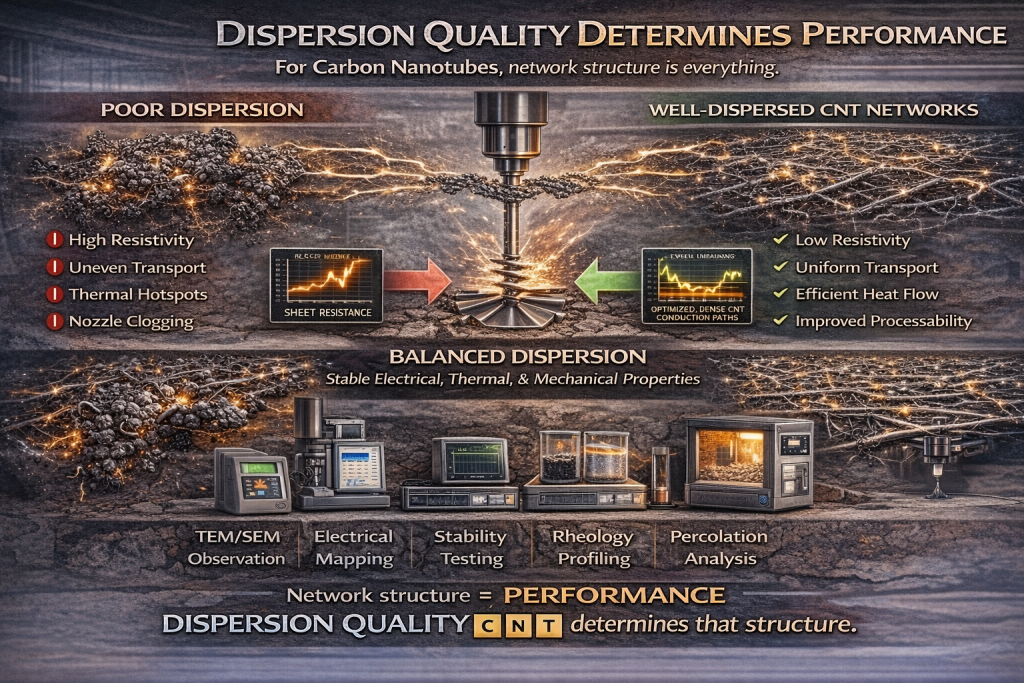
Dispersion Quality Determines Performance
For Carbon Nanotubes, network structure is everything.
When working with Carbon Nanotubes (CNTs), many teams focus on:
-
Purity
-
Aspect ratio
-
Diameter
-
Electrical conductivity (intrinsic)
But in real applications, one factor outweighs all others:
Dispersion quality determines final performance.
Not material spec.
Not supplier brochure data.
Not even CNT type alone.
Why CNTs Are Especially Sensitive to Dispersion
CNTs have:
-
Extremely high aspect ratio
-
Strong van der Waals attraction
-
Natural entanglement tendency
-
Agglomerated powder form
This makes them:
✔ Powerful for forming conductive networks
✘ Difficult to disperse uniformly
Poor dispersion destroys the very network they are valued for.
What “Good Dispersion” Actually Means
Many assume dispersion is “good” when:
-
No visible clumps
-
Looks uniform under simple mixing
But true high-quality dispersion requires:
-
Individual tube separation (or small bundles)
-
Controlled network formation
-
Stable rheology
-
Minimal re-agglomeration
-
Reproducible electrical results
Visual uniformity ≠ functional dispersion.
How Dispersion Affects Performance
1️⃣ Electrical Conductivity
CNTs rely on forming a percolation network.
If dispersion is:
Too aggregated → uneven pathways
Too over-dispersed → network breaks
Poorly controlled → unstable conductivity
The result?
-
High resistivity
-
Large batch variation
-
Unstable Joule heating
2️⃣ Mechanical Reinforcement
Well-dispersed CNTs:
-
Transfer stress efficiently
-
Improve crack resistance
-
Increase toughness
Agglomerated CNTs:
-
Act as stress concentrators
-
Reduce composite reliability
Mechanical performance depends on distribution quality, not loading alone.
3️⃣ Thermal Pathways
CNTs can enhance thermal transport—but only if:
-
They form continuous pathways
-
Contact resistance is minimized
-
Bundling is controlled
Clusters increase interface resistance.
Uniform dispersion improves effective heat flow.
4️⃣ Rheology & Processability
CNTs strongly influence viscosity.
Poor dispersion leads to:
-
Thickening
-
Thixotropy instability
-
Print nozzle clogging
-
Coating streaks
Well-controlled dispersion allows:
-
Predictable viscosity
-
Stable coating thickness
-
Scalable production
The Over-Dispersion Trap
Many teams try to “solve” aggregation by applying extreme shear or ultrasonication.
But excessive dispersion can:
-
Shorten nanotubes
-
Damage structure
-
Reduce aspect ratio
-
Destroy conductive efficiency
More shear does not mean better performance.
Balance matters.
Powder vs Masterbatch vs Slurry
The dispersion challenge shifts depending on format:
Powder CNT
-
Maximum flexibility
-
Highest dispersion responsibility
CNT Masterbatch
-
Pre-optimized dispersion
-
Easier scale-up
CNT Slurry
-
Controlled initial dispersion
-
Stability becomes key
Performance consistency depends on how dispersion is engineered—not just supplied.
Signs Dispersion Is the Real Issue
If you see:
-
Conductivity fluctuating between batches
-
Increasing resistance over time
-
Uneven heating in coatings
-
Mechanical property scatter
-
Sedimentation during storage
The root cause is often dispersion quality.
How Professionals Evaluate CNT Dispersion
Advanced evaluation methods include:
-
TEM/SEM observation
-
Rheology profiling
-
Percolation threshold analysis
-
Stability testing
-
Electrical mapping across coatings
-
Accelerated aging studies
Peak conductivity is less important than stable conductivity.
Practical Takeaway
High-performance CNT products are not created by:
-
Buying the highest purity
-
Increasing loading
-
Maximizing aspect ratio
They are created by:
Engineering dispersion quality to control network formation.
Because in CNT systems:
Network structure = performance.
And dispersion determines that structure.