

From Conductive Materials to Industrial Coating Systems
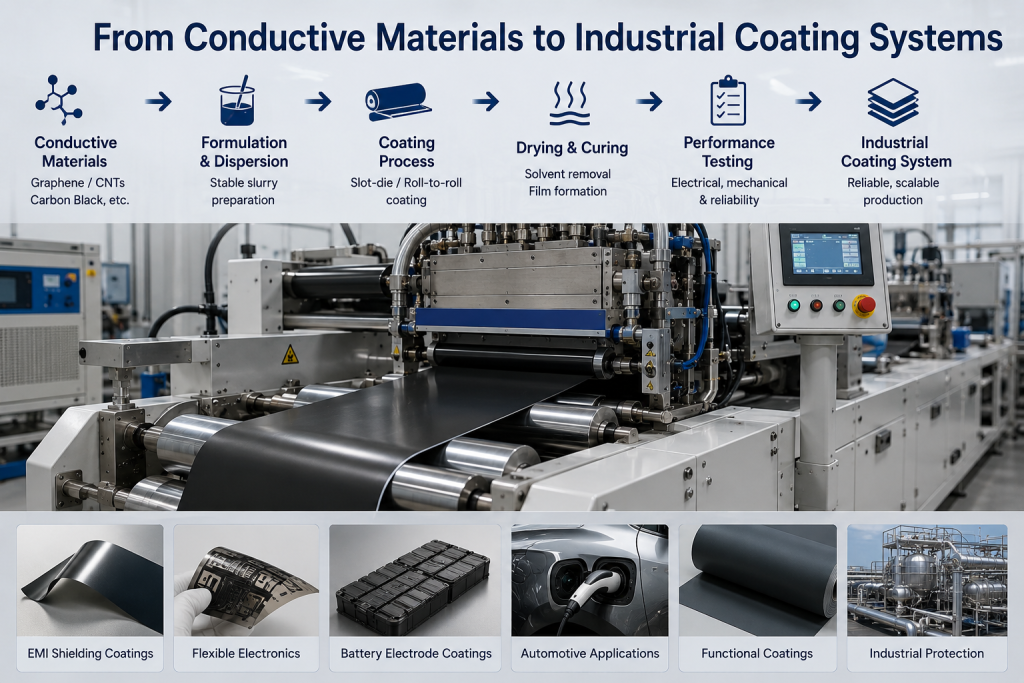
Conductive materials have become essential components in modern industrial technologies.
From electronics and energy storage to aerospace, automotive, telecommunications, and smart manufacturing, industries increasingly rely on conductive materials to improve product performance and enable new functionalities.
However, successful industrial applications require much more than selecting a highly conductive material.
Graphene, carbon nanotubes (CNTs), conductive carbon black, metal powders, and hybrid fillers each offer unique electrical properties, but they cannot deliver consistent results without proper formulation, coating processes, and manufacturing control.
This is why the industry is shifting its focus from individual conductive materials toward complete industrial coating systems—integrated solutions that combine material science, process engineering, and scalable production.
Conductive Materials Are Only the Starting Point
A material with excellent electrical conductivity does not automatically become an effective industrial coating.
Industrial performance depends on how the conductive material interacts with:
- Resin systems
- Solvents
- Dispersants
- Binders
- Additives
- Coating equipment
- Curing processes
Only when these elements work together can the coating deliver reliable electrical performance in real-world applications.
Common Conductive Materials Used in Industrial Coatings
Several conductive materials are widely used today.
Graphene
Graphene offers:
- High electrical conductivity
- Excellent thermal conductivity
- Large surface area
- Mechanical reinforcement
- Barrier properties
It is increasingly used in conductive coatings, thermal management films, EMI shielding, and anticorrosion systems.
Carbon Nanotubes (CNTs)
CNTs create interconnected conductive networks because of their extremely high aspect ratio.
Typical applications include:
- Battery electrodes
- Conductive coatings
- Flexible electronics
- Electrostatic discharge (ESD) protection
Their ability to maintain conductivity at relatively low loading levels makes them highly attractive for advanced formulations.
Conductive Carbon Black
Conductive carbon black remains one of the most widely used conductive fillers due to its:
- Cost-effectiveness
- Established manufacturing processes
- Reliable electrical performance
It is commonly used where balanced performance and economic efficiency are required.
Hybrid Conductive Systems
Many industrial formulations combine multiple conductive materials.
Examples include:
- Graphene + CNTs
- CNTs + Carbon Black
- Graphene + Metal Fillers
- Multi-carbon composite systems
Hybrid formulations often provide better balance between conductivity, processability, durability, and cost.
From Materials to Functional Formulations
Industrial coatings require carefully engineered formulations rather than individual raw materials.
A typical conductive coating formulation includes:
- Conductive fillers
- Polymer binder
- Solvent or water-based carrier
- Dispersing agents
- Rheology modifiers
- Performance additives
Each component influences both manufacturing behavior and final coating performance.
Optimizing the formulation is often one of the most important steps in product development.
Achieving Stable Dispersion
Uniform dispersion is critical for conductive coatings.
Poor dispersion may result in:
- Agglomeration
- Non-uniform conductivity
- Surface defects
- Poor coating appearance
- Reduced product reliability
Industrial dispersion processes often involve:
- High-shear mixing
- Rotor-stator systems
- Media milling
- Process monitoring
Maintaining dispersion consistency becomes increasingly important during pilot and commercial production.
Coating Process Selection
The coating method directly influences product quality and manufacturing efficiency.
Depending on the application, manufacturers may use:
Slot-Die Coating
Providing precise thickness control and excellent scalability for continuous production.
Roll-to-Roll Coating
Ideal for high-volume flexible substrates.
Spray Coating
Suitable for complex geometries and large surfaces.
Gravure Coating
Often used for thin functional films and printed electronics.
Selecting the appropriate coating technology depends on material properties, substrate type, and production requirements.
Drying and Curing
After coating, the film must be properly dried or cured to achieve its designed performance.
Key objectives include:
- Removing solvents
- Forming conductive pathways
- Improving adhesion
- Stabilizing film structure
- Achieving long-term durability
Improper drying conditions may lead to cracking, shrinkage, binder migration, or inconsistent electrical properties.
Process optimization is therefore essential.
Performance Evaluation
Industrial coating systems are evaluated using multiple performance criteria.
Electrical Performance
Typical measurements include:
- Surface resistance
- Volume resistivity
- Conductivity
- Charge dissipation
Mechanical Performance
Testing may include:
- Adhesion
- Flexibility
- Scratch resistance
- Wear resistance
Thermal Performance
For multifunctional coatings, thermal conductivity and heat dissipation capability are also evaluated.
Environmental Durability
Industrial coatings must withstand:
- Humidity
- Temperature cycling
- UV exposure
- Chemical environments
- Long-term aging
These tests ensure the coating performs reliably throughout its service life.
The Importance of Pilot Manufacturing
Many conductive coating formulations demonstrate promising laboratory results.
However, successful commercialization requires validation under production-like conditions.
Pilot manufacturing helps evaluate:
- Dispersion stability
- Continuous coating performance
- Drying behavior
- Process repeatability
- Batch-to-batch consistency
Pilot-scale testing reduces technical risk before commercial production begins.
Applications Across Industries
Industrial conductive coating systems are widely used in:
Electronics
Providing conductivity, EMI shielding, and ESD protection.
Energy Storage
Supporting battery components, current collectors, and electronic control systems.
Automotive
Enhancing sensors, battery systems, and electronic modules.
Aerospace
Reducing weight while maintaining electrical functionality.
Industrial Equipment
Protecting sensitive electronics and improving operational reliability.
As industries become increasingly electrified and connected, demand for advanced conductive coating systems continues to grow.
Future Trends
Several developments are shaping the future of conductive coating systems.
Multifunctional Coatings
Combining conductivity, thermal management, corrosion protection, and mechanical durability within a single coating.
Sustainable Manufacturing
Increasing adoption of water-based systems and energy-efficient production processes.
Advanced Carbon Materials
Greater integration of graphene, CNTs, and hybrid carbon technologies.
Intelligent Manufacturing
Using digital monitoring and process automation to improve coating consistency and manufacturing efficiency.
These trends are driving the evolution from individual conductive materials toward fully integrated industrial coating solutions.
Conductive materials are the foundation of modern functional coatings, but they represent only one part of a successful industrial solution.
True commercialization requires the integration of material selection, formulation design, dispersion technology, coating processes, drying optimization, quality control, and pilot-scale validation.
By viewing conductive materials as components of complete industrial coating systems rather than standalone products, manufacturers can achieve greater consistency, scalability, and long-term performance.
As advanced carbon materials continue to evolve, the future of conductive coatings will increasingly depend on integrated engineering solutions that combine innovative materials with reliable manufacturing processes.
- What is an industrial conductive coating system?
- How are graphene and CNTs used in conductive coatings?
- Why is dispersion important in conductive coatings?
- What coating methods are used for conductive materials?
- Why is pilot manufacturing essential for coating commercialization?
- How do conductive materials become scalable industrial coating solutions?