
From Lab Materials to Pilot Production: Bridging the Scale-Up Gap
In advanced materials and energy storage industries, one of the biggest challenges is not discovery—but scale-up. Many promising materials perform well in the lab but fail during industrialization due to process instability, incompatibility, or cost constraints.
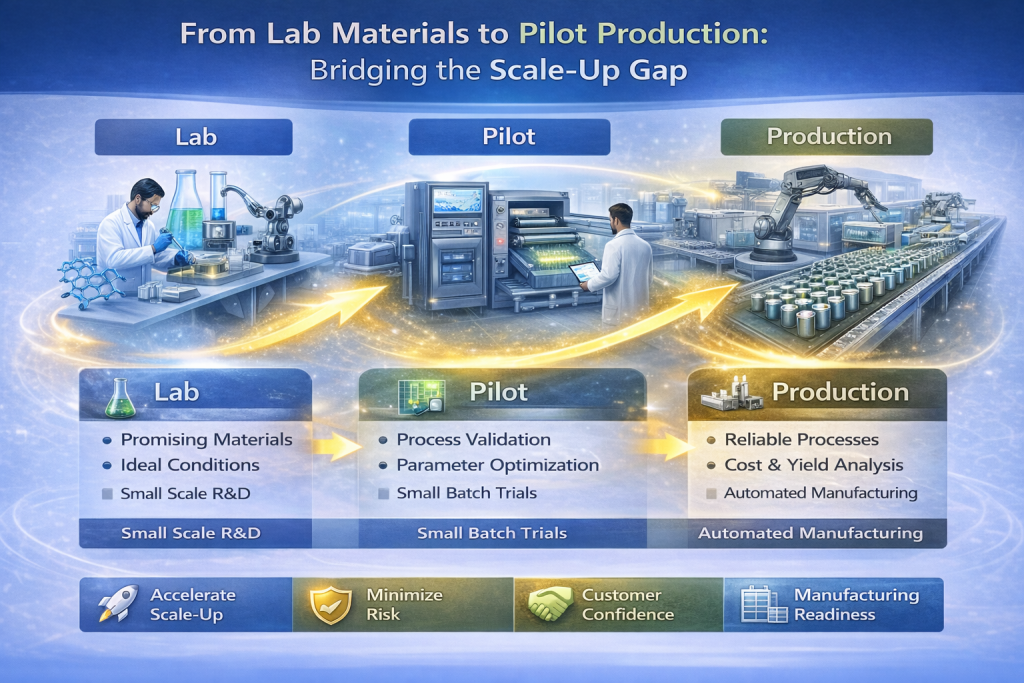
Bridging this gap requires a structured approach that connects laboratory innovation with pilot-scale validation and manufacturing readiness.
What Is the Scale-Up Gap?
The scale-up gap refers to the disconnect between:
- Lab-scale success (mg–g level, ideal conditions)
- Industrial production (kg–ton level, real constraints)
Typical issues include:
- Material behavior changes at larger scale
- Process parameters not transferable
- Equipment limitations
- Cost and yield challenges
Why Lab Results Don’t Translate Directly
1. Process Sensitivity
Small changes in:
- Mixing
- Coating speed
- humidity
can significantly impact performance at scale.
2. Material–Process Coupling
At lab level:
- Materials are often tested in ideal conditions
At pilot level:
- Materials must work within real manufacturing constraints
3. Equipment Differences
- Lab tools → high precision, low throughput
- Industrial tools → high throughput, less forgiving
This creates process adaptation challenges.
Role of Pilot Production in Bridging the Gap
Pilot production acts as the critical transition layer between lab and mass production.
It enables:
Process Validation
- Can the material be coated, dried, assembled consistently?
Parameter Optimization
- Define coating thickness, ताप度 windows, दबाव conditions
Compatibility Testing
- Interaction with binders, substrates, other materials
Sample Output
- Produce engineering samples for customer validation
Key Steps in Bridging Lab to Pilot
1. Material Down-Selection
- Choose formulations that are scalable, not just high-performing
2. Process Mapping
- Translate lab steps into industrial process equivalents
Example:
Drop-casting → Slot-die coating
3. Pilot Trials
- Small batch production under semi-industrial conditions
- Identify failure modes early
4. Data Feedback Loop
- Feed pilot results back to material design
- Iteratively optimize
5. Pre-Production Validation
- Stability testing
- Reproducibility
- Yield estimation
Common Bottlenecks
- Dispersion stability at scale
- Coating uniformity issues
- Drying and solvent management
- Interface compatibility
- Process window too narrow
Strategic Value of Bridging the Gap
Companies that master this transition gain:
- Faster time-to-market
- Lower scale-up risk
- Better customer confidence
- Stronger commercialization capability
Application Examples
Battery Materials
- Graphene / CNT conductive networks
- Solid-state electrolytes
- High-loading electrodes
Functional Coatings
- Anticorrosion coatings
- EMI shielding coatings
- Thermal interface materials
Advanced Composites
- Lightweight structural materials
- Electrically conductive polymers
Future Trends
- Integrated lab–pilot platforms
- Digital twins for scale-up simulation
- AI-driven process optimization
- Modular pilot lines for flexible materials
The transition from lab to production is where most innovations fail—but also where the most value is created.
By leveraging pilot production, process engineering, and iterative validation, companies can successfully bridge the scale-up gap and turn promising materials into real industrial solutions.