

Graphene Anticorrosion Coatings: How They Work
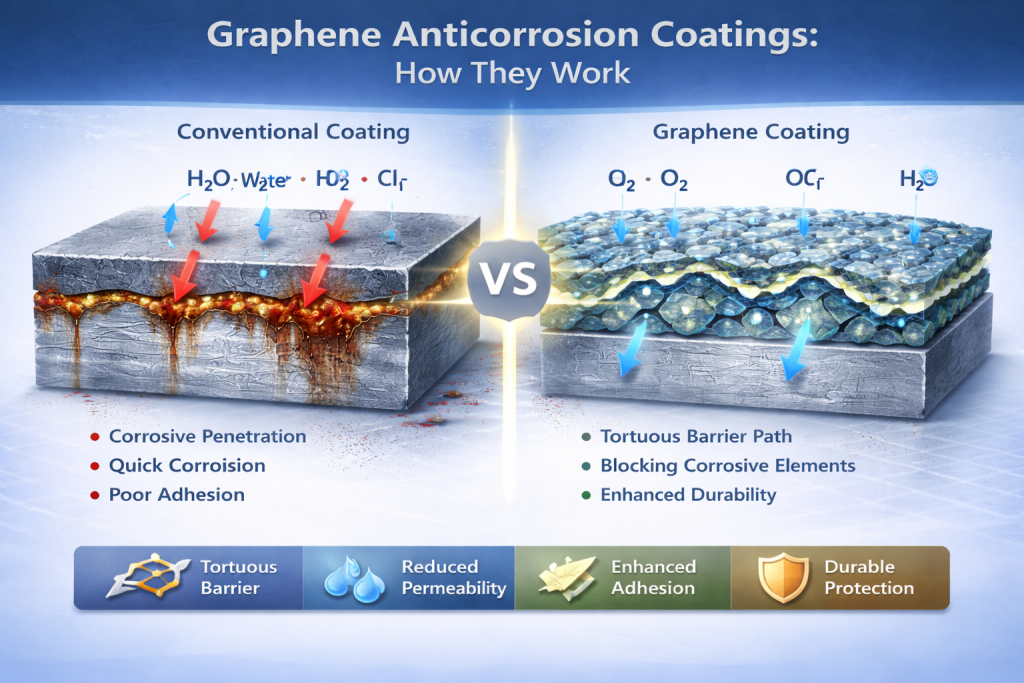
Corrosion is one of the most costly and persistent challenges in industries such as oil & gas, marine, infrastructure, and transportation. Traditional protective coatings often degrade over time due to moisture penetration, chemical attack, and mechanical wear.
Graphene anticorrosion coatings are emerging as a high-performance solution, offering superior barrier properties, durability, and multifunctionality compared to conventional systems.
What Is Corrosion and Why It Matters
Corrosion is the electrochemical degradation of metals caused by reactions with the environment—primarily involving water, oxygen, and ions.
Common consequences include:
- Structural weakening
- Increased maintenance costs
- Safety risks
- Reduced service life
Effective coatings must prevent or slow down these reactions.
Why Graphene Is Effective for Anticorrosion
Graphene possesses unique properties that make it highly suitable for corrosion protection:
- Impermeability – Nearly impenetrable to gases and liquids
- High aspect ratio – Creates long diffusion pathways
- Chemical stability – Resistant to harsh environments
- Mechanical strength – Enhances coating durability
These properties enable graphene to act as a next-generation barrier material.
Core Mechanisms of Graphene Anticorrosion Coatings
1. Barrier Effect (Primary Mechanism)
Graphene sheets create a tortuous path for corrosive species such as water, oxygen, and chloride ions.
- Slows down diffusion dramatically
- Reduces contact between metal and environment
- Extends coating lifetime
This is the most important mechanism.
2. Reduced Permeability
Even at low loading levels, graphene can:
- Decrease porosity in coatings
- Block micro-defects and pinholes
This improves overall coating integrity.
3. Enhanced Adhesion
Functionalized graphene improves bonding between:
- Coating and substrate
- Coating layers
Better adhesion reduces the risk of:
- Delamination
- Crack propagation
4. Mechanical Reinforcement
Graphene enhances:
- Scratch resistance
- Abrasion resistance
- Flexibility
This helps coatings maintain protection under mechanical stress.
5. Electrochemical Protection (Secondary Effect)
In some systems, graphene can:
- Influence electron transfer processes
- Reduce corrosion reaction rates
However, improper formulation may lead to galvanic effects, so system design is critical.
Types of Graphene Used in Coatings
Different forms of graphene are used depending on application:
- Graphene nanoplatelets (GNPs) – Cost-effective, widely used
- Graphene oxide (GO) – Good dispersion, functional groups for bonding
- Reduced graphene oxide (rGO) – Balance of conductivity and processability
Selection depends on performance requirements and formulation strategy.
Key Industrial Applications
1. Marine Coatings
- Ship hulls
- Offshore platforms
- Port infrastructure
Benefits: Saltwater resistance and long-term durability
2. Oil & Gas Industry
- Pipelines
- Storage tanks
- Refineries
Benefits: Resistance to chemicals and harsh environments
3. Infrastructure
- Bridges
- Steel structures
- Reinforced concrete
Benefits: Extended service life and reduced maintenance
4. Automotive and Transportation
- Chassis and body components
- Battery enclosures
Benefits: Lightweight protection and durability
Performance Advantages Over Traditional Coatings
| Property | Graphene Coatings | Conventional Coatings |
|---|---|---|
| Barrier Performance | Excellent | Moderate |
| Coating Thickness | Thinner | Thicker required |
| Durability | High | Medium |
| Corrosion Resistance | Superior | Standard |
| Maintenance Frequency | Lower | Higher |
Formulation and Processing Considerations
Dispersion Quality
- Uniform graphene distribution is essential
- Agglomeration reduces effectiveness
Optimal Loading
- Too little → limited protection
- Too much → processing and cost issues
Compatibility with Resins
- Epoxy, polyurethane, and other systems must be optimized
- Functionalization improves integration
Application Method
- Spray, रोल, dip coating depending on use case
- Scalable industrial processes are available
Challenges
- Cost vs performance balance
- Scalable dispersion technology
- Standardization and certification
- Long-term field validation
Future Trends
- Hybrid coatings (Graphene + CNTs + nanoclays)
- Smart coatings with self-healing properties
- Multi-functional systems (anticorrosion + EMI + thermal)
- Eco-friendly, water-based formulations
Graphene anticorrosion coatings work primarily by creating an ultra-effective barrier that blocks the penetration of corrosive agents while enhancing the mechanical and chemical stability of the coating system.
As industries demand longer-lasting and more efficient protection solutions, graphene-based coatings offer a scalable pathway to significantly improved corrosion resistance and reduced lifecycle costs.