
Graphene Thermal Pastes and Slurries – Formulation Logic
1. Why Graphene Thermal Formulations Matter
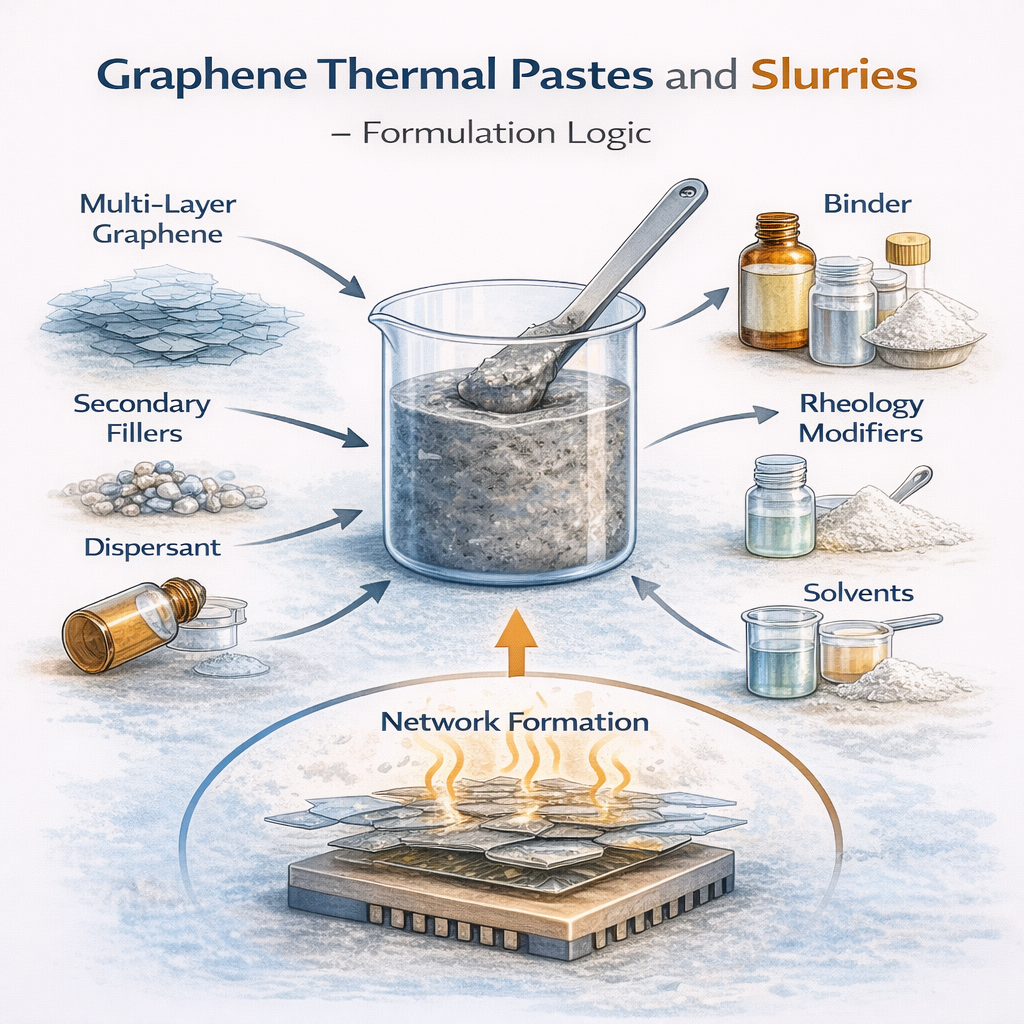
Graphene has extremely high intrinsic in-plane thermal conductivity, but in real applications—thermal pastes, coatings, and slurries—performance depends far more on formulation design than on raw material specifications.
A well-designed graphene thermal paste must balance:
-
Thermal conductivity
-
Processability
-
Stability
-
Interface contact
-
Cost
The challenge is not simply adding graphene—it is building an effective heat-transfer network within a workable formulation.
2. Thermal Pastes vs Slurries: Understanding the Difference
Although often grouped together, thermal pastes and thermal slurries serve different roles.
Thermal Pastes
-
High viscosity
-
Used as TIMs
-
Filled interfaces
-
Pressure-assisted contact
-
Controlled thickness
Thermal Slurries
-
Lower viscosity
-
Used for coatings or impregnation
-
Spray / brush / slot-die processes
-
Film-forming after drying or curing
Both rely on graphene networks, but their formulation priorities differ.
3. Core Components of Graphene Thermal Systems
A graphene thermal formulation typically includes:
-
Graphene or graphene-derived filler
-
Binder or matrix
-
Secondary fillers
-
Dispersants
-
Rheology modifiers
-
Solvent or carrier system
Each component influences thermal performance and stability.
4. Choosing the Right Graphene Type
Different graphene materials behave differently in formulations.
| Material | Typical Role |
|---|---|
| Multi-layer graphene | Main thermal network |
| Few-layer graphene | High conductivity boost |
| Graphene oxide (GO) | Dispersion aid |
| Reduced GO (rGO) | Thermal conductivity balance |
| Graphene nanoplatelets | Cost-effective spreading |
Multi-layer graphene is most commonly used in industrial thermal pastes due to:
-
Processability
-
Stability
-
Cost-performance balance
5. Network Formation: The True Performance Driver
Thermal conductivity increases when graphene forms:
-
Overlapping sheets
-
Continuous pathways
-
Low-resistance junctions
Key formulation goal:
Maximize network continuity at the lowest possible loading
Too little graphene → isolated flakes
Too much graphene → viscosity spike and agglomeration
Most systems reach optimal efficiency in the 5–20 wt% graphene range, depending on application.
6. Hybrid Filler Strategy
Pure graphene rarely delivers optimal performance alone.
Hybrid systems often include:
-
CNTs for bridging
-
Ceramic fillers for through-plane conduction
-
Metal particles for contact improvement
Benefits:
-
Lower graphene loading required
-
Better packing density
-
Reduced thermal contact resistance
Hybridization is often the most cost-effective route.
7. Dispersion Strategy
Dispersion determines:
-
Percolation threshold
-
Stability
-
Long-term performance
Key dispersion factors:
-
Mixing energy
-
Solvent compatibility
-
Surface functionalization
-
Addition sequence
Over-shearing can damage graphene sheets and reduce aspect ratio.
Under-shearing leaves agglomerates.
The goal is controlled exfoliation without structural damage.
8. Viscosity vs Thermal Conductivity Trade-Off
Increasing graphene loading improves conductivity but also increases viscosity.
Excess viscosity causes:
-
Poor coating
-
Trapped air
-
High contact resistance
-
Assembly difficulty
Engineering sweet spot:
-
Adequate network formation
-
Acceptable flow behavior
-
Stable film formation
This balance defines commercial success.
9. Interface Contact Is Often the Limiting Factor
In real assemblies, thermal resistance is dominated by:
-
Surface roughness
-
Micro-gaps
-
Air pockets
Graphene pastes must:
-
Conform to surfaces
-
Fill microvoids
-
Maintain stable contact over time
Soft matrices with well-dispersed graphene often outperform rigid high-loading systems.
10. Stability and Storage Considerations
Graphene slurries must remain stable during storage.
Common issues:
-
Sedimentation
-
Agglomeration
-
Viscosity drift
Stability strategies:
-
Density matching
-
Controlled particle size
-
Proper dispersants
-
Rheology tuning
Shelf stability is as important as thermal performance.
11. Processing Method Influences Formulation
Different application methods require different rheology:
| Method | Key Requirement |
|---|---|
| Screen printing | Thixotropic |
| Spray coating | Low viscosity |
| Dispensing | Shear thinning |
| Slot-die coating | Stable flow |
Formulation must match the process.
12. Cost–Performance Optimization
Graphene is a premium filler.
Adding more does not always improve performance proportionally.
Cost-effective strategies:
-
Hybrid fillers
-
Network optimization
-
Dispersion improvement
-
Interface engineering
The best formulation is not the one with the highest graphene content, but the one with the highest thermal efficiency per unit cost.
13. Engineering Takeaways
-
Graphene performance depends on network design
-
Dispersion quality shifts percolation behavior
-
Hybrid fillers often outperform pure graphene
-
Interface resistance dominates real systems
-
Viscosity must be engineered alongside conductivity
Graphene thermal pastes and slurries are not defined by graphene alone—they are defined by formulation logic.
Effective thermal systems require:
-
Controlled dispersion
-
Optimized filler loading
-
Strong interface contact
-
Stable processing behavior
When these elements align, graphene-based formulations can deliver reliable, scalable thermal performance across electronics, energy systems, and industrial applications.