
How Can Graphene Producers Improve Manufacturing Consistency?
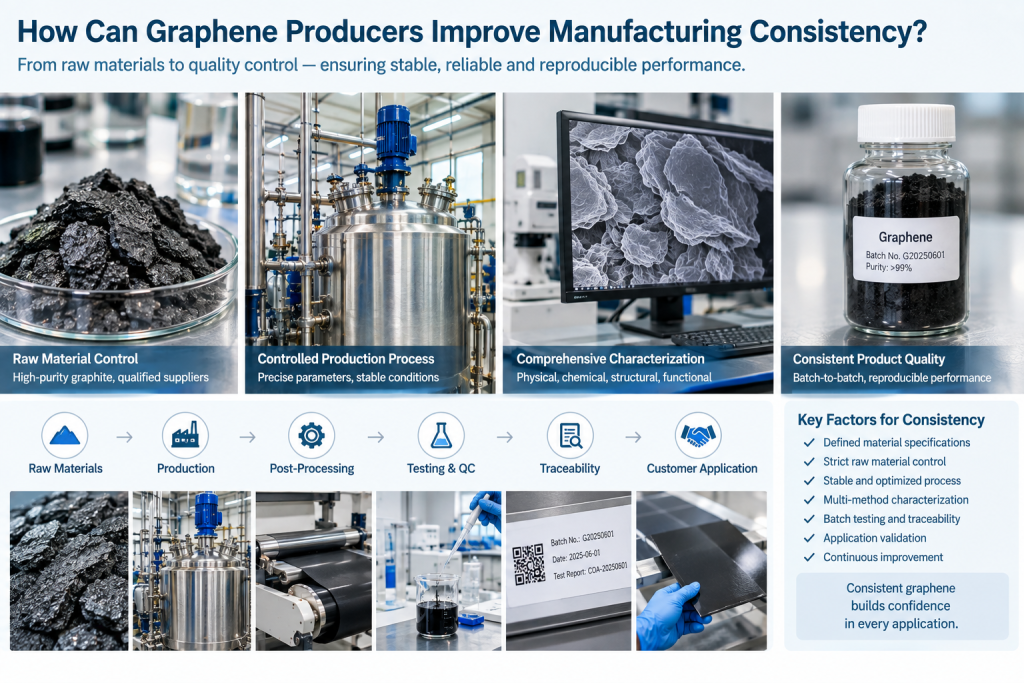
As graphene moves from laboratory research toward industrial applications, manufacturing consistency becomes one of the most important requirements for commercial success.
A graphene material may demonstrate excellent performance during initial laboratory testing. However, if the properties change significantly from one production batch to another, customers may experience unexpected differences in:
- Dispersion behavior
- Electrical conductivity
- Thermal performance
- Mechanical properties
- Coating performance
- Composite processing
- Electrochemical performance
For industrial customers, a material that performs exceptionally well in one batch but differently in the next can be difficult to qualify for long-term production.
This is why graphene producers need to control more than the final product.
A reliable manufacturing system should control the complete chain:
Raw Materials → Production Process → Post-Processing → Characterization → Batch Release → Packaging → Customer Feedback
The goal is not simply to produce graphene with high performance.
The goal is to produce graphene with predictable and reproducible performance.
1. Why Is Graphene Manufacturing Consistency Difficult?
Graphene is not a single standardized material.
Different production methods can produce materials with significantly different characteristics.
Important variables may include:
- Number of layers
- Lateral size
- Thickness
- Surface area
- Defect density
- Carbon purity
- Oxygen content
- Functional groups
- Electrical conductivity
- Thermal conductivity
- Moisture content
- Bulk density
- Morphology
- Dispersion behavior
Two products may both be described commercially as “graphene nanoplatelets” while behaving differently in a customer’s formulation.
This creates a fundamental challenge:
A commercial graphene specification needs to describe the properties that actually control application performance.
2. Start With a Clear Material Specification
One of the first steps toward manufacturing consistency is establishing a well-defined product specification.
A specification should not simply state:
“High-quality graphene.”
That description is too broad for industrial qualification.
Instead, producers should define measurable parameters relevant to the intended application.
Depending on the graphene type and application, these may include:
Physical Properties
- Particle size distribution
- Thickness or layer distribution
- Specific surface area
- Bulk density
- Moisture content
Chemical Properties
- Carbon content
- Ash content
- Oxygen content
- Residual chemicals
- Functional group concentration
Structural Properties
- Raman characteristics
- Crystallinity
- Defect level
- Layer structure
Functional Properties
- Electrical conductivity
- Thermal conductivity
- Dispersion behavior
- Surface energy
- Application-specific performance
Not every parameter needs to become a release specification.
The key is to identify the critical quality attributes that have the strongest relationship with customer performance.
3. Control Raw Material Variability
Manufacturing consistency begins before graphene production starts.
Raw materials can introduce significant variation into the final product.
Depending on the production technology, important inputs may include:
- Graphite feedstock
- Chemical reagents
- Solvents
- Reducing agents
- Functionalization reagents
- Process gases
- Water
- Other additives
For natural graphite-based processes, the source and grade of graphite can affect:
- Purity
- Flake size
- Crystallinity
- Impurity profile
- Oxidation behavior
- Final graphene structure
Therefore, producers should establish incoming raw material specifications and supplier controls.
A robust system can include:
Supplier Qualification → Incoming Inspection → Lot Identification → Production Traceability
This allows manufacturers to determine whether an unexpected change in graphene performance originated from the production process or from the incoming material.
4. Control the Production Process, Not Just the Final Product
Final-product testing is essential, but it cannot compensate for an unstable production process.
Graphene producers should identify the process parameters that have the greatest influence on product characteristics.
Depending on the manufacturing technology, these may include:
- Reaction temperature
- Reaction time
- Pressure
- Feed rate
- Mixing intensity
- Chemical concentration
- Gas flow
- Exfoliation energy
- Reduction conditions
- Washing conditions
- Drying temperature
- Post-treatment conditions
These parameters should be monitored and controlled within defined process windows.
The objective is to move from:
“Test the product and see whether it passes.”
toward:
“Control the process so that the product is consistently produced within specification.”
5. Use Statistical Process Control
For mature production, manufacturers can use statistical methods to monitor process stability.
Important quality characteristics can be tracked over time rather than evaluated only on an individual batch basis.
For example, a producer could monitor:
- Carbon content
- Moisture
- Particle size
- Surface area
- Raman parameters
- Electrical conductivity
- Bulk density
If a parameter gradually moves toward one specification limit, this may indicate process drift even if the current batch still passes.
This creates an opportunity for preventive process adjustment before a batch fails.
The value of statistical process control is therefore not only identifying bad batches.
It is identifying process trends before they become quality problems.
6. Establish Batch-to-Batch Testing
Every production batch should be associated with a defined quality-control program.
Depending on the material and application, batch testing may include:
Basic QC
- Appearance
- Moisture
- Ash
- Carbon content
- Particle size
Structural Characterization
- Raman spectroscopy
- SEM
- TEM
- XRD
- BET surface area
Functional Testing
- Electrical conductivity
- Thermal performance
- Dispersion behavior
- Application-specific testing
The testing package should be proportional to the customer’s requirements.
A research-grade graphene product may require a different QC approach from graphene intended for industrial coatings or battery electrode applications.
7. Do Not Rely on a Single Characterization Method
Graphene is a complex material, and no single analytical technique can fully describe it.
For example:
Raman Spectroscopy
Can provide information about graphene structure and defect-related characteristics.
SEM
Can provide information about morphology and particle structure.
TEM
Can provide more detailed information about layer and structural characteristics.
BET
Can help evaluate specific surface area.
XRD
Can provide information related to structural ordering and layer spacing.
TGA
Can help evaluate thermal behavior and composition.
Electrical Testing
Can provide information relevant to conductive applications.
The important point is that these methods answer different questions.
A producer should therefore build a characterization package based on the critical properties of the product, rather than using analytical techniques simply because they are available.
8. Connect Material Properties With Application Performance
One of the most valuable steps in graphene manufacturing is establishing a relationship between material properties and customer performance.
For example:
Specific Surface Area
↓
Dispersion behavior
↓
Coating uniformity
↓
Final coating performance
Or:
Graphene Structure
↓
Electrical conductivity
↓
Conductive network
↓
Electrode performance
Or:
Surface Chemistry
↓
Polymer compatibility
↓
Dispersion stability
↓
Composite mechanical properties
These relationships help producers determine which quality parameters are truly critical.
This is more useful than simply generating a long list of laboratory characterization data.
9. Control Dispersion Performance
For many commercial graphene applications, dispersion behavior may be more important than the appearance of the dry powder.
A graphene product can have excellent Raman results and high carbon purity but still perform poorly in a customer’s coating or polymer system if it is difficult to disperse.
Therefore, application-specific dispersion testing can be valuable.
Depending on the application, producers may evaluate:
- Dispersion time
- Dispersion stability
- Viscosity
- Particle/agglomerate size
- Sedimentation
- Optical uniformity
- Coating quality
For graphene-based coatings, for example, a producer may need to evaluate the graphene not only as a powder but as part of a representative coating formulation.
This creates a much stronger connection between material QC and customer performance.
10. Control Drying and Post-Processing
Post-processing can significantly influence graphene properties.
Drying, milling, classification, sieving, surface treatment, and packaging may change:
- Particle size
- Agglomeration
- Moisture
- Bulk density
- Dispersion behavior
- Surface chemistry
For example, graphene may be well dispersed during an earlier stage but form strong agglomerates after drying.
If the customer later needs to redisperse the material, this can create additional processing difficulties.
Therefore, producers should consider the entire manufacturing route:
Production → Washing → Separation → Drying → Deagglomeration → Classification → Packaging
rather than focusing only on graphene synthesis.
11. Improve Batch Traceability
Traceability is essential for industrial customers.
Each graphene batch should ideally have a unique identification number that can be connected to:
- Raw material lots
- Production date
- Production equipment
- Process parameters
- Operators or production records
- QC results
- Packaging information
- Shipment information
This makes it easier to investigate unexpected customer results.
For example, if a customer reports that Batch B performs differently from Batch A, the producer can compare:
Raw Materials → Process Conditions → QC Data → Application Data
This is much more effective than simply retesting the final product.
12. Use Reference Batches
A useful quality-control practice is to maintain representative reference samples from qualified production batches.
These reference samples can be used for:
- Long-term comparison
- Customer complaint investigation
- Internal QC method verification
- Supplier comparison
- Production trend analysis
For advanced materials, maintaining historical reference data can become particularly valuable because small changes may not be obvious from a single test.
A producer can gradually build a historical database showing how material characteristics vary over time.
13. Standardize Testing Methods
Manufacturing consistency is difficult to evaluate if the testing method itself changes.
For example, electrical conductivity measurements can vary depending on:
- Sample preparation
- Compaction pressure
- Electrode geometry
- Moisture
- Measurement method
- Instrument calibration
Similarly, dispersion testing can vary depending on:
- Solvent
- Concentration
- Mixing equipment
- Mixing time
- Shear rate
- Temperature
Therefore, producers should establish standardized test procedures.
A consistent material should be measured using a consistent method.
Otherwise, apparent batch variation may actually be measurement variation.
14. Separate Internal Specifications From Customer Specifications
Not every customer needs the same graphene.
A battery customer may prioritize:
- Electrical conductivity
- Dispersion
- Surface chemistry
- Purity
A thermal-management customer may prioritize:
- Thermal conductivity
- Particle structure
- Loading behavior
- Interface characteristics
A coating customer may focus on:
- Dispersion
- Surface compatibility
- Corrosion performance
- Rheology
Therefore, producers should distinguish between:
Core Material Specifications
Properties that define the basic commercial product.
Application-Specific Specifications
Properties that are critical for a particular customer or application.
This approach allows producers to maintain manufacturing discipline without forcing every application into the same material specification.
15. Reduce Unnecessary Product Variation
Another important principle is to avoid changing the manufacturing process unnecessarily.
Changes to:
- Raw material suppliers
- Equipment
- Production location
- Chemical suppliers
- Drying conditions
- Processing sequence
- Packaging
can potentially affect product behavior.
When a change is necessary, producers should evaluate its impact before commercial implementation.
For qualified customers, a structured change-control process can help protect product consistency.
16. Build a Practical COA
A Certificate of Analysis (COA) should provide meaningful information rather than simply listing generic specifications.
A useful COA may include:
| Parameter | Specification | Actual Result |
|---|---|---|
| Carbon Content | ≥ X% | X% |
| Moisture | ≤ X% | X% |
| Particle Size | X–X µm | X µm |
| Surface Area | X–X m²/g | X m²/g |
| Ash | ≤ X% | X% |
| Structural Parameter | Defined Range | Actual |
| Electrical Property | Defined Range | Actual |
The exact parameters should depend on the graphene grade and application.
The objective is to provide customers with enough information to understand what they actually received.
17. Connect QC Data With Customer Feedback
Manufacturing consistency improves when producers close the loop between production and application.
A useful feedback cycle is:
Production Batch
↓
QC Data
↓
Customer Application Test
↓
Performance Feedback
↓
Root-Cause Analysis
↓
Process Improvement
Suppose a customer reports that a graphene coating has suddenly become more difficult to disperse.
Instead of simply sending another batch, the producer can compare:
- Surface area
- Particle size
- Moisture
- Morphology
- Surface chemistry
- Drying conditions
- Dispersion test results
This creates a data-driven quality improvement process.
18. What Does “Consistent Graphene” Really Mean?
Consistency does not necessarily mean that every analytical number is identical.
Real manufacturing processes naturally have some variation.
The more useful definition is:
The material remains within a controlled range that produces predictable performance in the customer’s application.
This distinction is important.
A graphene producer does not necessarily need to minimize every variation to zero.
Instead, the producer needs to understand:
- Which properties naturally vary?
- Which properties affect customer performance?
- What range is acceptable?
- How can that range be controlled?
This creates a more practical quality system.
19. A Practical Framework for Improving Graphene Manufacturing Consistency
A graphene producer can build its quality system around seven key areas:
1. Raw Material Control
Qualify suppliers and establish incoming material specifications.
2. Process Control
Identify critical process parameters and maintain them within defined windows.
3. Product Characterization
Measure critical physical, chemical, structural, and functional properties.
4. Batch Testing
Apply standardized QC testing to each production lot.
5. Traceability
Connect every batch to its raw materials and production records.
6. Application Validation
Evaluate representative application performance rather than relying only on material-level tests.
7. Continuous Improvement
Use customer feedback, QC data, and production trends to improve the process.
Together, these create a closed-loop manufacturing system.
20. From “Graphene Powder” to “Qualified Industrial Material”
The industrial customer is rarely buying graphene simply because it is graphene.
The customer is buying a solution to a specific problem.
For example:
Graphene → conductive coating
Graphene → thermal interface material
Graphene → polymer composite
Graphene → corrosion-resistant coating
Graphene → battery electrode
Therefore, manufacturing consistency should ultimately be measured by the ability to deliver predictable application performance.
This changes the role of quality control.
Instead of asking only:
“Does this batch meet the graphene specification?”
the producer should also ask:
“Will this batch behave predictably when the customer processes it?”
That is the foundation of industrial material qualification.
Conclusion
Improving graphene manufacturing consistency requires more than better laboratory characterization.
Producers need to control the complete manufacturing chain:
Raw Materials → Process Parameters → Post-Processing → Characterization → Batch Release → Traceability → Application Validation
The most important step is identifying the critical quality attributes that actually influence customer performance.
A graphene producer that can consistently control these properties can provide customers with more predictable processing, easier qualification, and a smoother transition from laboratory trials to industrial production.
For advanced material applications, consistency is not simply a quality-control requirement.
Consistency is part of the product itself.
FAQ: Graphene Manufacturing Consistency
Why is graphene batch-to-batch consistency important?
Because differences between batches can affect dispersion, conductivity, thermal behavior, coating performance, composite processing, and other application-level properties.
How can graphene manufacturers improve batch consistency?
They can improve consistency by controlling raw materials, identifying critical process parameters, standardizing testing, conducting batch-level QC, maintaining traceability, and connecting material characterization with application performance.
What properties should be tested for graphene quality control?
Depending on the application, relevant properties may include carbon content, ash, moisture, particle size, surface area, layer structure, Raman characteristics, morphology, electrical properties, and dispersion behavior.
Is Raman spectroscopy enough to determine graphene quality?
No. Raman spectroscopy provides valuable structural information, but it does not fully describe all properties that may influence industrial application performance. Other physical, chemical, morphological, and functional tests may also be required.
Why can two graphene batches with similar specifications perform differently?
The listed specifications may not capture all application-critical properties. Differences in morphology, surface chemistry, particle distribution, agglomeration, moisture, or processing history can influence customer performance.
What is the best way to qualify a graphene supplier?
Supplier qualification should combine material specifications, COA data, batch consistency, production capability, traceability, application testing, documentation, and the supplier’s ability to maintain stable quality over time.
What is the difference between graphene material consistency and application consistency?
Material consistency means the graphene’s defined properties remain within an acceptable range. Application consistency goes one step further: the material produces predictable results when incorporated into the customer’s actual formulation or manufacturing process.