

How CNTs Improve Fast-Charging Battery Performance
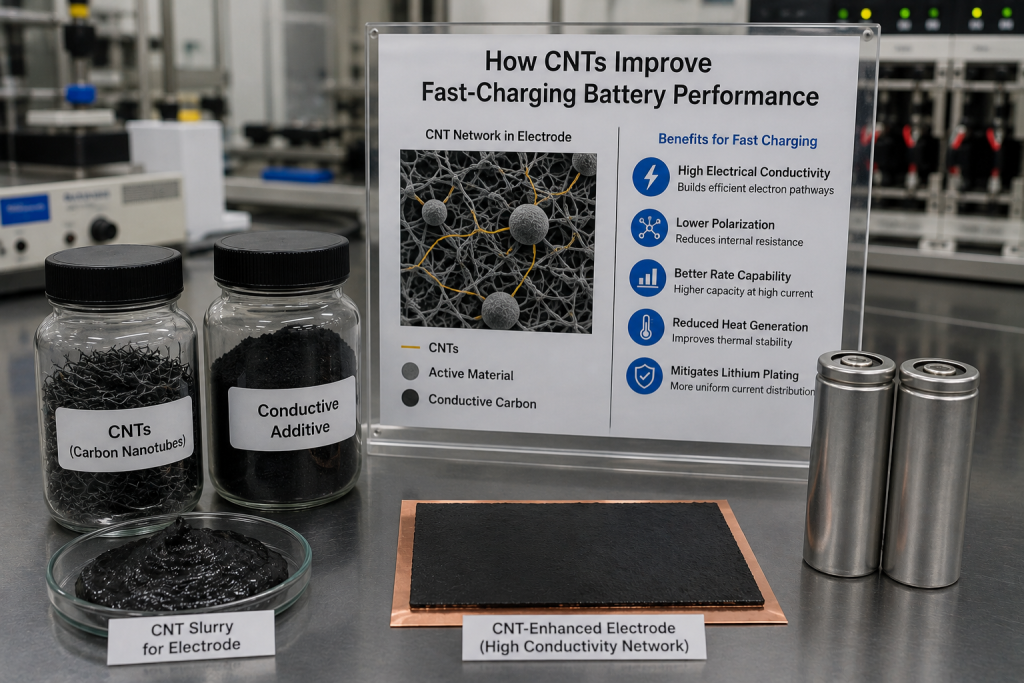
Fast charging is one of the most important performance requirements for next-generation lithium-ion batteries. As electric vehicles, energy storage systems, power tools, drones, and other high-power applications continue to develop, battery manufacturers are under increasing pressure to shorten charging times without sacrificing energy density, cycle life, safety, or manufacturing stability.
However, fast charging is not simply a matter of increasing the charging current. At high charging rates, batteries face several interconnected challenges, including increased polarization, uneven current distribution, lithium-ion transport limitations, localized heating, and, particularly for graphite-based anodes, the risk of lithium plating.
Carbon nanotubes (CNTs) have attracted significant attention as conductive additives for addressing some of these challenges. Because of their high aspect ratio, electrical conductivity, mechanical strength, and ability to form interconnected conductive networks at relatively low concentrations, CNTs can improve the electronic transport pathways inside battery electrodes.
More importantly, CNTs can contribute to fast-charging performance at the electrode-structure level rather than simply increasing bulk conductivity.
What Makes Fast Charging Difficult?
A lithium-ion battery operates under increasingly demanding conditions as the charging rate increases.
During conventional charging, lithium ions move relatively slowly from the cathode through the electrolyte and separator toward the anode, while electrons travel through the external circuit and electrode conductive network.
During fast charging, the same processes must occur much more quickly.
Several limitations can become significant:
- Electronic resistance inside the electrode
- Ionic transport resistance
- Charge-transfer resistance
- Electrode polarization
- Non-uniform current distribution
- Heat generation
- Limited diffusion into active particles
- Lithium plating on the graphite anode
These limitations are closely connected.
For example, if electrons cannot move efficiently through the electrode, local areas may experience higher electrical resistance. This can increase polarization and heat generation. Similarly, if the electrode structure does not provide sufficient pathways for electrolyte penetration and lithium-ion transport, increasing the charging current may result in severe concentration gradients.
Therefore, improving fast charging requires optimization of the entire electrode architecture.
This is where CNTs can provide an important advantage.
How CNTs Create Conductive Networks Inside Battery Electrodes
One of the most important characteristics of CNTs is their extremely high aspect ratio.
Compared with conventional carbon black particles, CNTs are long, nanoscale conductive structures. Instead of forming isolated conductive points, they can connect multiple active-material particles and create a three-dimensional conductive network.
This mechanism can be visualized as a network of conductive bridges.
Active material particles may have limited direct contact with one another. Carbon black can improve this contact by filling gaps between particles, but relatively large amounts may be required to establish an effective conductive network.
CNTs can connect these particles over longer distances.
As a result, a small amount of CNTs can potentially establish a continuous electronic pathway through the electrode.
This is particularly useful for high-loading electrodes, where maintaining efficient electron transport becomes more difficult.
CNTs Can Reduce Electronic Resistance
Fast charging requires rapid electron transport.
If the electrode has high electronic resistance, increasing the charging current can significantly increase voltage polarization.
CNT networks can reduce this resistance by creating additional conductive pathways between:
- Active material particles
- Conductive carbon particles
- Current collectors
- Different regions of the electrode
The resulting conductive network can help electrons reach more active-material particles more efficiently.
This is important because fast charging should ideally utilize the entire electrode rather than concentrating current in only a limited portion of the electrode.
A well-designed CNT network can therefore contribute to more uniform electrochemical utilization.
More Uniform Current Distribution
Fast charging places greater demands on current distribution within an electrode.
If certain regions have significantly lower resistance than others, those regions may carry disproportionately high current.
This non-uniformity can create localized electrochemical and thermal hotspots.
CNTs can help improve electrical connectivity throughout the electrode structure. When properly dispersed, they can form conductive pathways around active-material particles and across different electrode regions.
The goal is not simply to achieve the lowest possible electrical resistance.
The more important objective is to achieve uniform and stable conductivity throughout the electrode.
This distinction is critical for fast-charging battery design.
CNTs and Electrode Polarization
Polarization represents one of the major obstacles to high-rate charging.
When charging current increases, the battery voltage can deviate significantly from its equilibrium voltage because of several resistance and transport mechanisms.
CNTs primarily address the electronic component of this problem.
By improving electronic connectivity, CNTs can reduce ohmic losses within the electrode and current-collection pathways.
Lower electronic resistance can help reduce voltage losses during high-current operation.
However, CNTs cannot eliminate all forms of polarization.
For example, if lithium-ion diffusion through the active material is the dominant limitation, simply adding more conductive additive will not solve the problem.
This is why CNTs should be considered as one component of a broader fast-charging electrode strategy.
CNTs Can Support High Electrode Loading
Fast-charging performance becomes more challenging as electrode loading increases.
High-energy-density batteries require a large amount of active material per unit area. Thick electrodes can provide higher areal capacity, but they also increase transport distances and make electronic and ionic transport more difficult.
In such electrodes, conductive-network design becomes increasingly important.
CNTs can connect active-material particles throughout a relatively thick electrode structure while using a comparatively small fraction of the total electrode mass.
This creates an important engineering trade-off.
The objective is to achieve sufficient conductivity without excessively reducing the amount of electrochemically active material.
A well-designed CNT system can therefore help battery manufacturers maintain high active-material loading while preserving electrical connectivity.
CNTs and Lithium Plating Risk
Lithium plating is one of the major concerns during fast charging, especially for graphite anodes.
When the charging conditions become too aggressive, lithium ions may not be inserted into graphite quickly enough. Metallic lithium can then deposit on the graphite surface instead.
Lithium plating can reduce battery capacity and accelerate degradation. In severe cases, it can also create safety concerns.
CNTs may help indirectly by improving electronic conductivity and reducing electrode polarization.
A more uniform conductive network can support more homogeneous current distribution across the electrode, potentially reducing localized regions where the electrochemical reaction becomes excessively concentrated.
However, CNTs should not be described as a direct solution to lithium plating.
Lithium plating is influenced by many factors, including:
- Anode particle size
- Electrode thickness
- Porosity
- Temperature
- Charging current
- State of charge
- Electrolyte composition
- Graphite structure
- Electrode density
- Cell design
Therefore, CNTs can be part of a lithium-plating mitigation strategy, but they cannot replace proper fast-charging design.
CNTs Improve Mechanical Integrity of Electrodes
CNTs provide another benefit beyond electrical conductivity.
Their high aspect ratio and mechanical strength allow them to interact with active-material particles and binder systems.
During repeated charging and discharging, electrode particles undergo physical changes. Expansion, contraction, cracking, and loss of particle-to-particle contact can gradually damage the conductive network.
CNTs can act as nanoscale reinforcing structures within the electrode.
Their interconnected structure may help maintain electrical contact even when the electrode experiences mechanical stress.
This becomes particularly relevant for high-loading electrodes and advanced active materials that undergo significant volume changes.
CNTs and Silicon-Based Fast-Charging Anodes
The role of CNTs becomes particularly interesting when silicon is introduced into the anode.
Silicon offers extremely high theoretical capacity compared with conventional graphite, but it also experiences substantial volume changes during lithiation and delithiation.
These changes can cause:
- Particle cracking
- Loss of electrical contact
- Conductive-network disruption
- Electrode swelling
- Accelerated capacity degradation
CNTs can form flexible conductive frameworks around silicon particles.
Instead of relying entirely on direct contact between silicon particles and conventional carbon additives, CNTs can provide longer-range conductive connections.
CNT-silicon composite architectures therefore represent an important area of research for high-energy and fast-charging battery systems.
CNTs Must Be Properly Dispersed
The advantages of CNTs depend heavily on dispersion quality.
CNTs naturally tend to form bundles because of strong van der Waals interactions.
Poor dispersion can create large CNT agglomerates.
These agglomerates may produce several problems:
- Uneven conductivity
- Reduced active-material utilization
- Increased slurry viscosity
- Coating defects
- Poor electrode uniformity
- Difficult processing
Therefore, simply increasing CNT concentration does not necessarily improve battery performance.
In many cases, optimizing dispersion and conductive-network formation is more important than maximizing CNT loading.
This makes CNT slurry formulation a critical part of battery manufacturing.
CNT Slurry Formulation Matters
For industrial battery production, CNTs are usually introduced through a conductive slurry or premixed conductive additive system.
The formulation must balance several parameters.
These include:
- CNT concentration
- Solvent compatibility
- Binder compatibility
- Dispersant selection
- Viscosity
- Solid content
- Particle/agglomerate size
- Mixing energy
- Storage stability
The slurry must not only provide good electrochemical performance but also remain compatible with large-scale electrode manufacturing.
For example, excessive CNT content may dramatically increase slurry viscosity.
This can create difficulties during high-speed mixing, pumping, coating, filtration, and slot-die coating.
Therefore, the best CNT formulation is not necessarily the one with the highest CNT concentration.
It is the one that produces a stable conductive network while maintaining a practical manufacturing process window.
CNTs and Coating Processability
Fast-charging electrode development increasingly requires a connection between material formulation and coating technology.
A CNT-containing slurry must be compatible with the selected coating process.
Important variables may include:
- Coating speed
- Wet thickness
- Slurry viscosity
- Surface tension
- Drying temperature
- Drying rate
- Electrode density
- Calendering pressure
CNT agglomeration can become particularly problematic during coating because large particles or bundles may cause defects in the electrode surface.
Therefore, CNT dispersion should be evaluated not only through laboratory conductivity measurements but also through coating trials.
This is an important distinction between laboratory material development and industrial battery manufacturing.
CNTs and Calendering
Calendering compresses the electrode to achieve the required thickness, density, porosity, and mechanical properties.
CNT networks may respond differently to calendering compared with conventional particulate conductive additives.
An optimized CNT network can maintain electrical connectivity after compression.
However, excessive calendering may reduce electrode porosity and negatively affect electrolyte penetration and lithium-ion transport.
This creates an important optimization problem.
Higher electrode density may improve volumetric energy density, but excessive density can reduce ionic transport and make fast charging more difficult.
Therefore, CNT optimization must be performed together with electrode porosity and calendering conditions.
CNTs Do Not Solve Ionic Transport Limitations
One of the most important limitations of CNTs should be clearly understood.
CNTs primarily improve electronic conductivity.
They do not automatically increase lithium-ion diffusion through the electrolyte or active material.
If the dominant limitation is ionic transport, simply adding CNTs may provide limited benefits.
For fast-charging applications, electrode architecture must therefore balance electronic and ionic pathways.
An optimized electrode should provide:
Efficient electron transport + efficient lithium-ion transport + appropriate reaction kinetics + controlled heat generation.
CNTs are particularly valuable on the electronic side of this equation, but they need to work together with electrode porosity, particle size, electrolyte formulation, and cell design.
CNT Content Must Be Optimized
More CNTs do not always mean better battery performance.
Increasing CNT content can improve electronic conductivity up to a certain point. Beyond that point, additional CNTs may provide diminishing returns.
At excessive concentrations, CNTs can reduce the relative amount of active material and increase manufacturing costs.
They can also increase slurry viscosity and complicate coating.
Therefore, CNT optimization should consider multiple performance indicators:
- Electronic conductivity
- Rate capability
- Fast-charging performance
- Energy density
- Electrode density
- Slurry viscosity
- Coating stability
- Cycle life
- Cost
- Manufacturing yield
The optimum CNT concentration is therefore application-specific.
CNTs Should Be Evaluated at Cell Level
A major mistake in conductive-additive development is to evaluate CNTs only through powder conductivity or half-cell testing.
A material may show excellent laboratory conductivity but provide limited benefits in a practical battery.
For fast-charging applications, evaluation should progress through multiple levels:
CNT material → conductive slurry → coated electrode → calendered electrode → half cell → full cell → fast-charge cycling → pilot production.
At the cell level, engineers should examine parameters such as:
- DC internal resistance
- Charge polarization
- Temperature rise
- Charge acceptance
- Capacity retention
- Lithium-plating tendency
- Cycle life
- Electrode uniformity
- Fast-charge time
This approach provides a much more realistic assessment of the commercial value of CNTs.
CNTs and Thermal Management During Fast Charging
Fast charging generates additional heat because of increased current and electrochemical losses.
CNTs may contribute indirectly to thermal performance by reducing electrical resistance and improving current distribution.
However, CNTs should not be regarded as a standalone thermal-management solution.
Cell-level thermal behavior also depends on:
- Cell geometry
- Cooling architecture
- Current density
- Internal resistance
- Electrolyte properties
- Electrode thickness
- Thermal conductivity of surrounding materials
The role of CNTs is therefore better understood as part of an integrated electrochemical and thermal design strategy.
From Laboratory CNTs to Industrial Battery Production
The commercialization of CNT-based fast-charging electrodes requires more than demonstrating improved rate capability.
Manufacturers must answer practical questions:
Can the CNT slurry remain stable during storage?
Can it be pumped consistently?
Can it be coated at production speed?
Can the coating maintain uniform thickness?
Can the electrode survive calendering?
Can the conductive network remain stable during cycling?
Can the formulation be reproduced from batch to batch?
Can the additional material cost be justified by the improvement in cell performance?
These questions determine whether CNT technology can move from laboratory research to commercial battery production.
This is why pilot-scale validation is particularly important.
A CNT formulation that works perfectly in a small laboratory coating experiment may behave differently when coating speed, electrode width, slurry volume, drying conditions, and production time increase.
CNTs as Part of a Fast-Charging Battery Architecture
Fast charging is ultimately a system-level problem.
CNTs can improve one important part of that system by establishing efficient electronic pathways inside the electrode.
But successful fast-charging batteries generally require coordinated optimization of:
- Active materials
- Conductive additives
- Binder systems
- Electrode porosity
- Particle size
- Electrode loading
- Electrolyte formulation
- Separator characteristics
- Formation conditions
- Thermal management
- Charging protocols
- Cell architecture
CNTs are therefore best viewed as an enabling material rather than a standalone fast-charging solution.
Their greatest value appears when the conductive network is designed together with the rest of the electrode architecture.
CNTs can improve fast-charging battery performance by creating highly interconnected conductive networks, reducing electronic resistance, improving current distribution, supporting high-loading electrodes, and helping maintain electrode integrity during cycling.
Their benefits can be particularly valuable in high-power lithium-ion batteries and advanced anode systems such as silicon-containing electrodes.
However, fast charging cannot be achieved through conductivity alone.
If ionic transport, charge-transfer kinetics, heat generation, or lithium plating becomes the dominant limitation, simply adding more CNTs will not necessarily improve charging performance.
The most effective approach is to optimize CNT concentration, dispersion, slurry formulation, coating, drying, calendering, and electrode architecture together.
For battery manufacturers, the key question is therefore not “How conductive are the CNTs?”
It is:
“Can the CNT conductive network improve fast-charging performance while remaining compatible with high-loading electrodes, stable manufacturing, long cycle life, safety, and commercial cost targets?”
That is the real transition from CNT material technology to industrial fast-charging battery technology.