
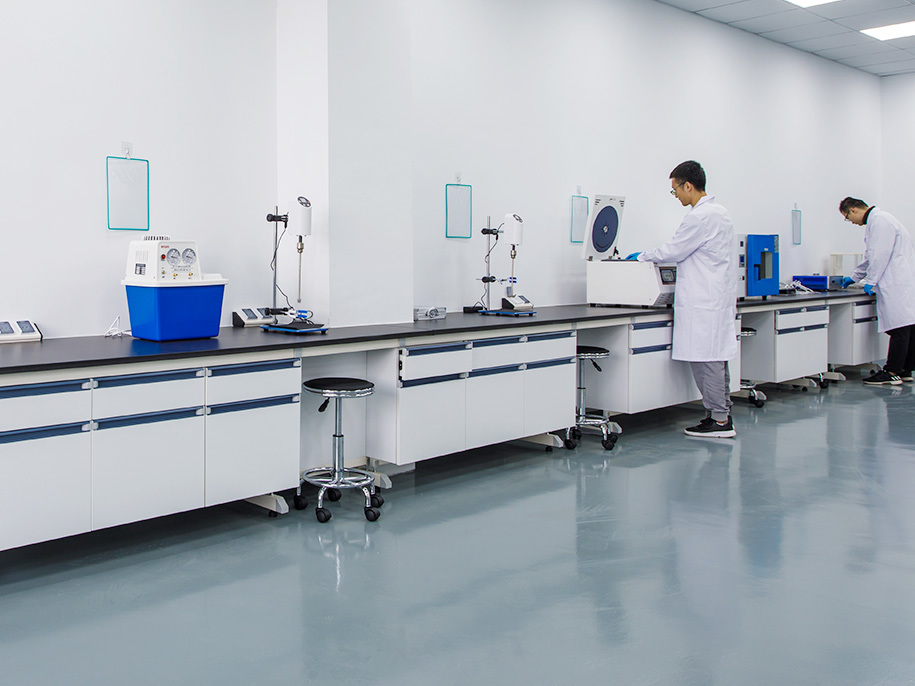
Battery Industrialization Requires More Than Materials
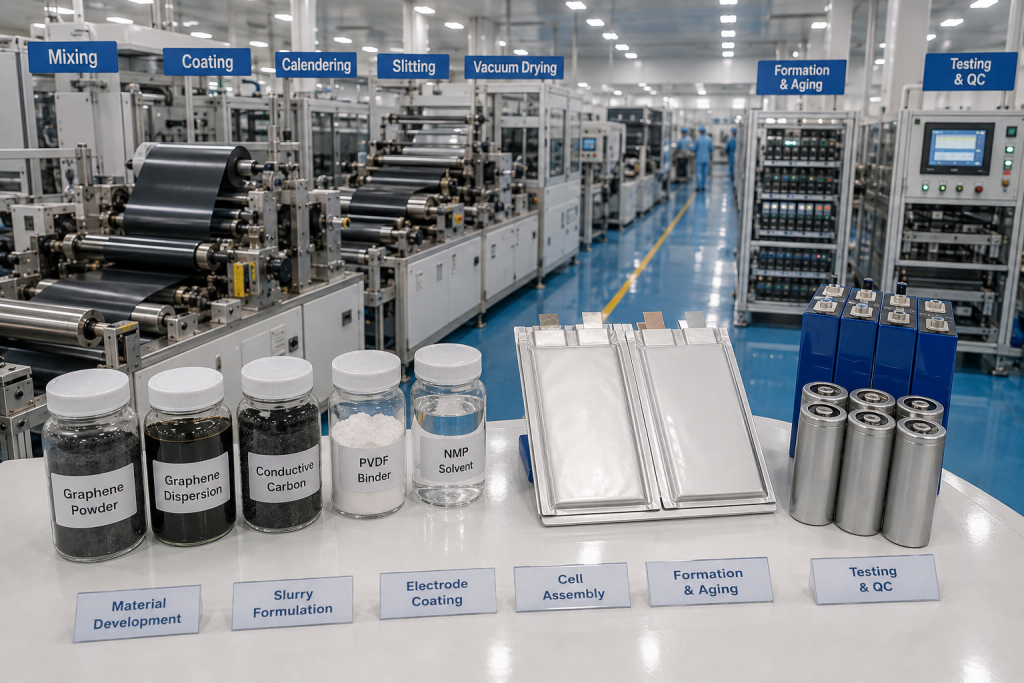
The development of next-generation batteries is often presented as a materials challenge.
Researchers search for higher-capacity cathodes, silicon-based anodes, solid-state electrolytes, conductive additives, graphene, carbon nanotubes, and other advanced materials that can potentially improve energy density, power capability, cycle life, safety, or charging performance.
However, discovering a high-performance material is only the beginning.
The difficult part is turning that material into a battery that can be manufactured consistently, economically, safely, and at commercial scale.
This is why battery industrialization requires much more than materials.
A successful battery technology must connect multiple elements:
Materials → Formulation → Process → Equipment → Cell Design → Quality Control → Supply Chain → Cost → Manufacturing Scale
If one of these elements remains immature, the entire commercialization pathway can be delayed.
For next-generation batteries, the ability to integrate these elements may ultimately be more important than achieving the highest laboratory performance.
From Material Discovery to Battery Manufacturing
A typical battery technology development pathway can be divided into several stages:
Material Research → Laboratory Cell → Prototype Cell → Pilot Production → Engineering Validation → Customer Qualification → Mass Production
Each stage introduces new requirements.
At the laboratory level, researchers may focus primarily on electrochemical performance.
At the pilot stage, manufacturing repeatability becomes increasingly important.
At commercial scale, additional factors such as production yield, equipment utilization, quality consistency, supply security, and cost become critical.
A material that performs exceptionally well in a laboratory cell may therefore fail to achieve commercial adoption if it creates excessive manufacturing complexity.
The industrialization question is not simply:
“Does this material improve battery performance?”
It is:
“Can this material improve battery performance within a stable and economically viable manufacturing process?”
Why Laboratory Performance Is Not Enough
Laboratory testing is essential for identifying promising technologies.
Researchers may demonstrate:
- Higher specific capacity
- Improved conductivity
- Longer cycle life
- Faster charging
- Better thermal stability
- Higher energy density
- Improved mechanical stability
These results provide evidence that a technology has potential.
However, laboratory cells are usually produced under highly controlled conditions.
Production environments are much more complicated.
Commercial manufacturing must deal with:
- Raw material variation
- Large batch sizes
- High-speed coating
- Drying limitations
- Equipment tolerances
- Environmental fluctuations
- Automation
- Production yield
- Quality control
The performance observed in a small laboratory cell must therefore be translated into a manufacturing process that can operate repeatedly over thousands or millions of cells.
Materials Are Only the Starting Point
Advanced battery materials can provide significant technical opportunities.
Examples include:
- High-nickel cathode materials
- Silicon and silicon-carbon anodes
- Solid-state electrolytes
- Lithium-metal systems
- Sodium-ion materials
- Graphene
- Carbon nanotubes
- Advanced conductive additives
- Functional coatings
Each material may offer specific advantages.
But every new material also introduces manufacturing questions.
For example:
Can it be mixed consistently?
Can it be coated uniformly?
Can it be dried without damaging its structure?
Can it withstand calendering?
Can it be assembled using existing equipment?
Can suppliers produce it consistently at the required volume?
These questions determine whether a material can move beyond laboratory research.
Formulation Development Is Critical
Battery materials rarely operate independently.
Cathode and anode materials are usually combined with binders, conductive additives, solvents, and other components to create processable electrode slurries.
The formulation determines many manufacturing characteristics.
Important parameters may include:
- Solid content
- Viscosity
- Particle distribution
- Dispersion stability
- Binder concentration
- Conductive additive ratio
- Mixing sequence
- Mixing energy
- Temperature
A material may have excellent electrochemical properties but still be difficult to formulate.
For example, excessive viscosity can create coating problems, while poor dispersion can produce non-uniform electrodes.
Therefore, formulation engineering is an important bridge between material science and battery manufacturing.
Coating Is a Manufacturing Challenge
Electrode coating is one of the most important steps in battery production.
The objective is to deposit a uniform layer of active material onto a current collector.
Industrial coating requires control of:
- Coating width
- Wet thickness
- Dry thickness
- Line speed
- Flow rate
- Web tension
- Surface quality
- Edge profile
- Drying conditions
A laboratory coating process may work at a relatively low speed.
Commercial production requires much higher throughput.
The formulation must therefore remain stable when coating speed, width, and production volume increase.
This is one reason pilot coating equipment is so important during battery industrialization.
Drying Can Determine Production Throughput
After coating, the electrode must be dried.
Drying is not simply a solvent-removal step.
It can influence:
- Binder distribution
- Porosity
- Particle arrangement
- Electrode adhesion
- Surface structure
- Residual solvent
- Energy consumption
Increasing production speed can reduce drying residence time.
Increasing coating thickness can increase drying requirements.
Changing solvent systems can also affect drying behavior.
Therefore, electrode formulation, coating speed, dryer design, and temperature profile must be optimized together.
A material that works well in a laboratory may become difficult to process when commercial throughput is required.
Calendering and Electrode Structure
Calendering compresses the coated electrode to achieve the required density and surface characteristics.
The process affects:
- Electrode density
- Porosity
- Thickness
- Mechanical strength
- Electrical contact
- Ion transport
Advanced materials may respond differently to calendering compared with conventional materials.
For example, an electrode containing a new conductive additive may require different pressure or density optimization.
Therefore, the industrialization process must evaluate not only the material itself but also how the material behaves during downstream manufacturing.
Cell Assembly Matters
Even a well-designed electrode does not guarantee a successful battery.
The electrode must eventually be integrated into a complete cell.
Depending on the cell format, manufacturing may involve:
- Slitting
- Notching
- Stacking
- Winding
- Welding
- Electrolyte filling
- Sealing
- Formation
- Aging
- Testing
Different cell formats introduce different manufacturing requirements.
These may include:
- Cylindrical cells
- Prismatic cells
- Pouch cells
A material technology should therefore be evaluated within the intended cell architecture as early as practical.
Formation Is Part of Industrialization
Formation is one of the most important stages in battery manufacturing.
During formation, the battery undergoes controlled charging and discharging to establish the electrochemical characteristics of the cell.
The process influences:
- Initial capacity
- Internal resistance
- Solid electrolyte interphase formation
- Gas generation
- Cell aging
- Production cycle time
A new material system may require changes to the formation process.
This can affect factory throughput and equipment utilization.
Therefore, formation requirements must be considered when evaluating the commercial viability of a new battery chemistry.
Quality Control Must Be Designed Into the Process
Battery manufacturing requires extremely consistent quality.
Small variations in electrode thickness, moisture, material loading, or cell resistance can affect final battery performance.
Quality control may include:
Raw Material Inspection
- Chemical composition
- Particle size
- Moisture
- Purity
- Surface properties
Electrode Inspection
- Coating thickness
- Loading
- Density
- Porosity
- Adhesion
- Surface defects
Cell Inspection
- Weight
- Dimensions
- OCV
- Internal resistance
- Capacity
- Leakage
- Appearance
The objective is not simply to identify defective cells.
The larger goal is to control the process so that defects are prevented before they occur.
Moisture Control Is a Manufacturing Requirement
Many advanced battery chemistries are sensitive to moisture.
Moisture can affect:
- Electrode processing
- Electrolyte stability
- Interface chemistry
- Cell performance
- Gas generation
- Long-term reliability
As a result, industrial battery production may require controlled humidity and appropriate drying processes.
This becomes particularly important for advanced materials that have high surface area or strong moisture sensitivity.
The manufacturing environment therefore becomes part of the battery technology itself.
Equipment Compatibility Determines Scalability
A new battery material must eventually work with real manufacturing equipment.
This includes:
- Mixers
- Pumps
- Filters
- Coaters
- Dryers
- Calendering machines
- Slitting equipment
- Stacking or winding systems
- Welding systems
- Formation equipment
- Testing systems
A material that requires completely new equipment may face a much longer commercialization pathway.
In contrast, a material that can be integrated into existing production infrastructure may have a significant commercialization advantage.
This is one reason process compatibility should be evaluated early.
Pilot Production Is the Bridge
Pilot production provides a controlled environment between laboratory research and commercial manufacturing.
A pilot line allows engineers to evaluate:
- Material handling
- Mixing
- Coating
- Drying
- Electrode processing
- Cell assembly
- Formation
- Testing
More importantly, it generates data that cannot easily be obtained from laboratory experiments.
Pilot production can reveal:
- Process instability
- Material loss
- Equipment limitations
- Batch variation
- Coating defects
- Drying constraints
- Assembly problems
The goal is to identify these issues before investing heavily in mass-production infrastructure.
Process Windows Are Essential
A commercial manufacturing process should operate within a defined process window.
For example, electrode coating may have acceptable ranges for:
- Slurry viscosity
- Coating speed
- Flow rate
- Wet thickness
- Dry thickness
- Dryer temperature
- Web tension
The same principle applies to mixing, calendering, formation, and other processes.
The objective is not to find one perfect setting.
Instead, manufacturers need to understand the range of conditions that consistently produces acceptable results.
A wider and more robust process window generally makes industrial production easier to control.
Manufacturing Yield Changes the Economics
One of the most important differences between laboratory development and commercial manufacturing is yield.
Suppose a new battery technology demonstrates excellent performance but initially produces a large percentage of defective cells.
The theoretical performance advantage may not translate into commercial value.
Low yield increases:
- Material consumption
- Labor requirements
- Waste
- Equipment utilization
- Quality-control costs
- Cost per usable cell
Therefore, industrialization must optimize both:
Performance per cell
and
Usable cells per production run
Commercial success requires both.
Supply Chain Is Part of Battery Technology
A battery manufacturer cannot rely on a material that is only available in small research quantities.
Commercial deployment requires:
- Stable supplier capacity
- Consistent quality
- Predictable lead times
- Multiple sourcing options where appropriate
- Quality documentation
- Logistics capability
- Long-term supply planning
A promising material may therefore face commercialization delays simply because production capacity has not caught up with customer demand.
Supply-chain development should begin before mass production rather than after qualification.
Cost Must Be Evaluated at Cell Level
The price of an individual material does not tell the full economic story.
A new material may be more expensive per kilogram but enable:
- Higher energy density
- Longer cycle life
- Lower material loading
- Reduced manufacturing steps
- Higher production yield
Conversely, a cheap material may require complex processing that increases total manufacturing cost.
Therefore, commercial evaluation should consider:
Cost per electrode → Cost per cell → Cost per usable energy unit → Total lifecycle value
This provides a much more realistic picture of commercialization potential.
Energy Density Is Not the Only Metric
Battery development is often dominated by energy density discussions.
However, commercial customers may also care about:
- Cycle life
- Fast charging
- Safety
- Thermal stability
- Power capability
- Manufacturing yield
- Reliability
- Cost
- Availability
A technology with slightly lower energy density but significantly better manufacturability may have stronger commercial potential.
Similarly, a material that provides excellent cycle life but dramatically increases production complexity may require further optimization.
The best commercial technology is usually the one that provides the best overall balance.
Reliability Requires Long-Term Testing
Laboratory demonstrations may cover dozens or hundreds of cycles.
Commercial batteries may need to operate for years.
Long-term validation can reveal:
- Capacity degradation
- Resistance growth
- Gas generation
- Interface instability
- Mechanical degradation
- Thermal effects
For this reason, industrialization requires extended reliability testing.
This is particularly important for advanced materials because their long-term interaction with other cell components may not be fully understood during early development.
Safety Cannot Be Separated From Industrialization
Safety is another area where material innovation must be considered alongside manufacturing.
Battery safety can be influenced by:
- Material chemistry
- Electrode loading
- Cell design
- Manufacturing defects
- Moisture
- Internal resistance
- Thermal management
- Formation conditions
A material that improves energy density but increases sensitivity to manufacturing variation may require additional process controls.
Therefore, safety validation must continue throughout the industrialization process.
Digitalization and Data Are Becoming More Important
Modern battery factories increasingly rely on manufacturing data.
Important data sources may include:
- Mixing parameters
- Coating parameters
- Dryer conditions
- Electrode inspection
- Cell resistance
- Formation data
- Aging data
Connecting these datasets can help manufacturers identify relationships between process conditions and cell performance.
Advanced analytics and AI can potentially support:
- Process optimization
- Defect detection
- Predictive maintenance
- Yield improvement
- Quality prediction
This creates a shift from reactive quality control toward data-driven process control.
Co-Development Reduces Industrialization Risk
Battery industrialization often requires collaboration between multiple organizations.
A development project may involve:
Material Supplier + Equipment Manufacturer + Cell Developer + Testing Laboratory + End Customer
Each participant contributes different expertise.
The material supplier understands material properties.
The equipment manufacturer understands processing limitations.
The cell developer understands electrochemical requirements.
The testing laboratory provides characterization.
The end customer defines application requirements.
This collaborative model can identify incompatibilities earlier and reduce the risk of developing a material that performs well in isolation but fails during manufacturing.
The Importance of Design for Manufacturing
Next-generation batteries should increasingly be designed with manufacturing in mind from the beginning.
This concept is often described as Design for Manufacturing (DFM).
Instead of asking only:
“What battery chemistry provides the highest performance?”
development teams should also ask:
- How will the electrode be manufactured?
- What equipment is required?
- What process window is available?
- What production speed is realistic?
- How sensitive is the process to material variation?
- What quality-control systems are required?
- Can the process achieve high yield?
These questions can significantly shorten the path from laboratory innovation to commercial production.
A Practical Battery Industrialization Framework
A structured approach can help manage commercialization risk.
Step 1: Define the Target Application
Identify the required energy density, power, cycle life, safety, cost, and operating conditions.
Step 2: Select the Materials
Choose materials based on both performance and manufacturability.
Step 3: Develop the Formulation
Optimize slurry composition, dispersion, viscosity, and stability.
Step 4: Validate Laboratory Cells
Establish baseline electrochemical performance.
Step 5: Conduct Pilot Production
Test the materials using representative manufacturing equipment.
Step 6: Establish Process Windows
Define acceptable ranges for critical manufacturing parameters.
Step 7: Build Representative Cells
Validate the technology using the intended cell format.
Step 8: Conduct Reliability Testing
Evaluate long-term performance and safety.
Step 9: Analyze Manufacturing Economics
Calculate yield, material utilization, throughput, and cost.
Step 10: Complete Customer Qualification
Demonstrate that the technology meets application-specific requirements.
Step 11: Scale Production Gradually
Move from pilot production to engineering production and eventually mass manufacturing.
What Makes a Battery Technology Commercially Attractive?
A commercially attractive battery technology usually demonstrates several characteristics simultaneously.
Strong Performance
It provides a meaningful advantage over existing technology.
Manufacturing Compatibility
It can be processed using scalable equipment.
Stable Quality
The manufacturing process produces consistent cells.
High Yield
The majority of production output meets specifications.
Reliable Supply
Materials and components can be supplied consistently.
Competitive Cost
The performance advantage justifies the manufacturing investment.
Customer Acceptance
The technology satisfies qualification and reliability requirements.
This combination is much more difficult to achieve than laboratory performance alone.
The Future of Battery Industrialization
As battery technology advances, the boundary between materials research and manufacturing engineering will continue to disappear.
Future development will increasingly combine:
- Materials science
- Process engineering
- Equipment development
- Data analytics
- Quality engineering
- Supply-chain management
- Cost engineering
- Application validation
New materials will remain essential.
However, the commercial winners will likely be technologies that can move efficiently through the entire development chain.
This is particularly important for:
- Silicon-anode batteries
- Solid-state batteries
- Sodium-ion batteries
- Lithium-metal batteries
- Advanced conductive materials
- Graphene-enhanced electrodes
- High-performance coatings
Each of these technologies requires more than a successful laboratory experiment.
Battery industrialization requires much more than discovering better materials.
A high-performance material is only the first building block of a commercial battery.
Successful commercialization requires the integration of:
Materials + Formulation + Process + Equipment + Cell Design + Quality Control + Supply Chain + Cost + Reliability
Pilot production plays a critical role in connecting these elements.
It provides an environment where manufacturers can identify process limitations, establish process windows, optimize equipment, evaluate material consistency, and produce representative cells before committing to full-scale manufacturing.
The key lesson is simple:
The best battery material is not necessarily the material with the best laboratory performance. It is the material that delivers meaningful performance improvements while remaining compatible with a stable, scalable, safe, and economically viable manufacturing process.
As the battery industry moves toward increasingly advanced chemistries and architectures, industrialization capability will become a major source of competitive advantage.
The future of battery innovation will therefore depend not only on what materials can achieve, but also on how reliably those materials can be transformed into millions of high-quality cells.