
Why Pilot Testing Is Critical for New Energy Materials
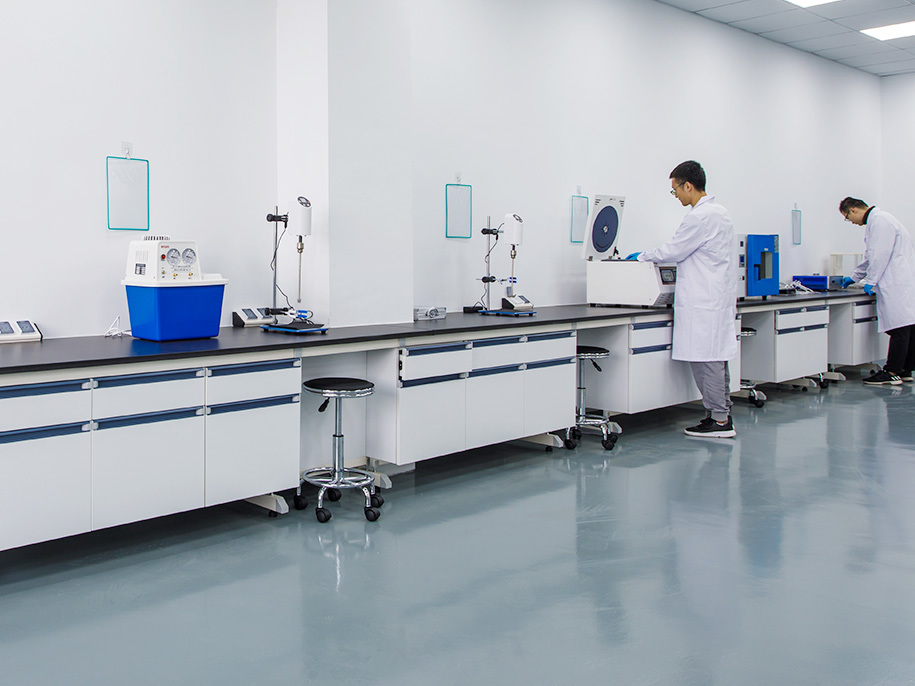
Every year, thousands of new energy materials show promising results in laboratories.
Researchers publish impressive data showing:
- Higher energy density
- Faster charging
- Better conductivity
- Improved thermal stability
- Longer cycle life
However, only a small percentage of these materials ever reach commercial production.
The reason is simple:
Laboratory success does not guarantee manufacturing success.
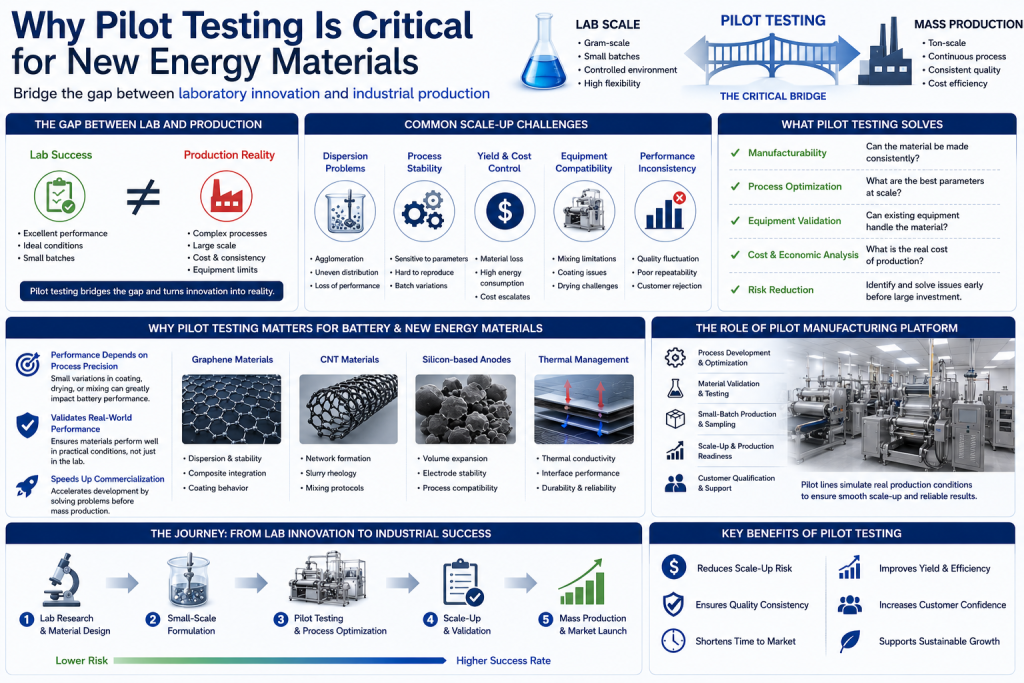
Between research and mass production lies a critical stage known as pilot testing.
For advanced materials such as graphene, carbon nanotubes (CNTs), silicon-based anodes, conductive additives, thermal management materials, and battery components, pilot testing often determines whether a technology becomes a commercial product—or remains a laboratory achievement.
The Gap Between Lab and Production
In the laboratory, researchers typically work with:
- Gram-scale materials
- Small batches
- Controlled environments
- Specialized equipment
- Highly trained operators
Industrial production is very different.
Manufacturing requires:
- Kilograms or tons of material
- Continuous processing
- Consistent quality
- Cost efficiency
- High production yields
A material that performs perfectly in a laboratory may encounter unexpected problems during scale-up.
Common Scale-Up Challenges
Dispersion Problems
Many advanced carbon materials perform well in small laboratory mixers.
However, when batch size increases:
- Agglomeration appears
- Particle distribution changes
- Conductivity decreases
- Product consistency suffers
This challenge is particularly common for:
- Graphene
- CNTs
- Carbon nanofibers
- Silicon-carbon composites
Process Stability
A successful laboratory formulation may rely on conditions that are difficult to reproduce at larger scales.
Variables include:
- Mixing energy
- Shear rate
- Temperature control
- Drying conditions
- Coating speed
Small changes can dramatically affect final product performance.
Yield and Manufacturing Cost
Many laboratory processes prioritize performance.
Industrial manufacturing requires balancing:
- Performance
- Yield
- Throughput
- Material utilization
- Production cost
Pilot testing helps identify practical manufacturing windows before major capital investment is made.
What Pilot Testing Actually Does
Pilot testing serves as a bridge between research and production.
It answers several critical questions:
Can the Material Be Manufactured Consistently?
Performance is meaningless if every batch behaves differently.
Pilot-scale production evaluates:
- Batch-to-batch variation
- Process repeatability
- Quality stability
Consistency is often more important than achieving the highest laboratory performance.
Can Existing Equipment Handle the Material?
Many advanced materials create processing challenges.
Examples include:
- CNT dispersion difficulty
- Graphene slurry viscosity variation
- Silicon particle expansion
- High-solids electrode formulations
Pilot testing verifies compatibility with:
- Mixers
- Coaters
- Drying systems
- Calendering equipment
- Roll-to-roll production lines
What Is the Real Production Cost?
Laboratory economics rarely reflect industrial reality.
Pilot production helps determine:
- Raw material consumption
- Energy requirements
- Process losses
- Labor requirements
- Equipment utilization
These factors directly influence commercial viability.
Why Pilot Testing Matters for Battery Materials
Battery manufacturing is especially sensitive to process variation.
A small change in:
- Coating thickness
- Porosity
- Conductive network formation
- Drying profile
can significantly impact:
- Capacity
- Cycle life
- Safety
- Fast-charging performance
Pilot testing enables engineers to optimize these variables before moving to large-scale production.
Pilot Testing for Advanced Carbon Materials
Advanced carbon materials often face unique industrialization challenges.
Graphene
Pilot testing helps evaluate:
- Dispersion quality
- Composite integration
- Coating behavior
- Thermal performance consistency
Carbon Nanotubes (CNTs)
Pilot validation focuses on:
- Conductive network formation
- Slurry rheology
- Mixing protocols
- Electrode processing compatibility
Thermal Management Materials
Pilot-scale testing verifies:
- Thermal conductivity consistency
- Mechanical durability
- Manufacturing repeatability
- Integration with cooling systems
Reducing Commercialization Risk
One of the biggest benefits of pilot testing is risk reduction.
Without pilot validation, companies may face:
- Expensive equipment modifications
- Production delays
- Product failures
- Customer qualification issues
- Lost investment
Pilot manufacturing identifies these risks early, when they are easier and less costly to solve.
The Role of Pilot Manufacturing Platforms
Dedicated pilot manufacturing platforms provide:
- Process development
- Material validation
- Small-batch production
- Scale-up optimization
- Customer qualification samples
These platforms help companies accelerate commercialization while minimizing technical and financial risks.
For startups and material innovators, pilot manufacturing often represents the fastest path from invention to market adoption.
Developing a breakthrough material is only the first step.
The true challenge lies in transforming laboratory innovation into a reliable industrial product.
Pilot testing bridges this gap by validating manufacturability, consistency, cost, and scalability before full-scale production begins.
For advanced carbon materials, battery components, thermal management products, and next-generation energy technologies, pilot testing is not simply a development stage—it is often the deciding factor between commercial success and technical failure.
As the new energy industry continues to evolve, companies that invest in pilot-scale validation will be better positioned to bring innovative materials from the laboratory to the marketplace.