
Pilot Lines Are Becoming the New Innovation Bottleneck: Why Industrial Scale-Up Needs More Than Laboratory Breakthroughs
Innovation in advanced materials, batteries, energy storage, functional coatings, and industrial technologies is accelerating. Research institutions and technology companies continue to develop new materials, improved formulations, and more efficient manufacturing processes.
However, an important challenge remains: many promising technologies struggle to move from laboratory success to commercial production.
A material may demonstrate excellent performance in a laboratory experiment, but that does not necessarily mean it can be manufactured consistently, processed using industrial equipment, or delivered at a commercially viable cost.
Between laboratory research and mass production lies a critical development stage: pilot-scale manufacturing.
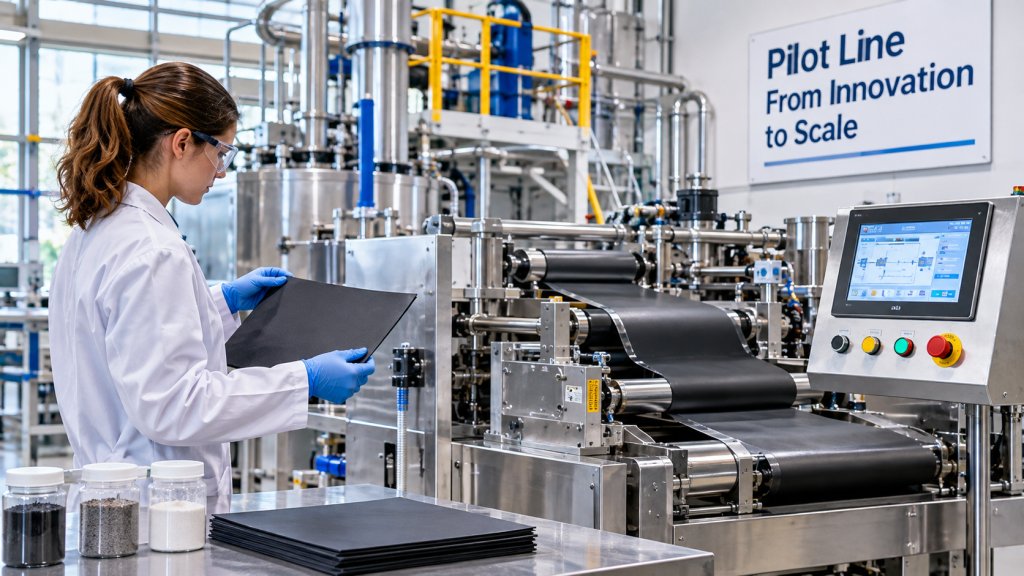
Pilot lines are designed to bridge this gap. They provide the equipment, process conditions, technical expertise, and production environment needed to evaluate whether an innovation can be translated into a repeatable manufacturing process.
Yet as innovation accelerates, access to suitable pilot lines is becoming increasingly difficult.
The problem is not simply a shortage of production capacity. It also involves equipment compatibility, technical expertise, process flexibility, validation costs, operational complexity, and coordination between different organizations.
Pilot lines are therefore becoming a new bottleneck in industrial innovation.
This article examines why pilot-scale manufacturing capacity is increasingly important, what prevents existing pilot facilities from meeting industrial demand, and how a more flexible validation ecosystem could accelerate commercialization.
1. Why Laboratory Innovation Is No Longer Enough
Laboratory research is essential for discovering new materials and understanding their fundamental properties.
However, laboratory conditions are usually designed to answer specific scientific questions rather than reproduce the complexity of industrial manufacturing.
A successful laboratory result may depend on:
- Small material quantities
- Precisely controlled experimental conditions
- Specialized laboratory equipment
- Experienced researchers
- Carefully selected raw materials
- Limited production cycles
- Simplified testing environments
Industrial manufacturing introduces additional variables.
Mixing behavior changes with equipment geometry and production volume. Heat and mass transfer become more complicated. Material handling, drying, filtration, coating, and packaging introduce additional process requirements.
A formulation that works well in a small laboratory batch may behave differently in a pilot mixer or continuous production line.
For example, a graphene dispersion developed through laboratory ultrasonication may show good stability at a small scale. However, transferring the formulation to a larger mixing system may change dispersion quality, energy distribution, and batch consistency.
Similarly, a battery electrode formulation may demonstrate promising electrochemical performance in a laboratory cell but encounter coating defects, drying limitations, or mechanical problems during pilot production.
The central challenge is that laboratory performance and manufacturing performance are not the same thing.
Pilot lines provide the environment needed to investigate this difference.
2. The Growing Demand for Pilot-Scale Manufacturing
Several technology sectors are increasing their dependence on pilot-scale validation.
2.1 Advanced Battery Materials
Battery manufacturers and material developers are working on increasingly complex material systems, including:
- Silicon-carbon anodes
- High-nickel cathode materials
- Solid-state electrolyte materials
- Conductive carbon additives
- Advanced separator coatings
- Functional electrode binders
- High-loading electrode formulations
These technologies require more than laboratory characterization.
They need practical evaluation through mixing, coating, drying, calendering, electrode preparation, cell assembly, and electrochemical testing.
Pilot lines help developers understand whether a material can be processed consistently using manufacturing-relevant conditions.
2.2 Graphene and Carbon Nanomaterials
Graphene, carbon nanotubes (CNTs), graphene oxide (GO), and reduced graphene oxide (rGO) have potential applications in batteries, conductive coatings, thermal management, composites, and water treatment.
However, their industrial adoption depends on several factors:
- Batch-to-batch consistency
- Dispersion stability
- Surface chemistry
- Formulation compatibility
- Processing requirements
- Application-specific performance
- Production cost
Pilot-scale validation is particularly important because the properties of advanced carbon materials can change during processing and scale-up.
A material that performs well in a laboratory formulation may not maintain the same performance after industrial mixing, coating, drying, or composite processing.
2.3 Functional Coatings and Composite Materials
Functional coatings are increasingly used for corrosion protection, thermal management, electrical conductivity, electromagnetic interference shielding, and specialized industrial applications.
Their development requires coordinated evaluation of raw materials, formulation, substrate preparation, coating thickness, curing conditions, and durability.
Pilot coating lines allow developers to test these variables under more realistic processing conditions.
2.4 Energy Storage and Thermal Management
Energy storage technologies require reliable materials and components that can operate under demanding thermal, electrical, and mechanical conditions.
Pilot validation may involve:
- Thermal interface materials
- Electrically insulating thermal composites
- Battery module insulation
- Protective coatings
- Conductive and shielding materials
- Cooling components
- Cable protection and fire-resistant materials
These products often require system-level testing rather than relying solely on raw material specifications.
As energy storage systems become more complex, the demand for application-specific pilot validation is likely to increase.
3. Why Existing Pilot Lines Are Becoming a Bottleneck
The increasing demand for pilot-scale development does not automatically mean that existing facilities can accommodate every innovation project.
Several structural limitations are becoming more visible.
3.1 Equipment Is Often Designed for Specific Processes
Pilot lines are usually developed around particular materials, manufacturing processes, or industrial applications.
For example:
- Battery electrode coating lines are designed around specific slurry and electrode processes.
- Chemical pilot facilities may focus on reaction, separation, or purification.
- Polymer processing facilities may specialize in extrusion, compounding, or molding.
- Coating pilot lines may be configured for particular substrates and coating technologies.
These facilities may have excellent capabilities within their intended scope, but they are not necessarily suitable for unrelated projects.
A new material may require equipment modifications, additional process controls, or entirely different production conditions.
The result is a mismatch between available pilot capacity and the actual requirements of emerging technologies.
3.2 Limited Access to Flexible Equipment
Many pilot facilities are optimized for scheduled projects or established technology programs.
Small companies and independent material developers may find it difficult to access these facilities for short development trials.
Some projects require only a few kilograms of material or several days of testing.
However, the facility may be structured around larger projects, longer booking periods, or established industrial customers.
This creates a practical access problem.
The innovation may be technically promising, but the developer cannot obtain the specific equipment time needed to validate it.
3.3 High Operating Costs
Pilot facilities require substantial investment in:
- Specialized machinery
- Utilities and infrastructure
- Process control systems
- Safety management
- Skilled technical personnel
- Maintenance and calibration
- Testing and analytical equipment
- Waste treatment and environmental compliance
These costs are difficult to avoid even when a project requires only a small production quantity.
For early-stage companies, the cost of pilot validation can become a major barrier.
The challenge is especially significant when a project requires several rounds of formulation adjustment and repeated testing.
3.4 Technical Expertise Is Not Always Available
Operating a pilot line requires more than access to equipment.
Experienced technical personnel must understand:
- Material characteristics
- Equipment limitations
- Process parameters
- Troubleshooting
- Quality control
- Scale-up behavior
- Safety requirements
A facility may possess sophisticated machinery but lack the specific expertise required to process a new material.
For example, a conventional mixing line may not automatically be suitable for high-aspect-ratio CNT dispersions or highly viscous functional composites.
The availability of appropriate technical personnel is therefore as important as the availability of equipment.
3.5 Pilot Facilities May Lack Commercial Validation Capabilities
Some pilot facilities are primarily designed to support scientific research.
Their work may focus on producing samples and measuring technical properties.
However, industrial customers often require additional information:
- Can the process be repeated?
- What is the acceptable process window?
- How does quality vary between batches?
- What is the expected production yield?
- What are the material and processing costs?
- Can the process be transferred to another manufacturing site?
- What quality documentation is available?
Without these manufacturing-oriented evaluations, a pilot project may generate useful research data but remain commercially difficult to implement.
4. The Gap Between Pilot Production and Mass Manufacturing
Pilot-scale production is not simply a smaller version of mass manufacturing.
The purpose of a pilot line is to generate knowledge about how a process behaves under more realistic conditions and what must change before commercial production becomes feasible.
Several challenges typically emerge during this transition.
4.1 Scale-Dependent Process Behavior
Production scale changes the way materials move, mix, heat, cool, and react.
For example, a mixing process may perform consistently in a small vessel but produce uneven material distribution in a larger system.
Important variables include:
- Mixing geometry
- Shear distribution
- Heat transfer
- Mass transfer
- Residence time
- Material addition sequence
- Equipment operating speed
The process must be optimized for the actual equipment rather than transferred through simple proportional scaling.
4.2 Batch Consistency
Industrial customers expect products to meet defined specifications across multiple production batches.
Pilot-scale development should therefore evaluate whether material properties remain consistent over repeated production runs.
For advanced materials, relevant parameters may include:
- Particle size distribution
- Layer number and lateral dimensions
- Surface chemistry
- Purity and impurity levels
- Moisture content
- Dispersion stability
- Viscosity
- Thermal or electrical performance
A successful single batch is not sufficient evidence of manufacturing readiness.
4.3 Yield and Material Loss
Laboratory experiments often use small quantities and tolerate relatively high material losses.
Commercial production requires a much stronger understanding of yield and material utilization.
Pilot lines help identify losses associated with:
- Filtration
- Separation
- Washing
- Drying
- Transfer
- Coating
- Trimming
- Cleaning
- Packaging
These losses can significantly influence production economics.
4.4 Process Repeatability
A process that works only under narrowly controlled experimental conditions may be difficult to industrialize.
Pilot testing should identify acceptable operating ranges rather than relying on one successful set of parameters.
The objective is to establish a practical process window within which product quality remains acceptable.
5. Pilot Lines Must Become More Flexible
One important development opportunity is the transition from highly specialized pilot facilities toward more flexible, modular validation platforms.
This does not mean every facility should attempt to support every technology.
Instead, pilot infrastructure should be organized around compatible processes, adaptable equipment, and clearly defined technical capabilities.
5.1 Modular Equipment Design
Modular systems can allow equipment configurations to be adjusted for different materials or process requirements.
Examples include:
- Interchangeable mixing heads
- Adjustable coating systems
- Modular filtration units
- Flexible drying configurations
- Replaceable process-contact components
- Adaptable material handling systems
Modularity can reduce the cost and time required to configure a facility for new projects.
However, equipment flexibility must be balanced against process contamination risks, cleaning requirements, safety, and validation needs.
5.2 Shared Pilot Infrastructure
Not every material developer needs to build an independent pilot line.
Shared infrastructure can provide access to specialized equipment without requiring each company to make substantial capital investments.
Potential users include:
- Startups
- University research groups
- Advanced material manufacturers
- Battery developers
- Industrial coating companies
- Technology licensing organizations
- Established manufacturers exploring new products
A shared model can improve equipment utilization and broaden access to industrial validation resources.
5.3 Application-Specific Validation Modules
Pilot platforms can also be organized around specific application requirements.
For example, an advanced carbon materials validation platform may integrate:
- Material characterization
- Dispersion and formulation
- Composite preparation
- Coating trials
- Thermal and electrical testing
- Pilot batch preparation
A battery materials platform may combine:
- Powder handling
- Slurry mixing
- Electrode coating
- Drying
- Calendering
- Cell assembly
- Electrochemical testing
The value comes from connecting relevant process stages rather than simply providing isolated equipment.
6. The Importance of Data and Process Documentation
A major benefit of pilot-scale manufacturing is the ability to generate process data.
However, this value is often underestimated.
Pilot production should not be viewed only as an activity for making samples. It should also produce information that helps manufacturers understand process behavior and prepare for scale-up.
6.1 Process Parameter Recording
Important data may include:
- Raw material specifications
- Material addition sequence
- Mixing speed
- Processing temperature
- Mixing duration
- Solids content
- Equipment configuration
- Pressure and flow conditions
- Drying temperature
- Coating speed
- Yield and material loss
The exact parameters depend on the technology and process.
6.2 Quality Data and Batch Comparison
Each pilot batch should be associated with relevant quality measurements.
Comparing multiple batches can help identify:
- Raw material variability
- Process instability
- Equipment-related differences
- Measurement variation
- Changes in product performance
This creates a foundation for process improvement and manufacturing quality control.
6.3 Establishing a Process Window
The ultimate objective is not merely to record what happened during one trial.
It is to understand which process parameters can change without causing unacceptable product variation.
A validated process window provides a more useful basis for future production transfer than a single set of laboratory operating conditions.
7. Pilot Lines Are Also a Commercialization Bottleneck
Pilot capacity is not only a technical issue. It also affects the commercial development of new technologies.
Without appropriate pilot validation, material developers may struggle to convince industrial customers that a new product is ready for qualification.
Industrial buyers commonly need evidence of:
- Consistent specifications
- Repeatable manufacturing
- Application-specific performance
- Reliable supply
- Acceptable production cost
- Technical documentation
- Quality control procedures
A material sample may generate initial interest, but commercial adoption often requires a much deeper validation process.
7.1 The Cost of Delayed Validation
When pilot facilities are unavailable or unsuitable, development projects may experience long delays.
These delays can affect:
- Customer qualification schedules
- Product launch timelines
- Investment decisions
- Technology licensing discussions
- Supplier selection
- Manufacturing partnerships
In competitive industries, the ability to validate a technology quickly can become an important commercial advantage.
7.2 The Challenge for Small and Medium-Sized Companies
Large manufacturers may have internal pilot lines or established relationships with research institutions.
Smaller companies often lack these resources.
They may have promising materials, intellectual property, and potential customers but no direct access to suitable pilot infrastructure.
This creates an uneven commercialization environment.
Flexible third-party pilot facilities and technical coordination platforms can help reduce this gap.
8. The Role of Cross-Border Pilot and Validation Networks
Innovation and manufacturing capabilities are increasingly distributed across different countries.
A material may be developed in one country, characterized in another, processed at a pilot facility elsewhere, and eventually manufactured near the end customer.
This creates opportunities for cross-border validation networks.
Instead of requiring one organization to own every piece of equipment and expertise, a coordinated network can connect specialized resources.
8.1 Connecting Research Institutions and Industrial Facilities
Research institutions may provide expertise in material synthesis, characterization, and formulation.
Industrial pilot facilities may provide equipment and manufacturing process experience.
Independent testing laboratories may offer performance and reliability evaluation.
Manufacturers can then assess whether the validated process is suitable for commercial production.
Each participant contributes a different capability.
8.2 Coordinating the Validation Process
A successful network requires clear coordination.
Before a project begins, the parties should establish:
- Customer requirements
- Technical scope
- Material specifications
- Required equipment
- Sample quantities
- Testing methods
- Expected deliverables
- Intellectual property arrangements
- Commercial terms
- Responsibility for technical decisions
This prevents misunderstandings and reduces the risk of uncontrolled development work.
8.3 Protecting Data and Intellectual Property
Cross-border projects often involve multiple technical partners.
Confidential information, material formulations, process parameters, and experimental results must be managed carefully.
Nondisclosure agreements, project-specific contracts, data ownership provisions, and clear reporting arrangements are important.
A coordinated validation network should make technical collaboration easier without weakening the commercial and intellectual property rights of participating organizations.
9. How Companies Can Evaluate a Pilot Line Before Starting a Project
Selecting a pilot facility should be based on technical suitability rather than equipment availability alone.
A practical evaluation framework includes the following areas.
| Evaluation Area | Key Questions |
|---|---|
| Equipment capability | Can the facility handle the required material and process? |
| Technical expertise | Does the team understand the relevant material system? |
| Process flexibility | Can equipment settings or configurations be adjusted? |
| Sample capacity | Can the facility produce the required quantity? |
| Quality control | Are suitable characterization and testing methods available? |
| Repeatability | Can multiple batches be evaluated? |
| Documentation | Will process parameters and results be recorded? |
| Safety and compliance | Are material-specific risks and handling requirements addressed? |
| IP protection | Are confidentiality and data ownership clearly defined? |
| Cost structure | Are equipment, labor, testing, and material costs transparent? |
| Scale-up relevance | Can the results support a realistic manufacturing transfer? |
A facility should be selected according to the project’s actual objectives.
A small formulation screening project may not require a full production line.
A project intended to qualify a new electrode process may require integrated mixing, coating, drying, and cell testing capabilities.
Matching the validation scope to the available resources can significantly improve efficiency.
10. Building a More Effective Pilot Validation Model
The future of pilot-scale manufacturing will depend not only on additional equipment investment but also on better project organization.
An effective validation model should connect technical requirements, facility capabilities, process development, testing, and commercialization.
A practical workflow can be divided into seven stages.
Stage 1: Requirement Definition
Clarify the application, target specifications, expected sample quantities, process requirements, and validation objectives.
Stage 2: Technical Feasibility Review
Evaluate whether the proposed material and process can be handled using available equipment and technical resources.
Stage 3: Pilot Facility Selection
Match the project with a suitable facility based on equipment, process expertise, safety requirements, and testing capabilities.
Stage 4: Scope and Commercial Agreement
Define responsibilities, deliverables, costs, intellectual property arrangements, and project milestones before detailed engineering work begins.
Stage 5: Pilot Execution
Conduct formulation, processing, sample preparation, and manufacturing trials according to the agreed technical scope.
Stage 6: Validation and Repeatability
Evaluate product properties, process stability, yield, and consistency across multiple batches where required.
Stage 7: Industrial Transfer Assessment
Determine whether the results support further development, equipment modification, manufacturing transfer, or additional optimization.
This model helps ensure that pilot production generates both physical samples and useful industrial knowledge.
11. The Future of Pilot Lines: From Equipment Capacity to Innovation Infrastructure
Pilot lines are likely to become an increasingly important part of the industrial innovation ecosystem.
Their future value will depend on several developments.
11.1 More Application-Oriented Facilities
Pilot facilities will increasingly need to support complete application workflows rather than isolated manufacturing operations.
For example, a battery material project may require formulation, electrode preparation, cell testing, and performance analysis within a coordinated development process.
11.2 Better Digital Process Monitoring
Sensors, process data collection, automated inspection, and digital manufacturing tools can improve process visibility.
These technologies may help identify deviations earlier and make pilot results easier to reproduce.
However, digital monitoring cannot replace appropriate experimental design or technical expertise.
11.3 Greater Integration Between Research and Manufacturing
Research organizations and manufacturers will need stronger collaboration.
Pilot facilities can serve as a practical interface between scientific discovery and industrial production.
11.4 Flexible Commercial Models
Different projects require different levels of support.
Potential models include:
- Equipment access and hourly trials
- Paid sample preparation
- Formulation development
- Pilot batch production
- Process optimization
- Technical testing packages
- Multi-stage validation programs
- Manufacturing transfer support
A flexible commercial structure can make pilot facilities more accessible to companies at different stages of development.
11.5 Greater Focus on Repeatability and Commercial Readiness
Future pilot programs will need to go beyond demonstrating that a process works.
They should establish whether the process can be repeated, controlled, documented, and transferred to a manufacturing environment.
This shift will make pilot lines more directly relevant to industrial decision-making.
The growing importance of pilot lines reflects a fundamental change in the innovation landscape.
Developing a new material or demonstrating a promising laboratory result is no longer sufficient to establish industrial value.
Companies must also understand how the material behaves during processing, whether the manufacturing process is repeatable, how product quality can be controlled, and whether production economics are commercially viable.
Pilot lines provide the essential environment for answering these questions.
However, existing facilities often face limitations involving equipment specialization, accessibility, operating costs, technical expertise, and manufacturing-oriented validation capabilities.
The solution is not simply to build more equipment. It is to develop more flexible, application-oriented pilot infrastructure supported by technical coordination, reliable process data, and cross-organizational collaboration.
For advanced materials, battery technologies, energy storage, and functional coatings, pilot-scale validation is becoming a critical link between innovation and industrial adoption.
The next competitive advantage may not come only from developing better technologies, but from building the infrastructure that allows those technologies to be manufactured, validated, and commercialized faster.
Questions
1. What is a pilot line in industrial manufacturing?
A pilot line is a manufacturing facility used to test and optimize production processes at an intermediate scale between laboratory research and commercial manufacturing. It helps evaluate process feasibility, product quality, repeatability, and scale-up requirements.
2. Why are pilot lines becoming an innovation bottleneck?
Many emerging technologies require specialized equipment, technical expertise, and repeated process validation. Existing facilities may have limited capacity, restricted access, high operating costs, or equipment configurations that are unsuitable for new materials.
3. What is the difference between laboratory testing and pilot-scale production?
Laboratory testing usually focuses on material properties and experimental feasibility. Pilot-scale production evaluates how a material behaves under more realistic manufacturing conditions, including larger processing volumes, equipment limitations, quality control, and repeatability.
4. Which industries need pilot lines most?
Industries such as battery manufacturing, advanced carbon materials, semiconductor materials, functional coatings, polymers, energy storage, and specialty chemicals rely heavily on pilot-scale validation.
5. Can small companies access shared pilot facilities?
Yes. Shared pilot facilities, research institutions, contract manufacturing partners, and independent validation platforms can provide access to specialized equipment without requiring companies to build their own production lines.
6. What should companies evaluate before selecting a pilot facility?
Important considerations include equipment compatibility, technical expertise, process flexibility, sample capacity, quality control, safety, intellectual property protection, project cost, and the relevance of the facility’s capabilities to future industrial production.
7. Does successful pilot production guarantee commercial manufacturing success?
No. Pilot production reduces uncertainty but does not eliminate all scale-up risks. Commercial manufacturing still requires further evaluation of production capacity, cost, supply chain reliability, quality systems, regulatory requirements, and long-term process stability.
8. Why is batch repeatability important in pilot validation?
Batch repeatability demonstrates whether a process can consistently produce materials or components within defined specifications. It is essential for customer qualification, manufacturing transfer, and commercial supply.