
Thermal Management Films: Materials, Coating Methods, and Applications
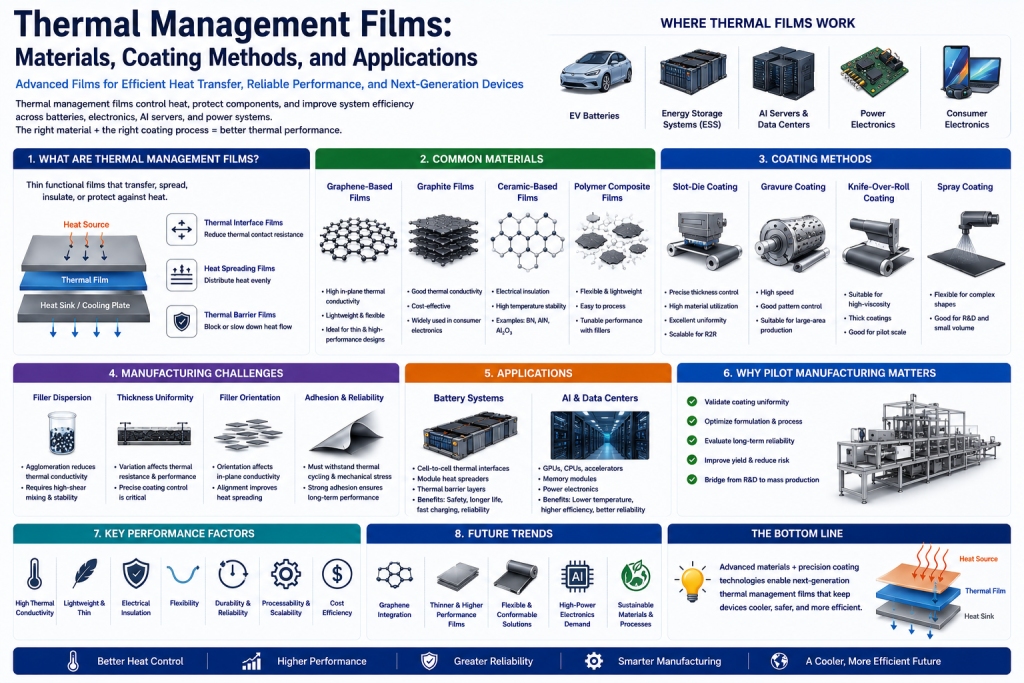
As electronic devices become more powerful and compact, thermal management has become one of the most critical engineering challenges across multiple industries.
Applications including:
- Electric vehicles (EVs)
- Battery energy storage systems (ESS)
- AI servers
- Data centers
- Consumer electronics
- Power electronics
all generate increasing amounts of heat during operation.
Without effective thermal management, excessive temperatures can lead to:
- Reduced performance
- Faster aging
- Lower reliability
- Safety concerns
Thermal management films have emerged as an important solution for controlling heat flow in modern devices and systems.
By combining advanced materials with precision coating technologies, these films help improve heat dissipation while enabling thinner, lighter, and more efficient product designs.
What Are Thermal Management Films?
Thermal management films are engineered materials designed to:
- Transfer heat
- Spread heat
- Insulate heat
- Protect sensitive components
depending on application requirements.
These films are typically positioned between:
- Heat sources
- Heat sinks
- Cooling plates
- Structural components
to improve thermal performance.
Depending on design objectives, thermal films may function as:
Thermal Interface Films
Reducing thermal contact resistance.
Heat Spreading Films
Distributing heat more evenly across a larger surface area.
Thermal Barrier Films
Preventing unwanted heat transfer.
Common Materials Used in Thermal Management Films
Material selection determines thermal conductivity, flexibility, durability, and cost.
Several material categories dominate the market.
Graphene-Based Films
Graphene offers exceptional in-plane thermal conductivity.
Advantages include:
- High thermal conductivity
- Lightweight structure
- Thin-film capability
- Mechanical flexibility
Graphene films are increasingly being evaluated for:
- EV battery thermal management
- Mobile devices
- AI hardware
- High-performance electronics
Because graphene spreads heat efficiently across surfaces, it can help reduce localized hot spots.
Graphite Films
Graphite remains one of the most widely used heat-spreading materials.
Benefits include:
- Mature manufacturing processes
- Good thermal conductivity
- Relatively low cost
Graphite films are commonly found in:
- Smartphones
- Laptops
- Consumer electronics
Ceramic-Based Films
Ceramic thermal materials offer:
- Electrical insulation
- High-temperature resistance
- Chemical stability
Examples include:
- Boron nitride (BN)
- Aluminum nitride (AlN)
- Alumina (Al₂O₃)
These materials are frequently used in power electronics and battery systems.
Polymer Composite Films
Thermal polymers are often filled with:
- Graphene
- Graphite
- Boron nitride
- Metal particles
to improve thermal conductivity.
Advantages include:
- Flexibility
- Lightweight construction
- Processability
- Cost effectiveness
Coating Methods for Thermal Management Films
The manufacturing process significantly influences final film performance.
Slot-Die Coating
Slot-die coating is widely used for producing uniform thermal films.
Advantages include:
- Precise thickness control
- High material utilization
- Scalability
- Roll-to-roll compatibility
This method is increasingly used in pilot and industrial-scale production.
Gravure Coating
Gravure coating provides:
- High production speed
- Excellent pattern control
- Large-area manufacturing capability
Common applications include flexible electronics and thermal films.
Knife-Over-Roll Coating
This process is suitable for:
- High-viscosity formulations
- Thick coatings
- Functional composite films
It is commonly used during material development and pilot-scale production.
Spray Coating
Spray deposition offers flexibility for:
- Complex geometries
- Small-volume production
- Prototype development
Although less common for mass production, it remains valuable for R&D activities.
Manufacturing Challenges
Producing high-performance thermal management films involves several technical challenges.
Filler Dispersion
Thermally conductive fillers such as graphene and boron nitride must be uniformly distributed.
Poor dispersion can cause:
- Reduced conductivity
- Performance variation
- Manufacturing defects
Film Thickness Uniformity
Thickness variation affects:
- Thermal resistance
- Mechanical properties
- Product consistency
Precise coating control is therefore critical.
Filler Orientation
Many thermal materials exhibit directional conductivity.
For example:
- Graphene
- Graphite flakes
- Boron nitride platelets
Proper alignment can significantly improve heat-spreading performance.
Adhesion and Reliability
Thermal films must maintain performance during:
- Thermal cycling
- Mechanical stress
- Long-term operation
Strong adhesion and structural stability are essential.
Applications in Battery Systems
Thermal management films are increasingly used in EV and ESS batteries.
Applications include:
Cell-to-Cell Thermal Interfaces
Improving heat transfer between battery cells and cooling systems.
Battery Module Heat Spreaders
Reducing temperature gradients across modules.
Thermal Barrier Layers
Protecting sensitive components from excessive heat.
Effective thermal management contributes to:
- Improved safety
- Longer cycle life
- Faster charging capability
- Enhanced reliability
Applications in AI and Data Centers
The rapid growth of AI computing has dramatically increased thermal management requirements.
Thermal films are being used in:
- GPUs
- CPUs
- AI accelerators
- Memory modules
- Power electronics
Benefits include:
- Lower operating temperatures
- Improved energy efficiency
- Higher computing reliability
As power densities continue to increase, advanced thermal materials will become increasingly important.
Why Pilot Manufacturing Matters
Many thermal film formulations demonstrate excellent laboratory performance.
However, scaling these materials presents significant challenges.
Pilot-scale manufacturing helps validate:
- Coating uniformity
- Film quality
- Material dispersion
- Production yield
- Long-term reliability
Pilot lines provide the bridge between material innovation and commercial production.
Future Trends
Several trends are shaping the future of thermal management films:
Graphene Integration
Increasing adoption of graphene-enhanced thermal materials.
Thinner Films
Reducing device size while maintaining cooling performance.
Flexible Thermal Solutions
Supporting wearable electronics and flexible devices.
High-Power Electronics
Meeting the cooling demands of AI systems, EVs, and advanced power modules.
These trends are expected to drive continued innovation across the thermal materials industry.
Thermal management films have become essential components in modern electronics, battery systems, AI infrastructure, and power devices.
By combining advanced materials such as graphene, graphite, boron nitride, and engineered polymer composites with precision coating technologies, manufacturers can significantly improve heat dissipation and system reliability.
As thermal requirements continue to increase across industries, the ability to develop, coat, and scale high-performance thermal films will become a key competitive advantage for next-generation energy and electronic systems.