
The Hidden Gap Between Graphene R&D and Commercialization
Graphene has been one of the most discussed advanced materials of the past decade. Its extraordinary:
- Electrical conductivity
- Thermal conductivity
- Mechanical strength
- Barrier performance
have created enormous expectations across industries such as:
- Batteries
- Conductive coatings
- Thermal management
- Electronics
- Aerospace
- Composites
However, despite strong academic research and significant investment, relatively few graphene technologies achieve large-scale commercial success.
The reason lies in a critical but often underestimated issue:
The hidden gap between graphene R&D and industrial commercialization.
This gap is not simply about material performance. It involves:
- Manufacturing integration
- Process stability
- Pilot validation
- Scalability
- Cost-performance balance
- Industrial reliability
Why Graphene Performs Well in the Lab
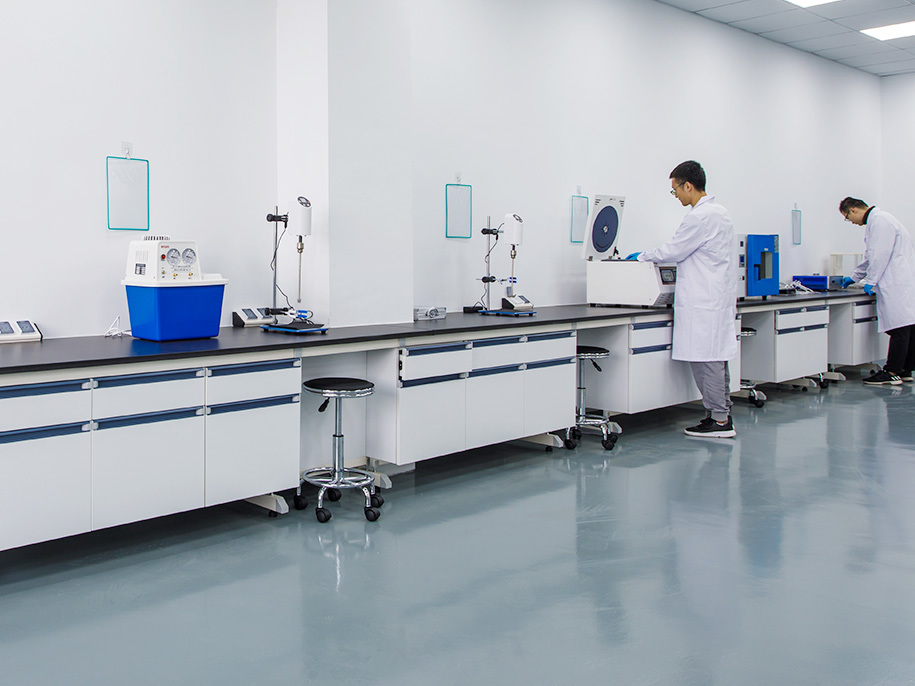
In research environments, graphene development benefits from:
- Small sample sizes
- Controlled conditions
- Flexible processing methods
- Manual optimization
Researchers can carefully tune:
- Dispersion conditions
- Coating parameters
- Drying profiles
- Material loading
Under these conditions, graphene often demonstrates excellent performance.
Why Commercialization Is Much Harder
Industrial manufacturing operates under completely different conditions.
Commercial production requires:
- Continuous processing
- Stable throughput
- High yield
- Equipment compatibility
- Repeatable quality
- Cost efficiency
This creates a major transition challenge between:
Scientific success
and
Manufacturable industrial systems
The Hidden Problems Most Graphene Projects Face
1. Dispersion Instability
One of the biggest commercialization challenges is maintaining stable graphene dispersion.
At industrial scale, graphene tends to:
- Agglomerate
- Restack
- Sediment
This affects:
- Conductivity consistency
- Coating uniformity
- Thermal performance
- Production yield
A graphene formulation that works in laboratory batches may become unstable in continuous industrial processing.
2. Laboratory Coating vs Industrial Coating
Lab-scale graphene films are often produced using:
- Hand coating
- Drop casting
- Small-area deposition
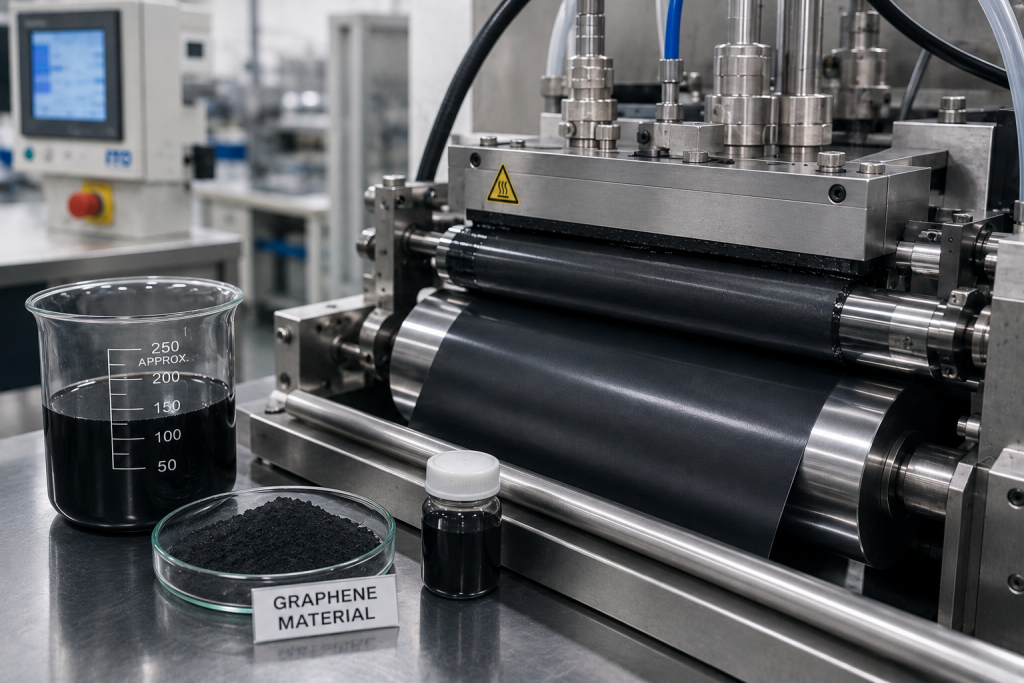
Industrial systems require:
- Roll-to-roll coating
- Slot-die coating
- High-speed continuous processing
Small coating defects become major manufacturing issues at scale.
3. Graphene Quality Variability
Graphene quality depends heavily on:
- Production method
- Layer thickness
- Functionalization
- Defect density
- Raw material consistency
Industrial customers require highly repeatable material specifications.
Even minor variability can create:
- Process instability
- Product inconsistency
- Qualification challenges
4. Poor Manufacturability
Many graphene systems are designed for maximum performance rather than industrial manufacturability.
Common issues include:
- High viscosity
- Difficult rheology control
- Slow processing speed
- Sensitive drying conditions
These factors reduce:
- Production efficiency
- Scalability
- Commercial feasibility
5. Scaling Amplifies Defects
At laboratory scale:
- Small defects may be manageable
At industrial scale:
- Tiny coating variations reduce yield
- Minor dispersion problems create large performance differences
- Process instability becomes expensive
Industrial manufacturing magnifies weaknesses.
Why Pilot-Scale Validation Matters
Pilot manufacturing is the bridge between:
Graphene R&D
and
Commercial production
Pilot lines help validate:
- Coating behavior
- Dispersion stability
- Drying performance
- Process repeatability
- Equipment compatibility
before full-scale investment.
Why Many Companies Skip the Most Important Stage
Some graphene projects move directly from:
- Laboratory success
to - Commercial launch attempts
without proper pilot validation.
This creates major risks including:
- Manufacturing failure
- Yield instability
- Product inconsistency
- Cost overruns
Pilot-scale engineering is often the missing link.
Commercialization Is More About Process Than Material
Many graphene companies focus primarily on:
- Material characterization
- Conductivity numbers
- Scientific publications
But industrial customers care more about:
- Stable manufacturing
- Scalable production
- Repeatability
- Long-term reliability
In reality:
Process engineering often determines commercial success more than material performance alone.
Why Co-Development Is Becoming Essential
Successful graphene commercialization increasingly requires collaboration between:
- Material suppliers
- Pilot manufacturing teams
- Coating engineers
- Equipment companies
- OEMs
The industry is shifting toward:
Integrated material + process + manufacturing development.
Industries Driving Graphene Commercialization
Battery Systems
- Conductive additives
- Silicon anode enhancement
- Thick electrode architectures
Conductive Coatings
- EMI shielding
- Antistatic coatings
- Smart conductive surfaces
Thermal Management
- AI server cooling
- Thermal interface materials
- Heat spreaders
Industrial Protection Systems
- Anticorrosion coatings
- Barrier films
- Chemical-resistant surfaces
What Successful Graphene Industrialization Looks Like
Successful graphene commercialization usually includes:
Early Pilot Validation
Process testing before scale-up.
Manufacturability-Driven Design
Materials optimized for production realities.
Stable Process Engineering
Repeatable industrial manufacturing systems.
Long-Term Industrial Partnerships
Co-development with customers and manufacturing teams.
Future Trends in Graphene Commercialization
The industry is increasingly moving toward:
- Continuous roll-to-roll production
- Water-based graphene coatings
- Hybrid graphene/CNT systems
- AI-assisted process optimization
- Smart manufacturing validation systems
The biggest challenge in graphene commercialization is not proving that graphene works in the laboratory.
The real challenge is transforming graphene into:
- Stable
- Scalable
- Manufacturable
- Economically viable industrial systems
The companies that successfully bridge the hidden gap between R&D and commercialization will lead the next generation of graphene industrialization.