

Why Process Stability Is Critical in Battery Development
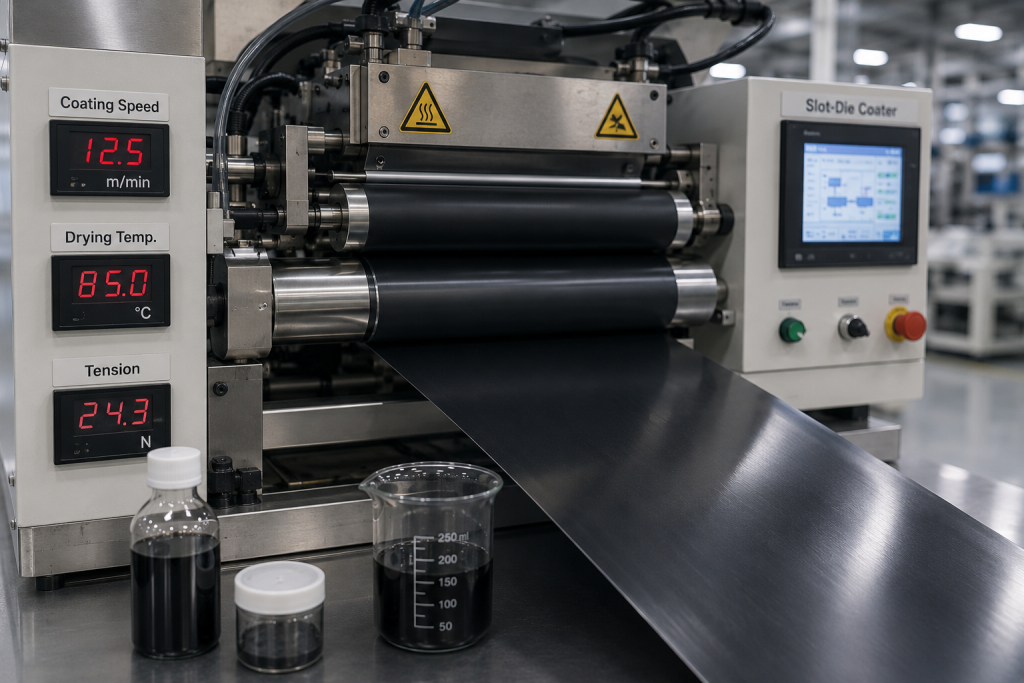
In battery development, breakthrough materials often receive the most attention. However, many battery technologies fail not because the materials are poor, but because the manufacturing process is unstable.
As the battery industry moves toward:
- Higher energy density
- Faster charging
- Thick electrodes
- Advanced conductive systems
- Solid-state architectures
the importance of process stability becomes increasingly critical.
In real industrial production:
Stable manufacturing processes matter just as much as battery chemistry itself.
What Is Process Stability in Battery Manufacturing?
Process stability refers to the ability to maintain:
- Consistent product quality
- Repeatable electrode performance
- Stable manufacturing conditions
- Reliable production yield
across continuous battery production.
A stable process ensures that batteries produced today perform similarly to batteries produced tomorrow.
Why Process Stability Matters
Battery manufacturing is highly sensitive to small variations.
Tiny process fluctuations can affect:
- Capacity consistency
- Internal resistance
- Cycle life
- Safety performance
- Production yield
In large-scale manufacturing, even small instability can become a major commercial problem.
Why Good Materials Still Fail Without Stable Processes
A battery material may show excellent laboratory results, but unstable manufacturing can cause:
- Coating defects
- Poor dispersion
- Electrode cracking
- Yield loss
- Performance inconsistency
This is why many advanced battery projects struggle during industrialization.
Critical Areas Where Process Stability Matters
1. Slurry Preparation and Mixing
Battery slurry stability directly affects:
- Electrode uniformity
- Conductive network formation
- Coating consistency
Common instability problems include:
- Sedimentation
- CNT entanglement
- Graphene restacking
- Viscosity fluctuation
Stable slurry behavior is essential for scalable manufacturing.
2. Electrode Coating Stability
Industrial coating systems require:
- Uniform thickness
- Stable loading
- Continuous roll-to-roll operation
Small coating variations can create:
- Capacity imbalance
- Local resistance increases
- Safety risks
For advanced electrodes, coating stability is often a major bottleneck.
3. Drying Process Stability
Drying affects:
- Porosity distribution
- Binder migration
- Electrode microstructure
- Adhesion quality
Improper drying may cause:
- Cracking
- Delamination
- Uneven conductive pathways
Stable drying conditions are critical for long-term performance consistency.
4. Calendaring Consistency
Compression directly influences:
- Electrode density
- Ion transport
- Mechanical integrity
Inconsistent calendaring can lead to:
- Variable battery performance
- Reduced cycle life
- Yield instability
5. Cell Assembly Stability
Battery assembly processes such as:
- Stacking
- Winding
- Electrolyte filling
- Sealing
must remain highly consistent.
Even tiny assembly deviations can affect:
- Safety
- Internal resistance
- Long-term reliability
Why Process Stability Becomes Harder at Scale
At laboratory scale:
- Processes are slow
- Conditions are controlled
- Operators manually optimize variables
Industrial production introduces:
- High-speed manufacturing
- Large batch sizes
- Continuous operation
- Equipment variability
This significantly increases process complexity.
The Relationship Between Process Stability and Yield
In battery manufacturing:
Yield is directly connected to process stability.
Unstable processes increase:
- Scrap rates
- Production costs
- Downtime
- Product inconsistency
Stable processes improve:
- Manufacturing efficiency
- Product reliability
- Commercial scalability
Why Pilot Lines Are Essential
Pilot lines help companies evaluate process stability before mass production.
Pilot-scale validation allows testing of:
- Slurry behavior
- Coating consistency
- Drying repeatability
- Equipment compatibility
- Yield performance
under realistic manufacturing conditions.
Process Stability Is Critical for Advanced Battery Technologies
Silicon Anodes
Highly sensitive to:
- Expansion behavior
- Electrode cracking
- Binder interaction
Solid-State Batteries
Require extremely stable:
- Interface engineering
- Pressure control
- Material handling
Thick Electrodes
Need optimized:
- Drying profiles
- Conductive network formation
- Ion transport balance
CNT and Graphene Conductive Systems
Depend heavily on:
- Dispersion stability
- Rheology control
- Uniform conductive pathways
Why Manufacturability Is Becoming More Important
The battery industry is shifting from:
“Can the battery work?”
toward:
“Can the battery be manufactured consistently at scale?”
Manufacturability now depends heavily on:
- Process engineering
- Production stability
- Industrial validation
not only material performance.
Co-Development Is Becoming Essential
Successful battery industrialization increasingly requires collaboration between:
- Material suppliers
- Pilot manufacturing teams
- Equipment manufacturers
- OEMs
The future of battery development is becoming:
Integrated material + process + manufacturing engineering.
Future Trends in Process Stability
The industry is moving toward:
- AI-assisted process optimization
- Digital twin manufacturing
- Real-time in-line monitoring
- Smart coating systems
- Automated process control platforms
These technologies aim to improve:
- Yield stability
- Manufacturing consistency
- Scale-up reliability
In battery development, advanced materials alone are not enough.
The ability to maintain stable, repeatable, and scalable manufacturing processes is what determines whether a battery technology can successfully move from laboratory research to industrial production.
As next-generation batteries become more complex, process stability will continue to be one of the most important factors in successful battery commercialization.