

The Precision of Slot-Die Coating: How to Control Wet Film Uniformity in Battery Pilot Lines
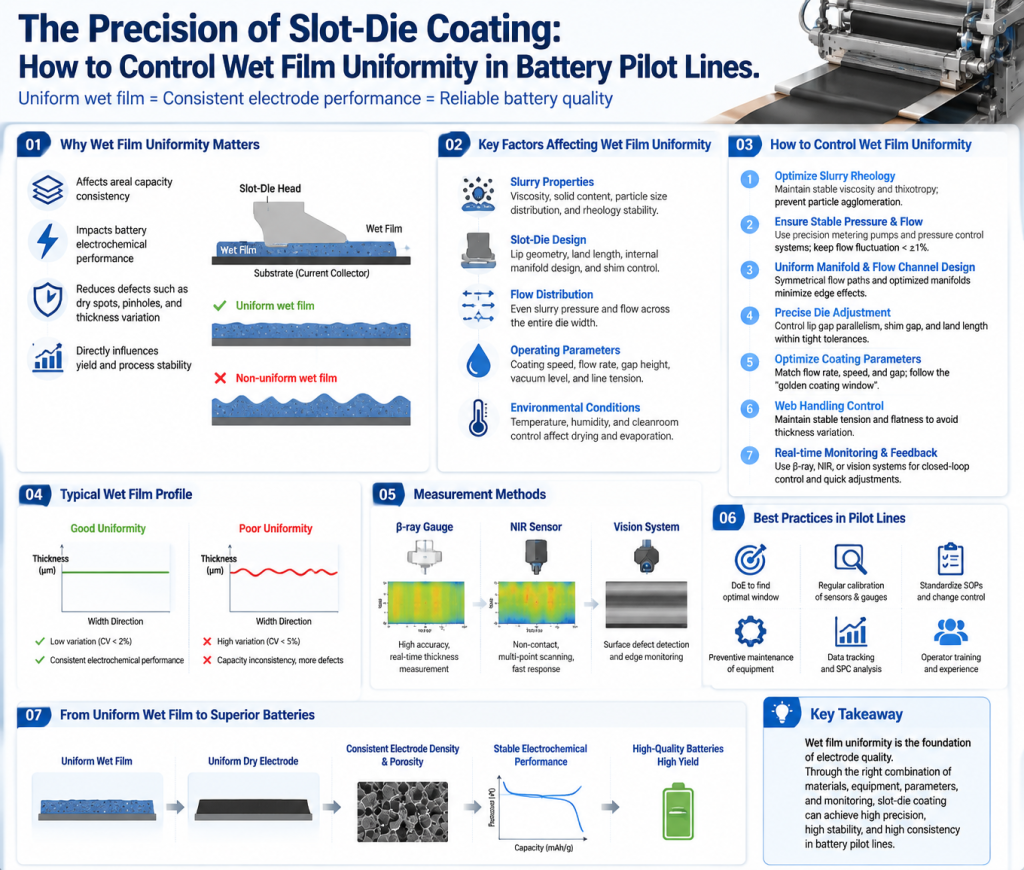
In lithium-ion battery manufacturing, achieving consistent wet film thickness during electrode coating is critical for cell performance, energy density, and cycle life. Among the many coating technologies available, slot-die coating stands out for its precision, repeatability, and scalability from pilot lines to industrial production.
In pilot-scale battery manufacturing, controlling wet film uniformity involves not only equipment settings but also slurry formulation, environmental conditions, and process monitoring. Understanding these factors is key to producing high-quality electrodes that scale effectively.
What Is Slot-Die Coating?
Slot-die coating is a pre-metered coating technique where a slurry is pumped through a precisely machined die onto a moving substrate, typically a current collector foil. Unlike doctor-blade or bar coating, slot-die coating offers:
- Accurate wet film thickness control
- Minimal material waste
- Excellent uniformity over wide substrates
- Compatibility with high-speed, roll-to-roll processes
Because the slurry is pre-metered, the process is highly reproducible—critical for pilot and industrial-scale battery electrode production.
Key Factors Affecting Wet Film Uniformity
Achieving a uniform wet film requires careful consideration of slurry, equipment, and process parameters:
1. Slurry Rheology
- Viscosity: Too low leads to sagging and uneven coating; too high causes poor leveling.
- Shear-Thinning Behavior: A controlled shear-thinning profile ensures smooth flow through the die and rapid leveling on the substrate.
- Particle Size Distribution: Uniform particle size minimizes defects like agglomeration or streaking.
Optimizing slurry rheology often involves adjusting solid content, binder type, solvent ratios, and dispersion techniques.
2. Slot-Die Equipment Parameters
Key equipment factors include:
- Die Gap / Lip Height: Sets the initial wet film thickness. Must be finely tuned relative to substrate speed.
- Coating Speed: Higher speeds can cause thinner or non-uniform films if the slurry is not optimized.
- Flow Rate: Must match the substrate speed and die width for consistent deposition.
- Die Alignment: Even slight misalignment can produce edge effects or thickness gradients.
Regular calibration and maintenance of the die are essential in pilot lines to ensure repeatable results.
3. Substrate and Environment
- Foil Tension: Maintaining consistent tension prevents wrinkling or uneven stretching.
- Surface Energy: Proper wetting ensures smooth slurry spreading.
- Temperature & Humidity: Solvent evaporation rate affects leveling. Controlled drying environments prevent defects like pinholes or uneven thickness.
4. In-Line Monitoring and Feedback
Modern pilot lines employ real-time monitoring to detect deviations in wet film uniformity:
- Laser or optical thickness sensors
- Vision systems for edge and coating defects
- Feedback loops to adjust flow rate or substrate speed dynamically
This approach allows early detection of coating issues before drying, saving materials and reducing pilot line downtime.
Common Challenges and Solutions
| Challenge | Cause | Solution |
|---|---|---|
| Edge Beading | Capillary flow at foil edges | Use edge guides, die lip adjustments |
| Streaking | Agglomerates or poor slurry dispersion | Optimize milling, dispersion techniques |
| Sagging / Thickness Variation | Low viscosity or high coating speed | Adjust rheology, reduce speed, control temperature |
| Air Bubbles / Pinholes | Solvent outgassing or trapped air | Degas slurry, controlled drying |
Addressing these challenges at the pilot scale ensures smooth transition to larger-scale industrial production.
Best Practices for Pilot-Scale Battery Lines
- Pilot Testing Slurry Formulations: Validate rheology, solids content, and particle dispersion before full-scale production.
- Regular Equipment Calibration: Verify die gap, alignment, and flow uniformity to minimize variability.
- Environmental Control: Maintain consistent temperature, humidity, and substrate tension throughout the process.
- In-Line Inspection: Implement optical or laser measurement to detect deviations early and adjust parameters in real time.
- Data Logging and Analysis: Use process data to refine coating parameters and support scale-up decisions.
The precision of slot-die coating is central to producing high-quality lithium-ion battery electrodes in pilot lines. Wet film uniformity directly affects cell performance, energy density, and reliability. Achieving uniform films requires a combination of:
- Optimized slurry formulation
- Fine-tuned equipment settings
- Controlled environmental conditions
- Real-time monitoring and feedback
By mastering these elements, pilot lines can reliably produce electrodes ready for scale-up to industrial manufacturing, reducing development cycles and accelerating commercialization of advanced battery technologies.