

Why CNT Networks Improve Lithium-Ion Battery Performance
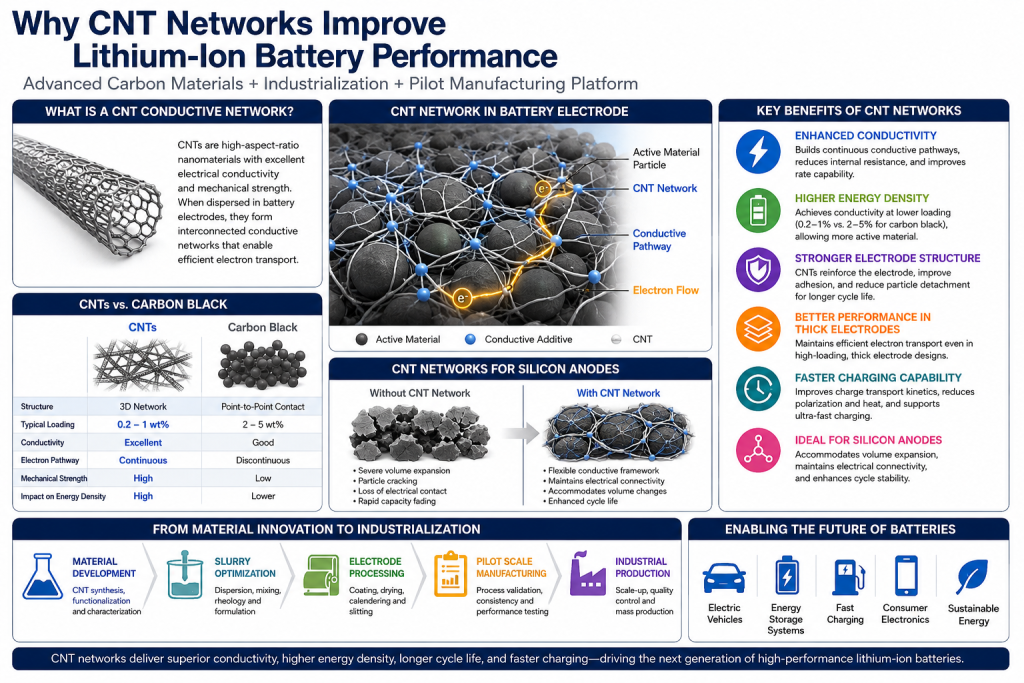
As lithium-ion batteries continue to evolve toward higher energy density, faster charging capabilities, and longer cycle life, the role of conductive additives has become increasingly important.
Among various advanced carbon materials, Carbon Nanotubes (CNTs) have emerged as one of the most effective solutions for building highly efficient conductive networks inside battery electrodes.
While CNT loading is typically less than 1% of total electrode mass, its impact on battery performance can be significant. From electric vehicles and energy storage systems to next-generation silicon-anode batteries, CNT networks are becoming a critical enabler for modern battery technologies.
Understanding how CNT networks work—and why they are increasingly adopted in industrial-scale manufacturing—provides valuable insight into the future of lithium-ion battery development.
What Is a CNT Conductive Network?
Carbon nanotubes are cylindrical nanostructures composed of graphene sheets rolled into seamless tubes.
Typical CNTs exhibit:
- Extremely high electrical conductivity
- High aspect ratio (length-to-diameter ratio)
- Excellent mechanical strength
- Chemical stability
- Low density
When dispersed within battery electrodes, CNTs form interconnected conductive pathways known as a CNT network.
Unlike conventional conductive additives such as carbon black, CNTs create three-dimensional conductive bridges that connect active material particles throughout the electrode structure.
This network allows electrons to travel more efficiently during charging and discharging processes.
Limitations of Traditional Conductive Additives
For decades, carbon black has been widely used as a conductive additive in lithium-ion batteries.
Although cost-effective, carbon black presents several limitations:
1. Point-to-Point Contact
Carbon black particles mainly rely on localized contact points.
As electrode thickness increases, maintaining continuous conductive pathways becomes increasingly difficult.
2. Higher Loading Requirements
Typical carbon black loading ranges from:
- 2–5 wt%
- Sometimes higher in high-capacity electrodes
This reduces the proportion of active materials and lowers overall energy density.
3. Weak Mechanical Reinforcement
Carbon black contributes little to electrode structural integrity.
During repeated cycling, microcracks may develop, disrupting electron transport pathways.
How CNT Networks Improve Battery Performance
Enhanced Electrical Conductivity
The most direct advantage of CNTs is improved electron transport.
Because CNTs possess exceptional intrinsic conductivity and high aspect ratios, a small amount of material can create a continuous conductive network throughout the electrode.
Benefits include:
- Reduced internal resistance
- Improved power output
- Lower polarization
- Better rate capability
This is particularly valuable for fast-charging batteries and high-power applications.
Higher Energy Density
CNTs often achieve conductivity targets at much lower loading levels than traditional conductive additives.
For example:
- Carbon black: 2–5%
- CNTs: 0.2–1%
Reducing inactive material content allows more active material to be incorporated into the electrode.
The result is:
- Increased energy density
- Higher cell capacity
- Improved volumetric efficiency
This advantage becomes increasingly important in EV battery design where every watt-hour matters.
Stronger Electrode Structure
CNTs function not only as conductive agents but also as nanoscale reinforcement fibers.
Their long tubular structure helps:
- Bind active particles together
- Improve adhesion
- Reduce particle detachment
- Enhance electrode mechanical stability
A stronger electrode structure contributes directly to longer cycle life and improved reliability.
Better Performance in Thick Electrodes
Many next-generation battery manufacturers are pursuing thicker electrodes to increase energy density while reducing manufacturing costs.
However, thick electrodes often suffer from:
- Poor conductivity
- Uneven current distribution
- Increased resistance
CNT networks provide conductive pathways across larger distances, helping maintain performance even in high-loading electrode designs.
This capability is becoming increasingly important in large-format EV and ESS cells.
CNT Networks and Silicon Anodes
One of the most promising applications of CNT technology is silicon-based anodes.
Silicon can theoretically store nearly ten times more lithium than graphite.
However, silicon faces a major challenge:
Volume expansion during cycling can exceed 300%.
This expansion causes:
- Particle cracking
- Loss of electrical contact
- Rapid capacity fading
CNT networks help address these issues by creating flexible conductive frameworks around silicon particles.
Benefits include:
- Maintaining electrical connectivity
- Accommodating volume changes
- Reducing mechanical degradation
- Extending cycle life
As silicon-graphite composite anodes move toward commercialization, CNTs are becoming an essential material component.
Benefits for Fast-Charging Batteries
Fast charging places extreme demands on battery electrode conductivity.
Poor electron transport can lead to:
- Excessive heat generation
- Lithium plating
- Reduced charging efficiency
- Safety concerns
CNT networks help lower electrode resistance and improve charge transport kinetics.
As a result, batteries can:
- Accept higher charging currents
- Maintain lower operating temperatures
- Deliver more stable performance during rapid charging cycles
This is one reason CNT adoption continues to grow among EV battery manufacturers focused on ultra-fast charging technologies.
Manufacturing Challenges of CNT Integration
Despite their advantages, CNTs are not always easy to implement.
The primary challenge is dispersion.
CNTs naturally tend to agglomerate due to strong van der Waals forces.
Poor dispersion can result in:
- Non-uniform conductivity
- Reduced performance gains
- Processing instability
- Manufacturing defects
Achieving consistent CNT distribution requires:
- Optimized slurry formulation
- Specialized mixing procedures
- Controlled processing conditions
This is where pilot-scale manufacturing becomes critical.
Why Pilot Manufacturing Matters
Laboratory success does not automatically translate into commercial production.
Many CNT-based formulations perform well in small batches but encounter difficulties during scale-up.
Pilot manufacturing allows companies to evaluate:
- Dispersion consistency
- Electrode coating behavior
- Drying performance
- Process repeatability
- Cell-level performance
A dedicated pilot manufacturing platform bridges the gap between material innovation and industrial commercialization.
For advanced carbon materials such as CNTs, pilot validation often determines whether a promising technology can become a viable commercial product.
The Growing Role of CNTs in Battery Industrialization
As battery manufacturers pursue:
- Higher energy density
- Faster charging
- Longer cycle life
- Lower production costs
CNT networks are increasingly viewed as a strategic enabling technology.
Their ability to enhance conductivity while reducing additive loading aligns directly with the industry’s key performance goals.
From lithium iron phosphate (LFP) batteries to high-nickel cathodes and silicon-rich anodes, CNT adoption continues to expand across multiple battery chemistries.
CNT networks represent one of the most impactful advances in battery electrode engineering.
By creating highly efficient conductive pathways, CNTs improve electrical conductivity, increase energy density, reinforce electrode structures, and support next-generation battery designs.
However, the true value of CNT technology lies not only in material performance but also in successful industrial implementation.
Through pilot-scale validation and manufacturing optimization, advanced carbon materials can move beyond laboratory research and become commercially scalable solutions for the global battery industry.
As lithium-ion batteries continue to evolve, CNT networks are expected to play an increasingly important role in enabling the next generation of high-performance energy storage systems.