
The Role of Pilot Roll Samples in Battery Qualification
In battery development, laboratory materials alone are not enough to validate industrial readiness. Before moving into mass production, companies must verify whether materials and electrode systems can operate reliably under realistic manufacturing conditions.
This is where pilot roll samples become critically important.
Pilot roll samples provide a bridge between:
- Laboratory formulation
- Pilot-scale validation
- Industrial battery qualification
They help battery developers evaluate not only electrochemical performance, but also:
- Manufacturability
- Process stability
- Coating consistency
- Production scalability
As next-generation battery technologies become more complex, pilot roll validation is becoming an essential step in commercial battery development.
What Are Pilot Roll Samples?
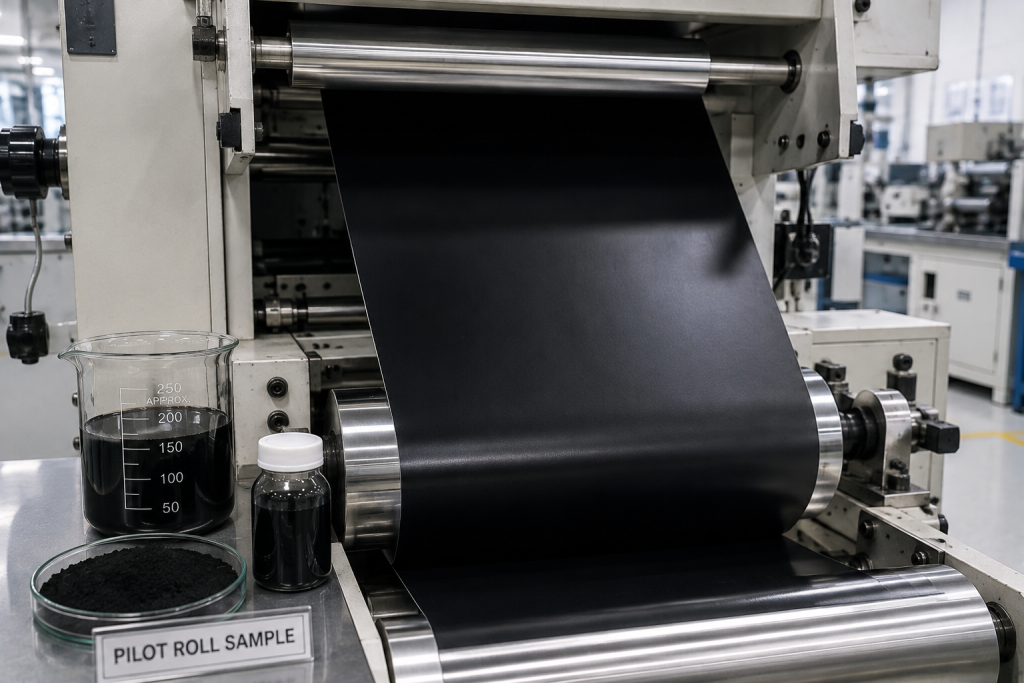
Pilot roll samples are electrode materials produced using:
- Pilot-scale coating systems
- Roll-to-roll manufacturing equipment
- Semi-industrial processing conditions
These samples are typically manufactured in continuous electrode rolls rather than small laboratory sheets.
Pilot roll production simulates real industrial battery manufacturing processes.
Why Pilot Roll Samples Matter
Laboratory samples often fail to represent:
- Industrial coating behavior
- Continuous processing stability
- Large-area uniformity
- Manufacturing repeatability
Pilot roll samples help evaluate whether a material system can survive real production environments.
The Gap Between Lab Samples and Industrial Production
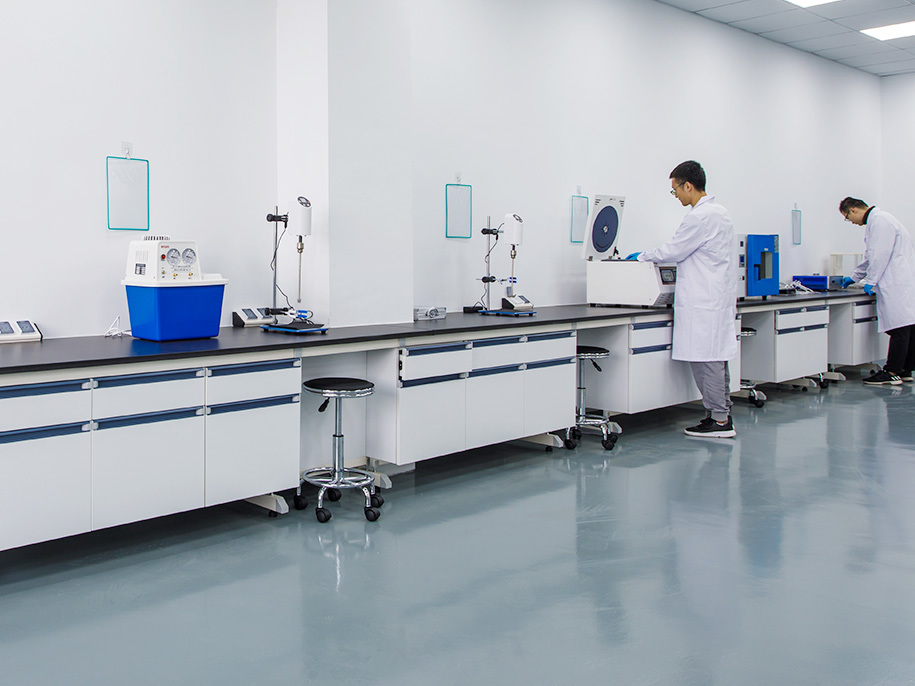
Laboratory Electrode Preparation
Lab electrodes are often produced using:
- Hand coating
- Small-area coating
- Manual drying
- Controlled testing conditions
These methods are excellent for R&D but may hide industrial risks.
Industrial Electrode Manufacturing
Industrial production requires:
- Continuous roll-to-roll coating
- High-speed operation
- Large-scale slurry mixing
- Stable drying systems
- Consistent calendaring
The manufacturing environment changes material behavior significantly.
Why Pilot Rolls Are Critical for Battery Qualification
1. Evaluating Coating Uniformity
Pilot roll samples reveal whether electrodes maintain:
- Stable thickness
- Uniform loading
- Consistent conductive pathways
across long continuous production runs.
Even small variations can affect:
- Capacity consistency
- Internal resistance
- Yield stability
2. Validating Slurry Stability
Pilot-scale mixing helps identify problems such as:
- Sedimentation
- CNT entanglement
- Graphene restacking
- Rheology instability
These issues may not appear during small-batch laboratory preparation.
3. Testing Drying and Film Formation
Industrial drying conditions influence:
- Electrode porosity
- Binder migration
- Conductive network formation
- Mechanical stability
Pilot rolls allow realistic drying validation before mass production.
4. Simulating Continuous Manufacturing
Pilot roll production tests whether materials can survive:
- Continuous coating
- High-speed transport
- Tension control
- Industrial handling conditions
This is essential for manufacturability assessment.
5. Supporting OEM Qualification
OEMs and battery manufacturers often require pilot roll samples for:
- Process evaluation
- Cell assembly trials
- Reliability testing
- Scale-up validation
Pilot samples provide more realistic industrial data than laboratory coupons.
Why Pilot Validation Is Becoming More Important
As batteries move toward:
- Higher energy density
- Thick electrodes
- Silicon anodes
- Solid-state architectures
- Advanced conductive systems
manufacturing complexity increases significantly.
Pilot-scale validation reduces industrial risk before gigafactory deployment.
Key Applications Requiring Pilot Roll Qualification
Advanced Conductive Systems
- CNT conductive networks
- Graphene-enhanced electrodes
- Hybrid carbon systems
Silicon Anodes
Pilot validation helps evaluate:
- Expansion behavior
- Electrode integrity
- Long-cycle manufacturability
Solid-State Batteries
Requires validation of:
- Interface stability
- Coating compatibility
- Dry processing systems
Thick Electrode Manufacturing
Pilot rolls help optimize:
- Drying profiles
- Conductive pathways
- Ion transport balance
Pilot Roll Samples and Manufacturability
Modern battery development is increasingly focused on:
Manufacturability-first engineering.
This means evaluating not only:
- Material performance
but also:
- Production compatibility
- Yield stability
- Process repeatability
- Industrial scalability
Pilot roll samples are essential for this transition.
Why Many Battery Projects Fail Without Pilot Validation
Skipping pilot-scale qualification often creates problems such as:
- Coating instability
- Yield loss
- Electrode cracking
- Process incompatibility
- Scale-up failure
Many materials work well in coin cells but fail during continuous electrode manufacturing.
Co-Development Is Becoming Essential
Successful battery qualification increasingly requires collaboration between:
- Material suppliers
- Pilot manufacturing teams
- Equipment companies
- Cell manufacturers
- OEMs
The industry is moving toward:
Integrated material + process + manufacturing development.
Future Trends in Pilot Battery Manufacturing
The future of pilot validation will increasingly include:
- AI-assisted coating optimization
- Digital twin manufacturing systems
- Smart in-line monitoring
- Dry electrode pilot production
- Automated process stability analysis
Pilot manufacturing is becoming a strategic part of battery commercialization.
Pilot roll samples play a critical role in bridging the gap between laboratory battery research and industrial manufacturing.
They help validate whether advanced battery materials can achieve:
- Stable processing
- Scalable production
- Consistent quality
- Commercial manufacturability
As next-generation battery systems become more advanced, pilot-scale roll validation will become increasingly important for successful battery qualification and industrial commercialization.