
Wet vs Dry Electrode Processes in Battery Manufacturing
A Practical Comparison of Two Key Production Technologies
As lithium battery technology evolves, innovation is no longer limited to new materials. Increasingly, the focus is shifting toward how batteries are manufactured.
Among the most important developments in this area is the comparison between wet electrode processing—the long-established industry standard—and dry electrode processing, an emerging alternative that promises to reshape battery production.
Understanding the differences between these two approaches is critical for material suppliers, engineers, and manufacturers working to improve performance, reduce costs, and scale next-generation battery systems.
What Is Wet Electrode Processing?
Wet electrode processing is the conventional method used in lithium-ion battery manufacturing.
Basic Process Steps
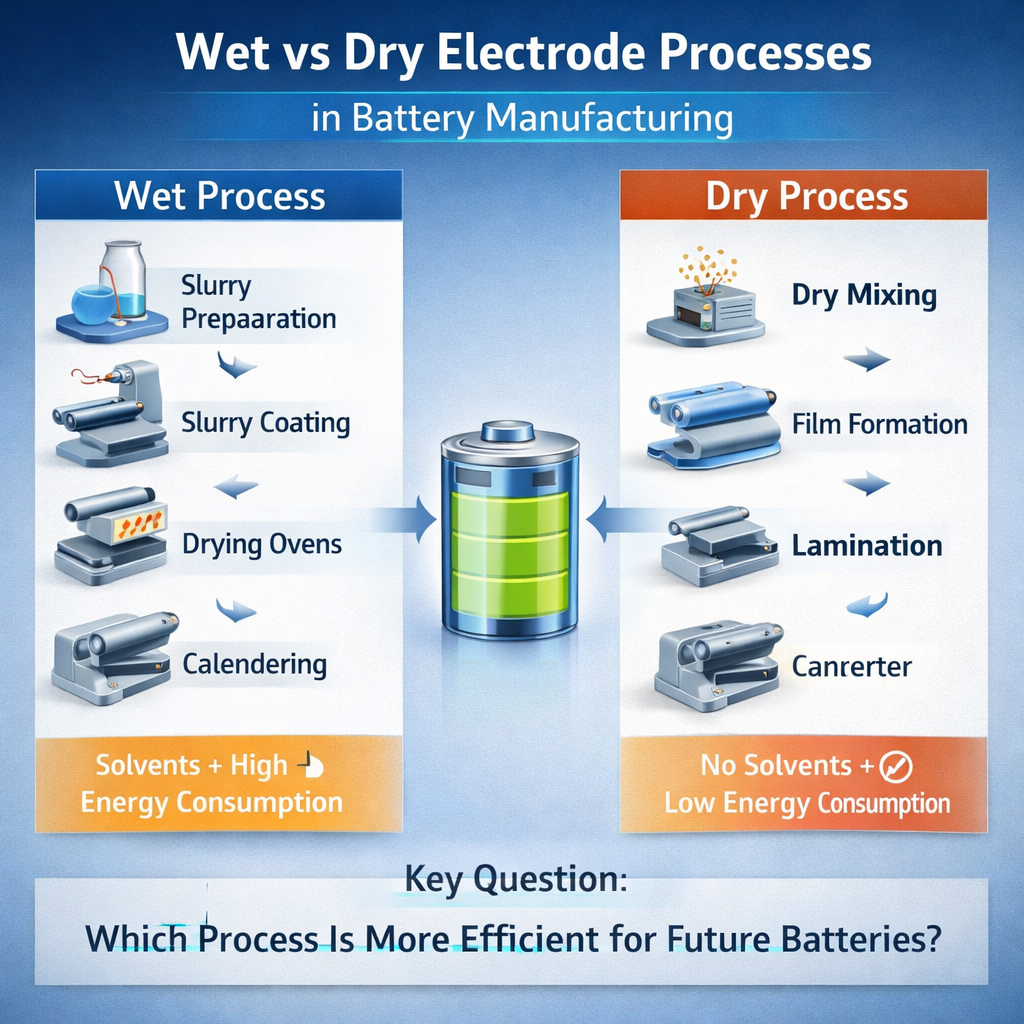
- Slurry Preparation
Active materials, conductive additives, binders, and solvents are mixed into a slurry. - Coating
The slurry is coated onto a metal current collector (e.g., aluminum or copper foil). - Drying
The coated electrode is passed through drying ovens to remove solvents. - Calendering
The electrode is compressed to achieve the desired density and thickness. - Slitting and Assembly
The electrode is cut and prepared for cell assembly.
Key Characteristics
- Mature and widely adopted
- Compatible with a wide range of materials
- Highly optimized industrial processes
Limitations
Despite its maturity, wet processing has several drawbacks:
- High energy consumption (drying ovens)
- Use of solvents such as NMP
- Complex process flow
- Large factory footprint
- Environmental and safety concerns
What Is Dry Electrode Processing?
Dry electrode processing eliminates the use of liquid solvents entirely.
Instead of slurry coating, materials are processed in solid or شبه-solid form and directly formed into electrode films.
Basic Process Steps
- Dry Mixing
Active materials, binders, and conductive additives are mixed without solvents. - Binder Fibrillation
Polymer binders (often PTFE-based) form a fibrous network under mechanical stress. - Film Formation
The mixture is formed into a free-standing electrode film. - Lamination
The film is pressed onto a current collector.
Key Characteristics
- Solvent-free processing
- Reduced energy requirements
- Simplified manufacturing flow
Current Status
Dry electrode technology is still developing, but it is gaining strong interest, especially for:
- electric vehicle batteries
- high-energy-density cells
- next-generation manufacturing lines
Core Differences Between Wet and Dry Processes
1. Solvent Use
Wet Process:
- Requires solvents (e.g., NMP or water)
- Needs solvent recovery systems
Dry Process:
- No solvents
- Eliminates drying and recovery
👉 This is the most fundamental difference.
2. Energy Consumption
Wet Process:
- High energy usage due to drying ovens
Dry Process:
- Significantly lower energy consumption
👉 Dry processing offers strong advantages in sustainability and cost.
3. Process Complexity
Wet Process:
- Multiple steps (mixing → coating → drying → recovery)
Dry Process:
- Fewer steps (mixing → forming → lamination)
👉 Dry processing simplifies production lines.
4. Equipment Requirements
Wet Process:
- Coating machines
- Drying ovens
- Solvent handling systems
Dry Process:
- High-shear mixers
- calendering and lamination equipment
👉 Equipment ecosystems differ significantly.
5. Material Compatibility
Wet Process:
- Broad compatibility
- Easier dispersion using solvents
Dry Process:
- More restrictive
- Requires materials engineered for dry mixing
👉 This is one of the biggest barriers to adoption.
6. Electrode Structure
Wet Process:
- Binder distribution through liquid phase
- Relatively uniform coatings
Dry Process:
- Binder forms mechanical network
- Structure depends on fibrillation and mixing
👉 Microstructure control is more complex in dry systems.
Performance Considerations
Conductivity
- Wet systems allow easier dispersion of conductive additives
- Dry systems require optimized network formation
Mechanical Strength
- Dry electrodes can exhibit strong mechanical integrity
- However, poor processing can lead to cracking or ضعف cohesion
Energy Density
Dry processing can enable:
- higher active material loading
- thicker electrodes
This supports higher energy density designs.
Implications for Advanced Materials (Graphene & CNTs)
In Wet Processing
- Graphene and CNTs can be dispersed using solvents
- Easier to achieve uniform conductive networks
In Dry Processing
- Dispersion becomes more challenging
- Agglomeration risk increases
- Network formation depends on mechanical mixing
Opportunity
If properly engineered, advanced carbon materials can:
- reduce conductive additive loading
- improve network efficiency
- enhance electrode performance
Challenge
Materials must be tailored for:
- dry mixing behavior
- interaction with binders
- process compatibility
Manufacturing Cost Perspective
Wet Process Costs
- Energy (drying)
- Solvent handling and recovery
- Environmental compliance
Dry Process Costs
- Lower operational energy
- Potentially lower footprint
- Higher initial development cost
Long-Term Outlook
Dry processing has the potential to:
- reduce total manufacturing cost
- simplify plant design
- improve scalability
But only after process maturity is achieved.
Why Pilot Lines Are Critical
The transition from wet to dry processing cannot be achieved through lab testing alone.
Pilot lines are essential to:
- validate material behavior under real processing conditions
- optimize mixing, ضغط, and lamination parameters
- evaluate electrode performance at scale
- reduce industrial risk
Dry electrode systems are highly sensitive to:
- pressure
- shear forces
- material interactions
This makes pilot-scale validation indispensable.
Industrial Adoption Outlook
Wet processing will continue to dominate in the near term due to its maturity and reliability.
However, dry electrode technology is expected to grow in importance as:
- sustainability requirements increase
- energy costs rise
- new battery architectures emerge
Early adopters are focusing on:
- high-performance EV batteries
- advanced manufacturing platforms
- integrated material-process solutions
Wet and dry electrode processes represent two fundamentally different approaches to battery manufacturing.
- Wet processing offers maturity, flexibility, and proven scalability
- Dry processing offers simplicity, efficiency, and long-term potential
The future of battery manufacturing will likely involve both approaches, with dry processing gradually gaining ground as materials and processes evolve.
For advanced materials such as graphene and carbon nanotubes, success in this transition will depend not only on material performance, but on the ability to integrate seamlessly into next-generation manufacturing systems.
And ultimately, the bridge between these two worlds is built through engineering, process development, and pilot-scale validation.