
Why Battery Pilot Lines Matter Before Mass Production
In the battery industry, moving directly from laboratory research to mass production is extremely risky. Many battery materials and cell designs that perform well in small-scale testing encounter major problems during industrialization.
This is why battery pilot lines are essential. They provide a critical transition stage where materials, processes, and equipment can be validated under realistic manufacturing conditions before large-scale investment and commercialization.
What Is a Battery Pilot Line?
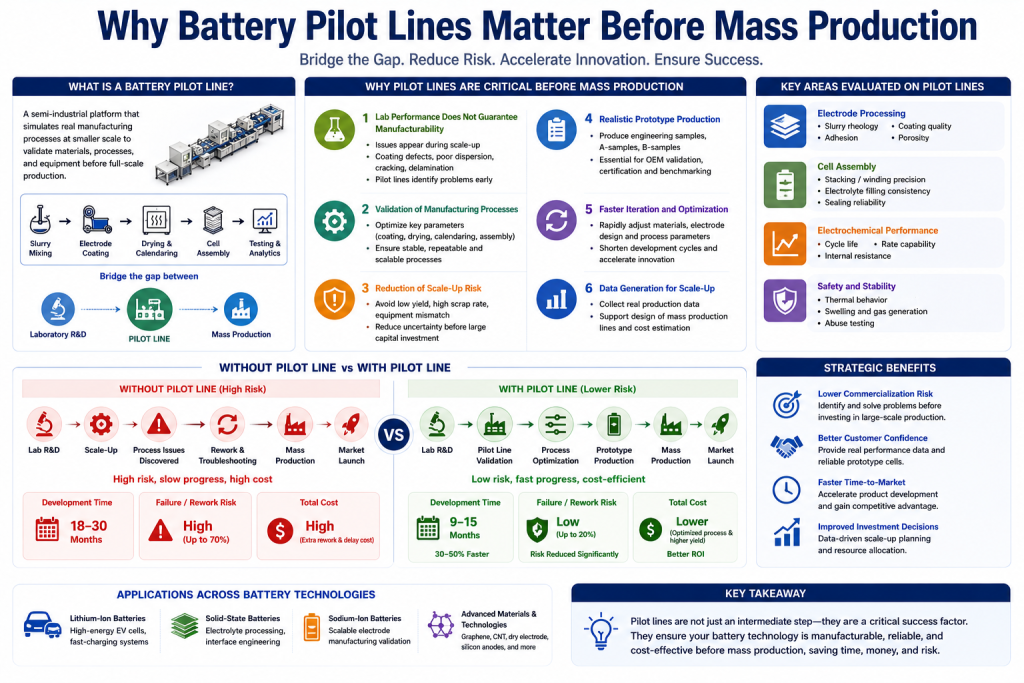
A battery pilot line is a semi-industrial production platform designed to simulate real manufacturing processes at a smaller scale.
It typically includes: Graphene, CNT
- Slurry mixing
- Electrode coating
- Drying and calendaring
- Cell assembly
- Electrochemical testing
Pilot lines bridge the gap between:
- Laboratory R&D
- Full-scale manufacturing
Why Pilot Lines Are Critical Before Mass Production
1. Lab Performance Does Not Guarantee Manufacturability
A material may perform well in:
- Coin cells
- Small laboratory batches
But problems often appear during scale-up:
- Poor coating uniformity
- Inconsistent dispersion
- Cracking or delamination
- Process instability
Pilot lines identify these issues early.
2. Validation of Manufacturing Processes
Battery performance depends heavily on processing conditions.
Pilot lines help optimize:
- Coating speed
- Drying temperature
- Electrode density
- Pressure and lamination parameters
This ensures the process is:
- Stable
- Repeatable
- Scalable
3. Reduction of Scale-Up Risk
Without pilot validation, companies risk:
- Low production yield
- High scrap rates
- Equipment incompatibility
- Delayed commercialization
Pilot lines reduce uncertainty before large capital investment. Graphene, CNT
4. Realistic Prototype Production
Pilot lines can produce:
- Engineering samples
- A-samples and B-samples
- Customer qualification batches
These are essential for:
- OEM validation
- Safety certification
- Performance benchmarking
5. Faster Iteration and Optimization
Pilot-scale testing enables rapid adjustment of:
- Material formulations
- Electrode structures
- Process parameters
This accelerates innovation and shortens development cycles.
Key Areas Evaluated on Pilot Lines
Electrode Processing
- Slurry rheology
- Coating quality
- Adhesion and porosity
Cell Assembly
- Stacking or winding precision
- Electrolyte filling consistency
- Sealing reliability
Electrochemical Performance
- Cycle life
- Rate capability
- Internal resistance
Safety and Stability
- Thermal behavior
- Swelling and gas generation
- Abuse testing
Applications Across Battery Technologies
Lithium-Ion Batteries
- High-energy EV cells
- Fast-charging systems
Solid-State Batteries
- Electrolyte processing
- Interface engineering
Sodium-Ion Batteries
- Scalable electrode manufacturing validation
Advanced Conductive Systems
- Graphene and CNT-enhanced electrodes
- Dry electrode technologies
Pilot Lines vs Mass Production
| Aspect | Pilot Line | Mass Production |
|---|---|---|
| Purpose | Validation & optimization | High-volume manufacturing |
| Flexibility | High | Lower |
| Output Volume | Small to medium | Large-scale |
| Risk Level | Controlled | Commercial risk |
| Process Adjustment | Easy | Difficult & expensive |
Strategic Benefits for Companies
Lower Commercialization Risk
Identify problems before factory-scale investment.
Better Customer Confidence
Provide real prototype cells instead of theoretical data.
Faster Time-to-Market
Accelerate transition from R&D to commercial launch.
Improved Investment Decisions
Generate real production and performance data for scaling plans.
Common Challenges
- High pilot line setup costs
- Need for experienced engineers and operators
- Balancing flexibility with process stability
- Translating pilot data into gigafactory-scale production
Future Trends
- Modular multi-chemistry pilot lines
- AI-driven process optimization
- Digital twin manufacturing simulation
- Dry electrode and solvent-free pilot production systems
Battery pilot lines matter because they transform laboratory concepts into manufacturable technologies. They reduce risk, validate processes, improve product reliability, and accelerate commercialization before mass production begins. Graphene, CNT
For companies developing next-generation batteries, pilot lines are not optional—they are a critical foundation for successful scale-up and long-term competitiveness.