
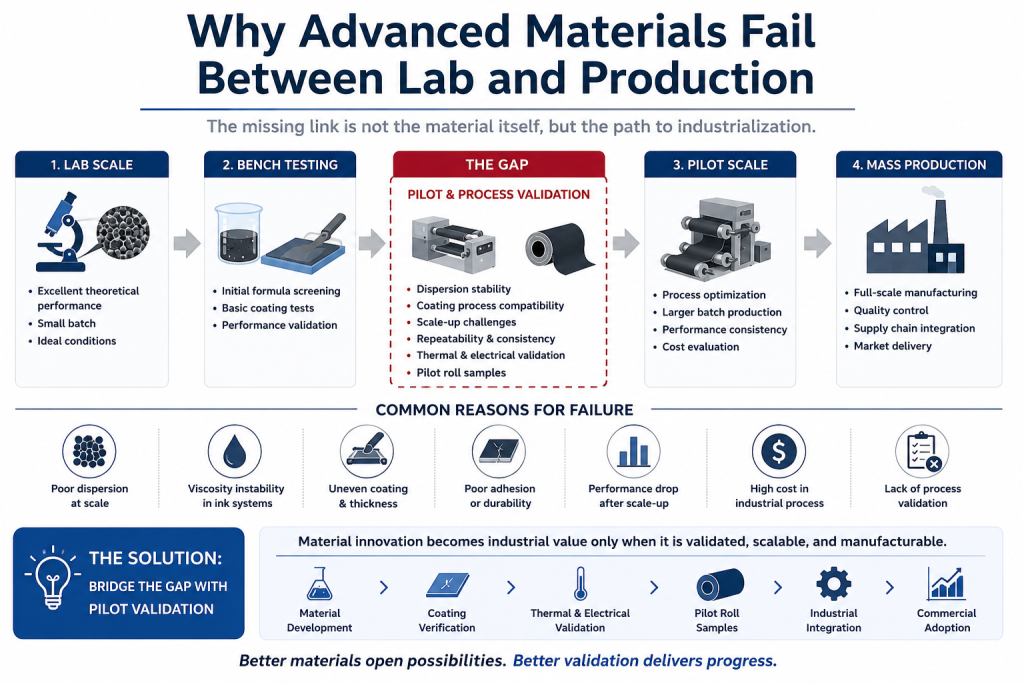
Why Advanced Materials Fail Between Lab and Production
Advanced materials such as graphene, CNTs, and other nano-enhanced systems continue to attract attention across industries including energy storage, thermal management, electronics, and AI infrastructure.
In laboratories, many of these materials demonstrate impressive theoretical properties:
- High thermal conductivity
- Excellent electrical performance
- Lightweight structures
- Enhanced mechanical strength
However, moving from laboratory success to industrial production remains one of the biggest challenges in the materials industry.
The Gap Between Performance and Manufacturability
A material may perform well in a controlled laboratory environment, but industrial manufacturing introduces completely different requirements:
- Process stability
- Repeatability
- Coating compatibility
- Dispersion consistency
- Large-scale handling
- Cost efficiency
This is where many promising projects begin to slow down.
For example, a conductive ink that performs well in a small laboratory sample may behave very differently during pilot coating or roll-to-roll processing. Issues such as aggregation, viscosity instability, uneven coating thickness, or poor adhesion can quickly appear during scale-up.
The challenge is no longer only about the material itself.
It becomes a question of whether the material can integrate into a real manufacturing process.
Industrialization Requires Validation
In many next-generation material projects, the missing step is not research — it is validation.
Between laboratory testing and full-scale production, there is an important intermediate stage:
- Pilot validation
- Coating process verification
- Thermal and electrical testing
- Small-batch repeatability studies
- Pilot roll sample evaluation
Without this stage, many projects remain theoretical concepts rather than manufacturable solutions.
Why Pilot-Scale Evaluation Matters
Pilot-scale validation helps bridge the gap between material innovation and industrial adoption.
It allows teams to evaluate:
- Whether a formulation can be coated consistently
- Whether dispersion remains stable during scaling
- Whether thermal or electrical performance remains repeatable
- Whether the process can fit existing industrial equipment
This stage often determines whether a material becomes commercially viable.
The Future Is Not Only Better Materials
The future of advanced materials will not depend only on higher performance values.
Increasingly, success will depend on:
- Process compatibility
- Manufacturing integration
- Industrial repeatability
- Validation capability
The companies that can connect materials with scalable industrial processes will play an important role in the next phase of energy storage, electronics, and thermal management development.
Advanced materials are only the beginning.
Industrialization is what ultimately determines real-world adoption.