
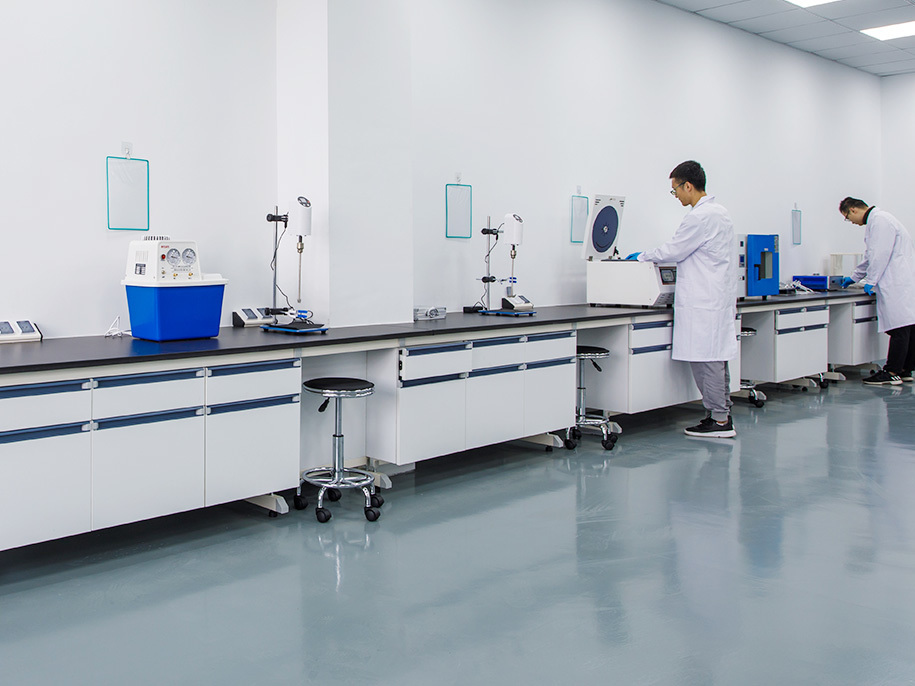
Why Europe’s Energy Transition Needs Material Validation Platforms
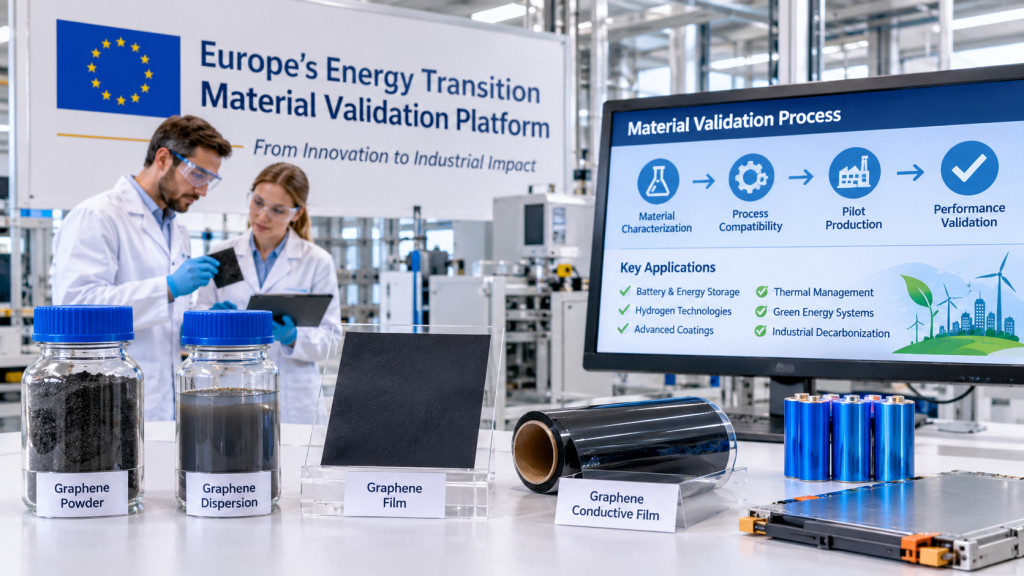
Europe’s energy transition is creating new opportunities across battery manufacturing, energy storage, renewable energy, hydrogen technologies, electric mobility, advanced electronics, and industrial decarbonization.
As governments and industries work toward lower-carbon energy systems, demand is increasing for materials that can improve energy efficiency, storage capacity, durability, safety, and manufacturing performance.
Advanced materials such as graphene, carbon nanotubes (CNTs), silicon-based anode materials, conductive additives, functional coatings, advanced ceramics, and high-performance composites are attracting growing interest.
However, discovering a promising material is only the beginning of the commercialization process.
A material that performs well in laboratory experiments may not deliver the same results when incorporated into a commercial formulation, processed using industrial equipment, or integrated into a complete energy system.
This creates an important gap between material innovation and industrial adoption.
For Europe, where energy transition projects involve complex supply chains, strict quality expectations, and demanding industrial applications, material validation platforms can play an increasingly important role.
They connect material suppliers, research institutions, engineering teams, pilot facilities, and industrial customers through a structured process of testing, validation, and application development.
The question is no longer simply which advanced materials can be developed, but how quickly and reliably they can be validated for real industrial use.
1. Europe’s Energy Transition Is Also a Materials Challenge
The energy transition is often discussed in terms of renewable energy generation, battery capacity, grid infrastructure, and electrification.
However, every major energy technology depends on materials.
The performance and reliability of energy systems are influenced by the properties of their constituent materials and how those materials interact during manufacturing and operation.
Battery and Energy Storage Technologies
Battery manufacturing requires a wide range of materials, including:
- Cathode active materials
- Graphite and silicon-based anodes
- Conductive carbon additives
- Binders and electrolytes
- Separator materials
- Current collectors
- Thermal management materials
- Fire protection and insulation materials
The development of next-generation batteries introduces additional material challenges.
Silicon-carbon anodes, sodium-ion battery materials, solid-state electrolytes, and advanced conductive networks may offer potential performance improvements, but their industrial suitability must be demonstrated through systematic testing.
Renewable Energy Systems
Solar, wind, and other renewable energy technologies also depend on specialized materials.
Examples include:
- Corrosion-resistant coatings
- Lightweight structural composites
- Electrical insulation materials
- Thermal management components
- High-performance polymers
- Protective materials for outdoor equipment
These materials must withstand environmental exposure, temperature changes, mechanical stress, and long-term operation.
Hydrogen Technologies
Hydrogen production, storage, and utilization involve demanding material requirements.
Catalysts, membranes, electrodes, seals, coatings, and corrosion-resistant components must be evaluated under specific chemical, electrical, thermal, and pressure conditions.
A material that performs well in a laboratory environment may behave differently under continuous operating conditions.
Power Electronics and Grid Infrastructure
The electrification of industrial processes and expansion of renewable energy require increasingly sophisticated power conversion and distribution systems.
Materials used in thermal interface components, electrical insulation, conductive structures, encapsulation, and protective coatings must meet application-specific requirements.
Across these sectors, material performance is inseparable from system reliability.
2. The Gap Between Laboratory Research and Industrial Adoption
One of the most persistent challenges in advanced materials commercialization is the transition from laboratory success to industrial performance.
Research institutions may demonstrate promising material properties using controlled laboratory conditions.
Industrial manufacturers, however, need answers to different questions:
- Can the material be produced consistently?
- Can it be incorporated into existing formulations?
- Is it compatible with current manufacturing equipment?
- Can its performance be reproduced across multiple batches?
- Does it remain stable under actual operating conditions?
- Is the production cost commercially acceptable?
- Can the material be supplied reliably?
These questions cannot always be answered through basic material characterization.
Laboratory Results Do Not Automatically Translate into Production Results
A material may show high electrical conductivity in a laboratory test but perform inconsistently when incorporated into a large-area coating.
A graphene-based additive may improve the conductive network in a small battery electrode, but its dispersion and processing behavior may change during larger-scale slurry preparation.
A corrosion-resistant coating may perform well in a short laboratory test but experience adhesion deterioration after prolonged environmental exposure.
These examples illustrate an important distinction:
Material properties, manufacturing compatibility, and application performance are three different levels of validation.
A successful energy transition requires all three.
3. What Is a Material Validation Platform?
A material validation platform is a coordinated technical and industrial resource that helps evaluate whether a material is suitable for a defined application.
It is not necessarily a single laboratory or testing machine.
Instead, it can combine several capabilities through a connected development process.
Typical functions include:
- Material characterization
- Formulation development
- Process compatibility evaluation
- Prototype preparation
- Pilot-scale manufacturing
- Performance testing
- Reliability assessment
- Batch consistency evaluation
- Technical documentation
The platform connects material development with practical industrial requirements.
From Material Supply to Application Validation
A conventional material transaction may involve a supplier providing samples and technical datasheets to a customer.
However, the customer may still need to determine:
- Whether the material is compatible with the formulation
- How much material should be used
- Which processing parameters are suitable
- Whether existing equipment can handle it
- How the final component should be evaluated
A validation platform helps organize these activities.
It provides a more structured pathway from initial material evaluation to application-specific evidence.
4. Why Europe Needs More Connected Validation Resources
Europe has a diverse industrial ecosystem involving automotive manufacturers, battery developers, chemical companies, equipment manufacturers, research institutions, and energy technology startups.
These organizations may have different levels of access to advanced materials, testing equipment, and pilot manufacturing resources.
However, technical capabilities are not always located within the same organization or geographical region.
This creates several reasons why connected material validation platforms are valuable.
4.1 Fragmented Technical Resources
A material supplier may have production capability but limited access to downstream application testing.
A university may have advanced analytical equipment but no suitable pilot manufacturing line.
An industrial customer may have a clear application requirement but lack the internal resources to evaluate an unfamiliar material.
A validation platform can coordinate these capabilities.
Instead of requiring every participant to build all facilities internally, technical resources can be organized according to the requirements of each project.
4.2 Reducing Development Time
Industrial development projects often involve repeated cycles of sample testing, formulation adjustment, and performance evaluation.
Without a clearly defined validation process, these cycles can become inefficient.
A coordinated platform can help establish:
- Application requirements
- Material selection criteria
- Testing objectives
- Prototype preparation
- Performance evaluation
- Process optimization
- Pilot validation
- Commercial feasibility assessment
This structure helps identify technical limitations earlier and makes development decisions more evidence-based.
4.3 Supporting Smaller Companies and Startups
Large manufacturers may maintain internal R&D laboratories and pilot production facilities.
Smaller technology companies often face greater resource constraints.
They may have promising materials or application concepts but insufficient infrastructure to conduct comprehensive validation.
Access to external testing and pilot resources can help reduce the investment required before approaching industrial customers.
This is particularly relevant for startups developing advanced battery materials, functional coatings, thermal management solutions, and specialized energy components.
4.4 Connecting Research with Manufacturing
Europe has strong research capabilities in materials science, chemistry, engineering, and energy technologies.
However, scientific innovation and industrial manufacturing operate under different requirements.
Research may prioritize demonstrating a new material mechanism.
Manufacturing prioritizes process stability, production efficiency, cost, quality control, and repeatability.
Material validation platforms help connect these two environments by translating research outcomes into measurable manufacturing requirements.
5. Key Material Areas That Require Validation
Different energy transition technologies require different validation methods.
A platform should therefore be organized around application-specific requirements rather than relying on one universal testing procedure.
5.1 Advanced Carbon Materials
Graphene, graphene oxide, reduced graphene oxide, and carbon nanotubes are being investigated for applications in:
- Battery conductive networks
- Supercapacitor electrodes
- Conductive coatings
- Thermal management
- Corrosion protection
- Polymer composites
- Electromagnetic interference shielding
Their performance depends on more than nominal material purity.
Important validation parameters include:
- Layer number and lateral size
- Surface chemistry
- Defect characteristics
- Dispersion stability
- Electrical conductivity
- Thermal properties
- Compatibility with binders and solvents
- Batch-to-batch consistency
For example, a graphene material intended for battery electrodes must be evaluated in the actual electrode formulation.
Powder characterization alone cannot establish its suitability for commercial electrode manufacturing.
5.2 Battery and Energy Storage Materials
Battery materials require validation at several levels.
These may include:
- Raw material characterization
- Slurry formulation
- Electrode coating
- Drying and calendering
- Electrode mechanical properties
- Cell assembly
- Electrochemical performance
- Thermal and safety-related evaluation
For advanced materials such as silicon-carbon anodes and novel conductive additives, pilot-scale electrode processing is particularly important.
A material may demonstrate promising capacity or conductivity in a small laboratory test but encounter challenges during high-loading electrode production.
Validation should therefore consider the entire manufacturing sequence.
5.3 Functional Coatings and Surface Materials
Coatings used in energy systems must often combine multiple functions.
Examples include:
- Corrosion resistance
- Electrical conductivity
- Thermal conductivity
- Electrical insulation
- Wear resistance
- Chemical resistance
- Environmental protection
The final coating performance depends on formulation, substrate preparation, application method, curing conditions, adhesion, and environmental exposure.
Testing the coating material alone is insufficient.
The coating must be evaluated as part of the actual substrate and component structure.
5.4 Thermal Management Materials
As power density increases in batteries, power electronics, and energy conversion equipment, thermal management becomes increasingly important.
Potential materials include:
- Graphene-based thermal fillers
- Carbon nanotube composites
- Thermally conductive polymers
- Ceramic-filled interface materials
- Thermal insulation materials
- Protective thermal coatings
Validation should distinguish between in-plane and through-plane thermal conductivity, electrical insulation requirements, interface resistance, mechanical stability, and long-term aging.
The highest thermal conductivity value does not necessarily translate into the best system-level performance.
6. Pilot-Scale Validation: The Missing Link in Commercialization
Material characterization is important, but many industrial challenges only become visible during processing.
Pilot-scale validation provides an intermediate step between laboratory development and commercial production.
It allows developers to evaluate materials under more realistic manufacturing conditions without immediately committing to full industrial investment.
What Pilot-Scale Validation Can Reveal
Process compatibility
Can the material be handled by existing mixing, coating, extrusion, printing, or forming equipment?
Formulation stability
Does the material remain evenly distributed during processing and storage?
Manufacturing repeatability
Can the same product quality be achieved across multiple production runs?
Performance under realistic conditions
Does the material maintain its required properties after manufacturing and application?
Production economics
Are material consumption, process time, energy requirements, yield, and equipment costs commercially reasonable?
Example: Graphene-Based Battery Conductive Additives
A battery developer may identify a graphene or CNT additive that shows promising conductivity in laboratory testing.
The next step is not simply to increase the sample quantity.
The material should be incorporated into an electrode slurry, followed by coating, drying, calendering, and relevant electrode or cell testing.
During this process, developers may discover:
- Unexpected slurry viscosity
- Dispersion instability
- Coating defects
- Poor electrode adhesion
- Differences in loading uniformity
- Unexpected impedance behavior
Pilot-scale validation helps identify these issues before commercial adoption.
7. Material Validation Should Include Repeatability and Reliability
A single successful test is not enough to establish industrial suitability.
Energy systems are expected to operate reliably over extended periods, often under demanding environmental and operating conditions.
Material validation should therefore include repeatability and reliability.
Batch-to-Batch Consistency
Different production batches should be evaluated to determine whether critical material properties remain within agreed specifications.
Relevant indicators may include:
- Chemical composition
- Particle size distribution
- Moisture content
- Surface chemistry
- Dispersion behavior
- Electrical or thermal properties
Environmental Stability
Depending on the application, testing may include:
- Thermal cycling
- Humidity exposure
- Salt spray or corrosion testing
- Chemical resistance
- UV exposure
- Mechanical abrasion
- Long-duration operation
Process Repeatability
The same formulation and manufacturing conditions should be tested across multiple runs.
Variations in material behavior may affect production efficiency and final product quality even when individual samples pass basic characterization.
A validation platform should help distinguish between a material that works once and a material that can be manufactured consistently.
8. Building a Cross-Border Material Validation Ecosystem
Europe’s energy transition involves companies and research organizations across multiple countries.
Material suppliers may be located outside Europe, while formulation development, pilot testing, and final manufacturing take place in different regions.
This creates opportunities for cross-border validation networks.
A connected ecosystem may involve:
| Participant | Potential contribution |
|---|---|
| Material producers | Supply materials and provide technical specifications |
| Research institutions | Conduct fundamental research and advanced characterization |
| Independent laboratories | Perform standardized material and performance testing |
| Pilot facilities | Evaluate manufacturing processes and repeatability |
| Equipment manufacturers | Assess process and equipment compatibility |
| Industrial customers | Define application requirements and acceptance criteria |
| Engineering partners | Coordinate technical development and integration |
The purpose is not to centralize every capability in one organization.
It is to connect the appropriate resources according to the technical requirements of each project.
Why Independent Validation Can Be Valuable
Material suppliers naturally focus on the properties of their own products.
Industrial customers, on the other hand, need evidence that a material performs within their specific manufacturing and application environment.
An independent or appropriately structured validation process can provide additional confidence.
However, independence alone does not guarantee quality.
Testing methods, sample preparation, acceptance criteria, data integrity, and technical responsibilities must also be clearly defined.
9. What Makes a Good Material Validation Platform?
A useful platform should provide more than access to testing equipment.
It should connect technical capabilities with practical development requirements.
Several characteristics are particularly important.
Clear Project Scope
Each project should define:
- Target application
- Material specifications
- Testing objectives
- Required sample quantities
- Processing conditions
- Expected deliverables
- Acceptance criteria
Appropriate Technical Resources
The platform should have access to relevant equipment and qualified technical teams.
Not every project requires the same testing facilities.
Resources should be selected according to the material, application, and validation stage.
Defined Deliverables
A validation project should produce clear outputs.
These may include:
- Material characterization reports
- Formulation records
- Prototype samples
- Process parameter records
- Performance test results
- Repeatability assessments
- Technical recommendations
Data and Intellectual Property Protection
Material development often involves confidential formulations, process parameters, and customer-specific product designs.
NDA arrangements, sample ownership, data confidentiality, background intellectual property, and newly developed intellectual property should be addressed before work begins.
Commercial and Technical Transparency
The platform should distinguish between material supply, testing services, paid development work, and application engineering.
This helps customers understand what is included in a project and prevents confusion about technical responsibilities or performance guarantees.
10. From Material Validation to Commercial Deployment
Material validation should not be viewed as an isolated laboratory service.
It is part of a broader commercialization pathway.
A practical development process may include:
Stage 1: Material Screening
Identify candidate materials and compare their basic properties against application requirements.
Stage 2: Technical Feasibility
Evaluate whether the material is technically suitable for the intended application.
Stage 3: Formulation Development
Develop or adjust the formulation to improve compatibility and processing performance.
Stage 4: Prototype Preparation
Produce initial samples or components for functional evaluation.
Stage 5: Pilot-Scale Validation
Test the material under representative manufacturing conditions.
Stage 6: Reliability and Repeatability Assessment
Evaluate performance across multiple runs and relevant environmental or operating conditions.
Stage 7: Industrial Qualification
Confirm specifications, quality requirements, manufacturing compatibility, supply arrangements, and commercial feasibility.
This structured pathway can help reduce the uncertainty associated with introducing unfamiliar materials into established industrial systems.
11. The Commercial Opportunity for Material Validation Platforms
As the energy transition progresses, the need for advanced materials will continue to create opportunities for specialized technical service providers.
However, the commercial value of a validation platform does not come only from testing individual samples.
Its value comes from helping customers make better development and investment decisions.
Potential service models include:
- Material characterization and screening
- Application-specific testing
- Formulation and process development
- Prototype and sample preparation
- Pilot-scale production
- Batch consistency evaluation
- Technical coordination across suppliers and research teams
- Industrial qualification support
For material producers, these services can help demonstrate application suitability.
For industrial customers, they can reduce the risk of adopting unfamiliar materials.
For research institutions, they can create a clearer pathway from research outcomes to manufacturing applications.
For technology startups, they can provide access to technical resources without requiring the immediate construction of complete in-house facilities.
The most effective platform is therefore not necessarily the one with the largest equipment inventory.
It is the one that can connect the right technical resources, define clear project responsibilities, and deliver reliable evidence for industrial decisions.
Europe’s energy transition is not only a challenge of deploying renewable energy systems and expanding battery production. It is also a challenge of developing, validating, and industrializing the materials that make these technologies possible.
Advanced materials such as graphene, CNTs, silicon-carbon systems, functional coatings, and thermal management composites offer opportunities across multiple energy sectors.
However, laboratory performance alone cannot establish industrial suitability.
Materials must be evaluated through formulation development, process compatibility, pilot manufacturing, repeatability testing, and application-specific validation.
Material validation platforms can help bridge the gap between research and manufacturing by connecting material suppliers, laboratories, pilot facilities, engineering teams, and industrial customers.
As Europe’s energy transition becomes increasingly technology-intensive, the ability to validate materials efficiently and reliably will become an important part of industrial competitiveness.
The next stage of the energy transition will depend not only on discovering better materials, but also on proving that they can work consistently in real industrial applications.
Questions
1. What is a material validation platform?
A material validation platform is a coordinated technical resource that evaluates whether materials are suitable for specific applications. It may combine characterization, formulation development, prototype preparation, pilot production, and performance testing.
2. Why does Europe need material validation platforms for its energy transition?
Europe’s energy transition involves complex technologies and supply chains. Validation platforms can help connect research institutions, material producers, manufacturers, and industrial customers while reducing the uncertainty involved in adopting new materials.
3. What materials require validation for energy applications?
Examples include graphene, carbon nanotubes, silicon-based anode materials, conductive additives, advanced ceramics, functional coatings, thermal interface materials, electrolytes, and high-performance composites.
4. What is the difference between material testing and material validation?
Material testing measures specific properties under defined conditions. Material validation evaluates whether a material meets the requirements of a particular application, including processing compatibility, performance, repeatability, and reliability.
5. Why is pilot-scale validation important?
Pilot-scale validation helps identify manufacturing challenges that may not appear in laboratory experiments. It evaluates process compatibility, formulation stability, production repeatability, product quality, and preliminary manufacturing economics.
6. Can small technology companies benefit from external validation platforms?
Yes. External platforms can provide access to testing, formulation, and pilot manufacturing resources without requiring startups to invest immediately in complete internal facilities.
7. Does material validation guarantee commercial success?
No. Validation reduces technical uncertainty but does not guarantee commercial adoption. Market demand, production economics, regulatory requirements, supply continuity, and customer qualification also influence commercialization.