
Why Most Graphene Projects Fail Before Industrialization
Graphene has been described as one of the most revolutionary advanced materials of the modern era. Its exceptional:
- Electrical conductivity
- Thermal conductivity
- Mechanical strength
- Lightweight structure
- Barrier performance
have created enormous expectations across industries such as:
- Batteries
- Conductive coatings
- Thermal management
- Electronics
- Composites
Yet despite thousands of research papers and years of investment, relatively few graphene projects achieve successful industrial commercialization.
The reason is simple:
Laboratory success does not automatically translate into industrial success.
Most graphene projects fail before industrialization because the challenges of manufacturing, scalability, process integration, and commercial validation are far more complex than the material itself.
The “Graphene Commercialization Gap”
Many graphene projects succeed in:
- Material characterization
- Academic testing
- Small-scale demonstrations
But fail during transition to:
- Pilot manufacturing
- Process validation
- Industrial production
This gap is where most commercialization attempts break down.
Why Most Graphene Projects Fail
1. Overfocus on Material Performance
Many projects concentrate heavily on:
- Conductivity values
- Surface area
- Material purity
- Laboratory test results
However, industrial customers care more about:
- Manufacturability
- Process stability
- Scalability
- Cost-performance balance
A graphene material can look impressive scientifically while remaining commercially impractical.
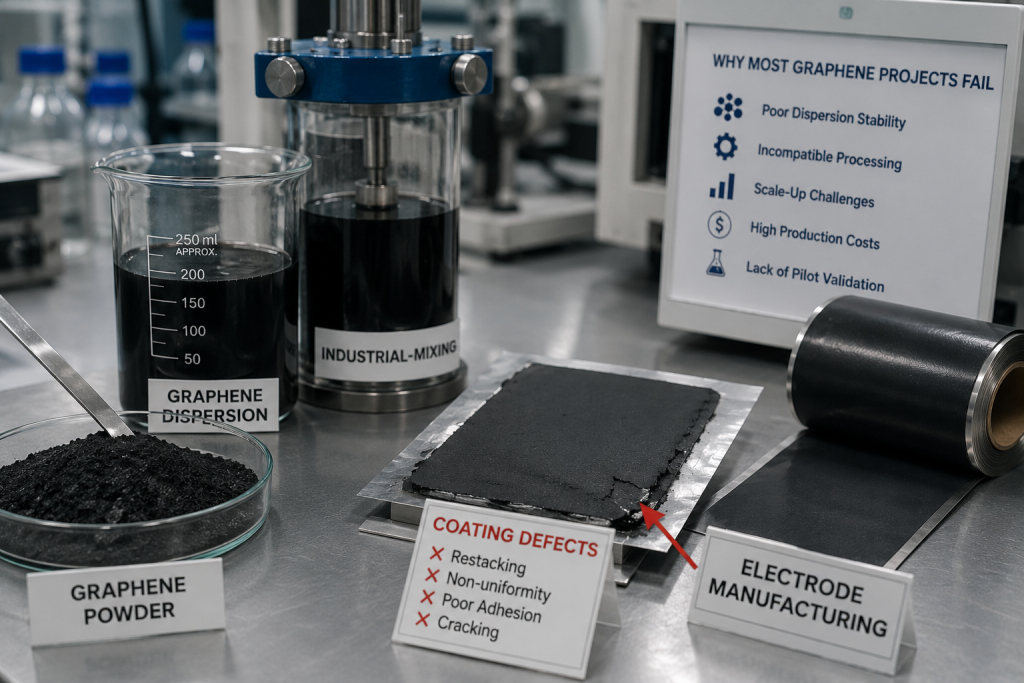
2. Poor Dispersion Stability
Graphene sheets naturally tend to:
- Agglomerate
- Restack
- Sediment
At laboratory scale, these problems may be manageable.
At industrial scale, they become major issues affecting:
- Conductivity consistency
- Coating quality
- Production yield
- Long-term stability
Dispersion engineering is often underestimated.
3. Lack of Manufacturing Compatibility
Industrial production requires compatibility with processes such as:
- Roll-to-roll coating
- Slot-die coating
- Continuous mixing systems
- Automated production lines
Many graphene formulations fail because they:
- Change slurry rheology
- Cause coating instability
- Increase viscosity excessively
- Create equipment handling problems
4. Failure to Scale Economically
A formulation that works in gram-scale research may become:
- Too expensive
- Too slow
- Too complex
when scaled to industrial production.
Commercialization requires balancing:
- Performance
- Cost
- Throughput
- Yield
not simply maximizing laboratory performance.
5. Inconsistent Material Quality
Graphene quality can vary significantly depending on:
- Production method
- Layer thickness
- Defect density
- Functionalization
- Raw material source
This creates problems in:
- Repeatability
- Product consistency
- Customer qualification
Industrial markets require highly stable material specifications.
6. Weak Understanding of Electrode and Coating Processes
Many graphene projects are driven by material scientists but lack deep integration with:
- Electrode manufacturing
- Coating engineering
- Process scale-up
- Industrial validation
As a result:
- Lab coatings work
- Industrial coatings fail
This is a common commercialization bottleneck.
7. Lack of Pilot-Scale Validation
Skipping pilot validation is one of the biggest reasons projects fail.
Pilot lines are essential for testing:
- Dispersion behavior
- Coating uniformity
- Process repeatability
- Yield stability
- Equipment compatibility
before mass production.
Without pilot validation, industrial risk becomes extremely high.
The Difference Between Research and Industrialization
| Research Focus | Industrial Focus |
|---|---|
| Maximum performance | Stable manufacturability |
| Small-batch optimization | Continuous production |
| Scientific novelty | Commercial scalability |
| Material characterization | Process validation |
| Lab testing | Yield and reliability |
This difference is where many projects collapse.
Why Industrialization Requires Process Engineering
Graphene commercialization is not just about materials.
It also depends on:
- Rheology control
- Coating process optimization
- Drying behavior
- Interface engineering
- Production stability
In reality:
Process engineering often matters more than material performance alone.
The Importance of Co-Development
Successful graphene industrialization increasingly requires collaboration between:
- Material suppliers
- Pilot manufacturing teams
- Equipment companies
- OEMs and end users
The future of graphene commercialization is moving toward:
Integrated material + process + manufacturing development.
Key Areas Where Graphene Still Has Strong Potential
Despite commercialization challenges, graphene remains highly promising in applications such as:
Conductive Coatings
- EMI shielding
- Antistatic coatings
- Smart conductive surfaces
Thermal Management
- AI server cooling
- Thermal interface materials
- Heat spreaders
Battery Systems
- Conductive additives
- Silicon anode enhancement
- Thick electrode architectures
Structural Composites
- Lightweight conductive materials
- Reinforced polymer systems
What Successful Graphene Companies Do Differently
Successful industrial graphene companies usually focus on:
Application-Driven Development
Not “graphene for everything.”
Pilot Manufacturing Early
Validate processes before commercialization.
Manufacturability First
Design materials around industrial production realities.
Long-Term Industrial Partnerships
Co-develop solutions with customers and manufacturers.
Future Trends in Graphene Industrialization
The next phase of graphene commercialization will focus on:
- Pilot-scale process engineering
- Hybrid graphene/CNT systems
- Water-based scalable formulations
- AI-assisted manufacturing optimization
- Continuous industrial coating systems
Most graphene projects fail before industrialization not because graphene lacks potential, but because commercialization requires far more than strong laboratory data.
Industrial success depends on the ability to transform graphene into:
- Stable
- Manufacturable
- Scalable
- Economically viable systems
The companies that succeed will be those capable of integrating:
- advanced materials
- process engineering
- pilot validation
- industrial manufacturing
into a complete commercialization strategy.