
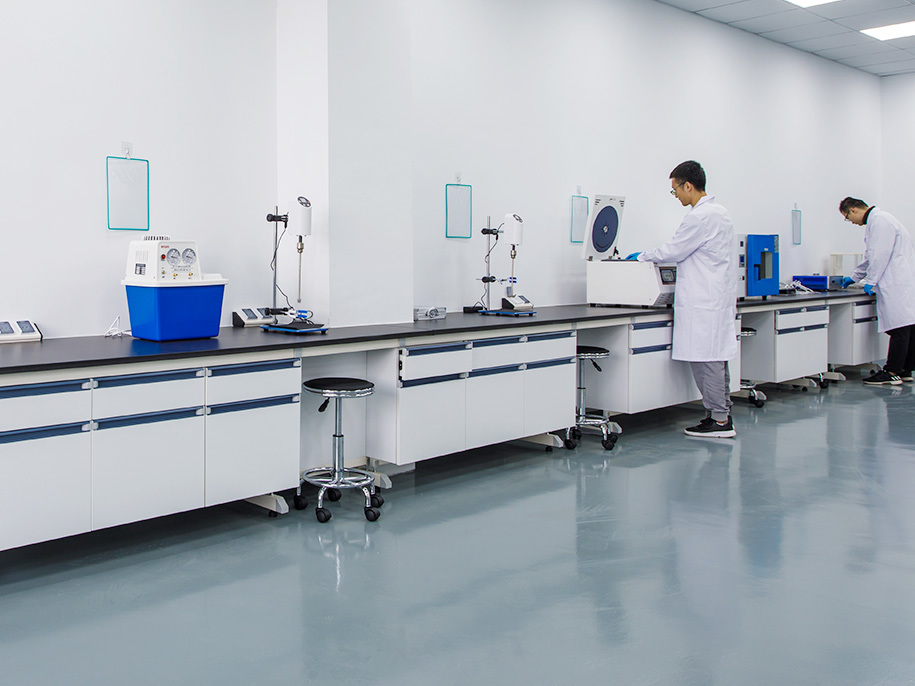
Why Coating Process Matters More Than Material in Graphene Films
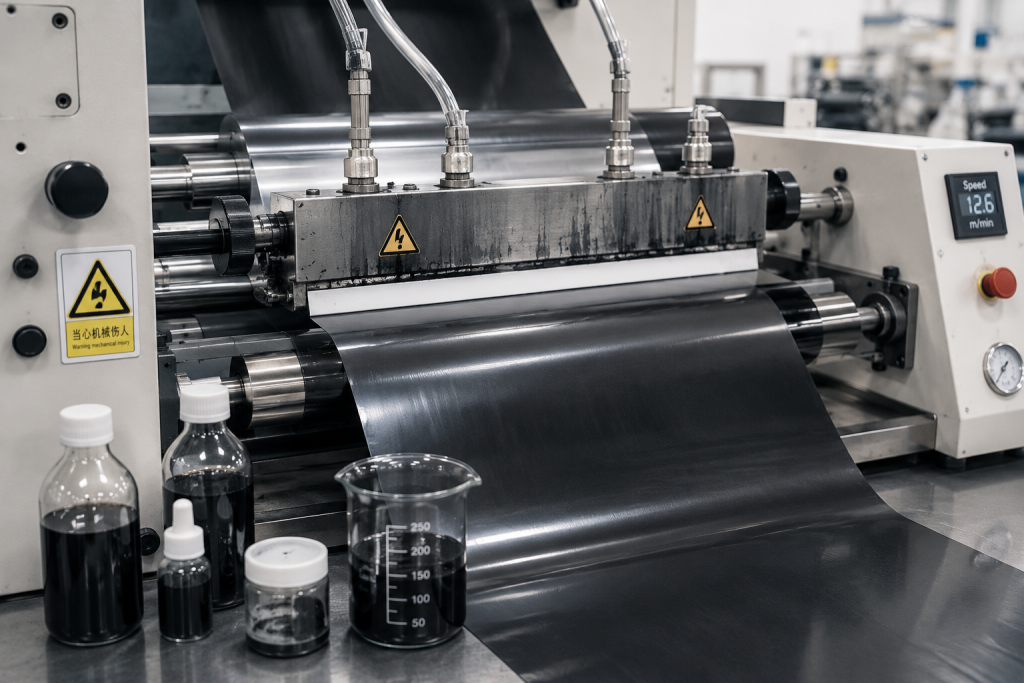
Graphene films are widely recognized for their exceptional:
- Electrical conductivity
- Thermal conductivity
- Mechanical strength
- Lightweight structure
As a result, graphene films are increasingly explored for applications such as:
- Conductive coatings
- Thermal management systems
- EMI shielding
- Flexible electronics
- Battery technologies
However, many graphene film projects fail to achieve stable industrial performance—not because of the graphene itself, but because of the coating process.
In real manufacturing environments:
The coating process often matters more than the material properties alone.
Why Graphene Film Performance Depends on Processing
Many companies focus heavily on:
- Graphene quality
- Conductivity data
- Surface area
- Material characterization
But industrial graphene film performance is strongly influenced by:
- Dispersion stability
- Coating uniformity
- Drying behavior
- Film formation
- Process repeatability
A high-quality graphene material can still produce poor industrial films if the coating process is not properly optimized.
The Reality of Graphene Film Manufacturing
Laboratory graphene films are often produced using:
- Small-area coating
- Hand casting
- Drop coating
- Slow drying conditions
Industrial manufacturing requires:
- Continuous roll-to-roll coating
- High-speed processing
- Large-area uniformity
- Stable throughput
This creates major scale-up challenges.
Why the Coating Process Is Critical
1. Dispersion Determines Film Quality
Even excellent graphene materials can fail if dispersion is unstable.
Common issues include:
- Agglomeration
- Restacking
- Sedimentation
Poor dispersion causes:
- Uneven conductivity
- Surface defects
- Inconsistent thermal performance
In graphene films:
Dispersion quality directly affects final functionality.
2. Coating Uniformity Controls Performance
Industrial graphene films must maintain:
- Consistent thickness
- Stable conductive pathways
- Uniform thermal transport
Small coating variations can lead to:
- Local resistance increases
- Hotspots
- EMI shielding inconsistency
Uniform coating is often more important than peak conductivity numbers measured in the lab.
3. Drying Changes Graphene Structure
Drying is not simply solvent evaporation.
It also affects:
- Graphene orientation
- Film density
- Conductive network formation
- Mechanical integrity
Improper drying may cause:
- Cracking
- Delamination
- Non-uniform conductive regions
4. Film Formation Impacts Conductive Networks
Graphene films rely on interconnected conductive pathways.
The coating process determines:
- Sheet alignment
- Contact resistance
- Network continuity
Even highly conductive graphene can lose performance if film formation is poor.
5. Industrial Speed Changes Everything
At laboratory scale:
- Slow coating may work perfectly
At industrial scale:
- High-speed coating introduces instability
- Rheology behavior changes
- Surface tension effects become critical
This is why many graphene formulations fail during industrialization.
Why Pilot Validation Matters for Graphene Films
Pilot-scale manufacturing bridges the gap between:
Laboratory coating
and
Industrial production
Pilot lines help validate:
- Coating behavior
- Drying stability
- Process repeatability
- Roll-to-roll compatibility
- Yield performance
before mass production investment.
Key Industrial Coating Processes for Graphene Films
Slot-Die Coating
Used for:
- Battery electrodes
- Conductive films
- Functional coatings
Requires highly stable rheology.
Roll-to-Roll Coating
Critical for scalable manufacturing.
Challenges include:
- Speed stability
- Tension control
- Uniform drying
Spray Coating
Useful for:
- Thermal coatings
- EMI shielding surfaces
- Large-area conductive layers
Requires optimized dispersion control.
Dip Coating and Printing
Applied in:
- Flexible electronics
- Smart surfaces
- Sensor systems
Why Many Graphene Film Projects Fail
Most failures are not caused by poor graphene quality.
Instead, they come from:
| Problem | Industrial Impact |
|---|---|
| Poor dispersion | Conductivity instability |
| Uneven coating | Yield loss |
| Drying defects | Cracking and delamination |
| Process incompatibility | Scale-up failure |
| Unstable rheology | Manufacturing inconsistency |
This is why process engineering is becoming more important than material performance alone.
Applications Requiring High-Quality Graphene Films
Thermal Management
- AI server cooling
- Heat spreaders
- Thermal interface systems
Conductive Coatings
- Antistatic surfaces
- Smart conductive films
- Flexible electronics
EMI Shielding
- Electronics protection
- Communication systems
- High-frequency devices
Battery Systems
- Conductive electrode coatings
- Current collector enhancement
- Advanced electrode architectures
The Shift Toward Manufacturability
The graphene industry is gradually moving from:
“Best material performance”
toward:
“Best manufacturable performance”
Industrial success now depends on:
- Stable coating systems
- Scalable processing
- Pilot validation
- Production repeatability
Co-Development Is Becoming Essential
Successful graphene film industrialization increasingly requires collaboration between:
- Material suppliers
- Coating engineers
- Pilot manufacturing teams
- Equipment companies
- OEMs
The future is not simply selling graphene powder.
It is:
Building manufacturable graphene film systems.
Future Trends in Graphene Film Manufacturing
The industry is moving toward:
- AI-assisted coating optimization
- Water-based graphene coatings
- Continuous roll-to-roll production
- Hybrid graphene/CNT conductive films
- Pilot-scale industrial validation systems
In graphene film manufacturing, material quality alone is not enough.
The coating process determines whether graphene can form stable, scalable, and high-performance industrial films.
This is why successful graphene commercialization increasingly depends on:
- Process engineering
- Coating optimization
- Pilot-scale validation
- Manufacturability
Companies that understand the importance of industrial coating processes will lead the future of graphene film applications.