

Why Some Materials Need Pilot Lines Before Scale
Because lab success doesn’t guarantee industrial reality.
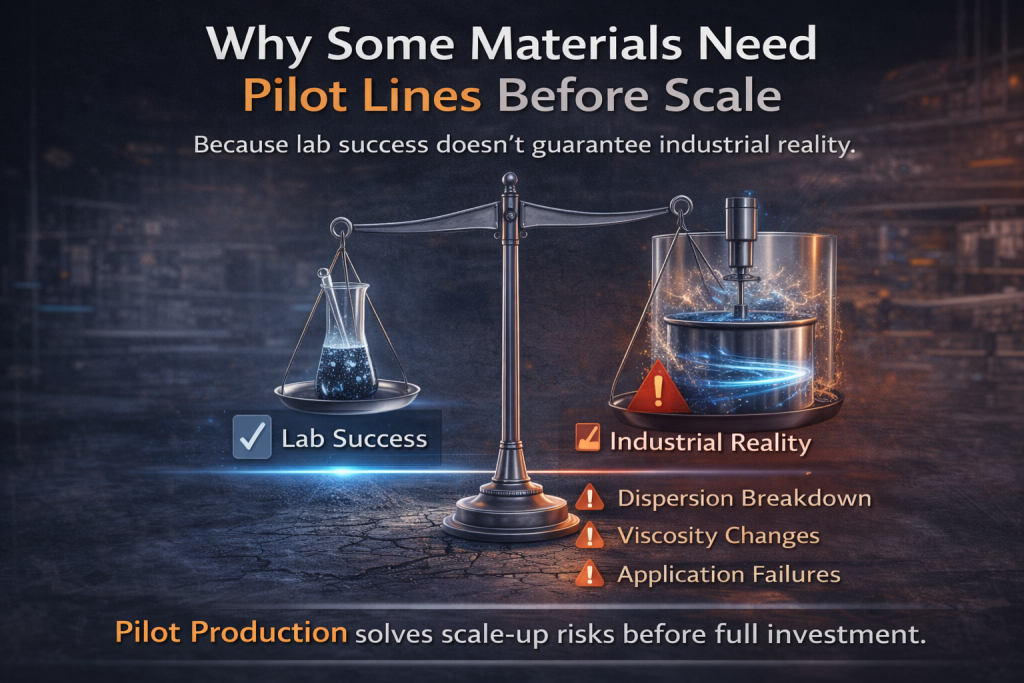
In advanced materials industries, it’s tempting to assume that once a formulation works in the lab, it can be scaled immediately. But for many graphene, CNT, and hybrid material systems, skipping pilot production leads to surprises—and often failure.
Pilot lines are the bridge between material potential and industrial performance.
1️⃣ The Gap Between Lab and Factory
Laboratory experiments typically involve:
-
Small batch volumes (grams to kilograms)
-
Controlled mixing environments
-
Idealized curing or deposition conditions
-
Immediate testing after preparation
Industrial scale requires:
-
Hundreds to thousands of liters per batch
-
Continuous or semi-continuous mixing
-
Extended storage and transportation
-
Application under variable environmental conditions
What works in the lab may break down when scaled.
2️⃣ Process Sensitivities That Require Pilot Lines
a. Dispersion Stability
-
Nano-materials like graphene and CNTs are prone to aggregation
-
Sedimentation and re-agglomeration can appear over time
-
Pilot lines reveal if stability holds during prolonged mixing and storage
b. Shear & Mixing Differences
-
Lab mixers provide uniform shear at small scale
-
Industrial mixers have variable shear zones
-
Pilot lines allow tuning of mixing energy and time
c. Rheology & Application Behavior
-
Viscosity changes nonlinearly with scale
-
Sprayability, coating thickness, and leveling can differ from lab predictions
-
Pilot lines let engineers adjust formulation and process parameters
3️⃣ Material-Specific Risks
Some materials require pilot validation more than others:
-
High aspect ratio nanomaterials (CNT, graphene)
-
Multi-component hybrid systems (graphene + polymers + fillers)
-
Reactive or sensitive chemistries (waterborne coatings, adhesives)
For these materials, small inconsistencies at lab scale amplify in industrial batches.
4️⃣ Pilot Lines Reduce Scale-Up Risk
Pilot production allows:
-
Process optimization before full-scale investment
-
Verification of performance consistency
-
Detection of handling, storage, or application issues
-
Refinement of formulations for industrial conditions
Investing in pilot lines saves time, cost, and reputation in the long run.
5️⃣ Strategic Value
Companies that implement pilot lines gain:
-
Faster commercialization with predictable outcomes
-
Ability to troubleshoot before committing to full production
-
Data to guide customers on real-world applicability
-
Confidence to supply early-adopter clients
Some materials are deceptively complex.
Lab success proves potential, but pilot lines prove practical reality.
Skipping this step often turns promising innovations into costly failures.
A robust pilot phase ensures materials perform consistently when it really counts: at industrial scale.