
Why Thermal Management Is Becoming Critical in AI Infrastructure
The rapid expansion of artificial intelligence is transforming the design requirements of modern data centers.
As AI models become larger and computational workloads increase, data centers are deploying more powerful processors, including high-performance GPUs and AI accelerators.
However, increased computing power brings a fundamental engineering challenge:
How can next-generation infrastructure effectively remove the enormous amount of heat generated by AI systems?
Thermal management is no longer a secondary consideration. It has become one of the most critical factors influencing:
- Server reliability
- Energy efficiency
- Data center design
- Equipment lifetime
- AI infrastructure scalability
The Rise of AI Computing Density
Traditional data centers were designed around general-purpose computing workloads.
Modern AI infrastructure is fundamentally different.
AI servers require:
- Higher processing power
- More powerful GPUs
- Greater rack density
- Continuous high-load operation
As a result, power consumption per rack has increased significantly.
Higher electrical power inevitably creates higher thermal loads.
The challenge is no longer simply providing computing capacity—it is managing the heat generated by that capacity.
Why Traditional Cooling Approaches Are Facing Limitations
For many years, air cooling has been the primary thermal management method in data centers.
However, increasing AI workloads are pushing traditional cooling methods toward their limits.
Challenges include:
Lower Cooling Efficiency
Air has relatively low heat transfer capability compared with liquids and advanced thermal materials.
Higher Energy Consumption
Large cooling systems require significant electrical power, reducing overall data center efficiency.
Limited Rack Density
High-power AI servers generate more heat than conventional airflow systems can efficiently remove.
Hot Spot Formation
Localized high-temperature areas may appear around GPUs and power components.
These hot spots can reduce system reliability.
The Shift Toward Advanced Thermal Management
To support future AI infrastructure, data centers are adopting more advanced cooling approaches.
Key technologies include:
Liquid Cooling
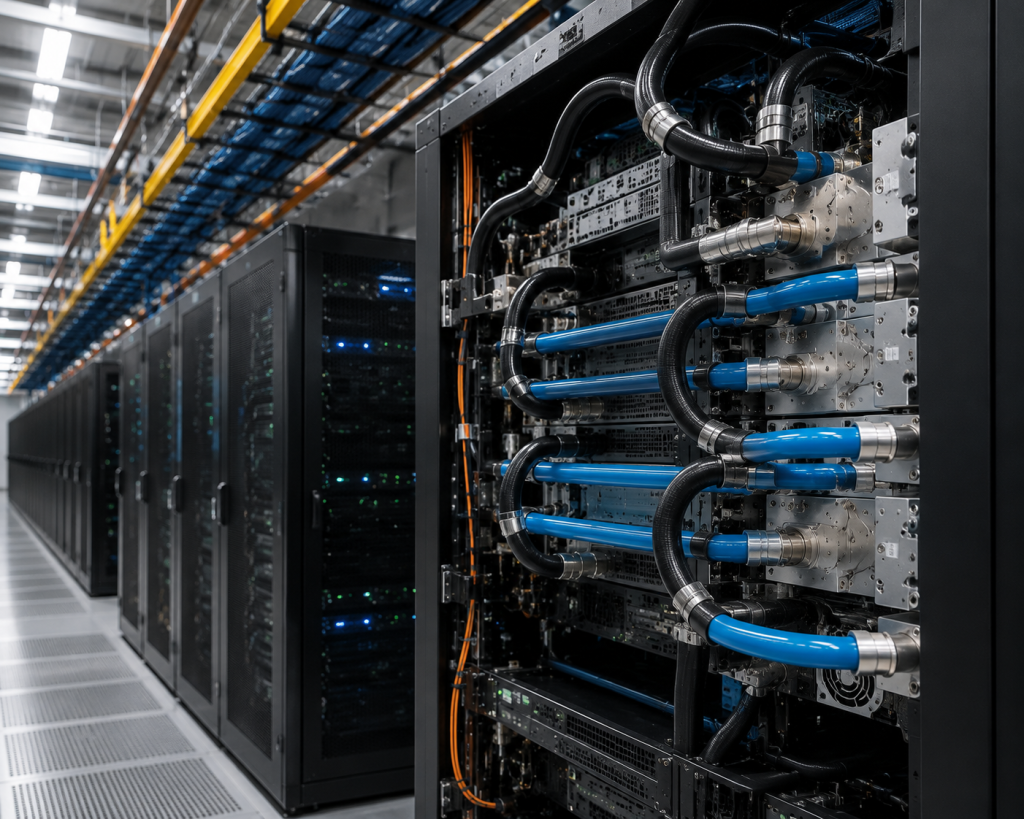
Liquid cooling systems directly transfer heat away from high-power components.
Examples include:
- Cold plate cooling
- Direct-to-chip cooling
- Immersion cooling
These approaches provide significantly higher heat removal capability.
Advanced Heat Spreaders
Heat spreaders help distribute thermal energy away from concentrated heat sources.
Materials with high thermal conductivity are increasingly important.
Thermal Interface Materials
Thermal interface materials improve heat transfer between components and cooling structures.
They reduce thermal resistance at contact surfaces.
Functional Thermal Coatings
Advanced coatings, including graphene-enhanced systems, can improve heat spreading and surface thermal performance.
The Role of Materials in AI Thermal Management
Thermal management is not only a cooling system challenge.
It is also a materials engineering challenge.
Important materials include:
Aluminum
Aluminum remains widely used in AI infrastructure because of:
- Lightweight structure
- Good thermal conductivity
- Excellent manufacturability
Applications include:
- Server chassis
- Heat sinks
- Structural components
Copper
Copper provides excellent thermal conductivity.
It is commonly used in:
- Cold plates
- Heat pipes
- High-performance cooling components
Graphene and Advanced Carbon Materials
Graphene offers unique possibilities for next-generation thermal solutions.
Potential advantages include:
- High thermal conductivity
- Lightweight structure
- Thin-film compatibility
- Multifunctional performance
Applications include:
- Thermal coatings
- Heat spreading layers
- Electronic cooling components
Thermal Management Challenges in AI Data Centers
Despite rapid technology development, several challenges remain.
Increasing Power Density
Future AI systems will continue requiring higher computing power.
Thermal solutions must scale accordingly.
Space Constraints
Data center operators need higher performance within limited physical space.
Energy Efficiency Requirements
Cooling systems must improve efficiency to control operational costs.
Reliability Requirements
AI infrastructure often operates continuously.
Thermal instability can lead to:
- Hardware failure
- Reduced performance
- Increased maintenance costs
The Importance of Integrated Thermal Design
Modern AI infrastructure requires thermal management to be considered during system design.
Thermal performance depends on the interaction between:
- Server architecture
- Mechanical structures
- Cooling systems
- Materials
- Airflow or liquid flow design
A successful solution requires cooperation between mechanical engineering, materials science, and thermal engineering.
The Role of Advanced Manufacturing
New thermal solutions require more than advanced materials.
They require reliable manufacturing processes.
Important technologies include:
- Precision machining
- Aluminum extrusion
- Coating technologies
- Thin-film manufacturing
- Thermal material integration
Pilot manufacturing and validation are increasingly important for bringing new thermal technologies into real applications.
Future Trends in AI Thermal Management
Higher Efficiency Liquid Cooling
Liquid cooling will continue expanding as AI systems become more powerful.
Hybrid Cooling Systems
Future infrastructure may combine:
- Air cooling
- Liquid cooling
- Advanced thermal materials
Smart Thermal Management
Sensors and AI-based control systems will optimize cooling performance in real time.
Advanced Carbon-Based Thermal Solutions
Graphene, CNTs, and other advanced materials may provide new approaches for lightweight and high-performance thermal management.
The rapid growth of artificial intelligence is changing the requirements of data center infrastructure.
As AI processors become more powerful and rack densities increase, thermal management is becoming one of the most important engineering challenges.
Future AI infrastructure will depend on integrated solutions combining:
- Advanced cooling technologies
- High-performance materials
- Optimized mechanical structures
- Intelligent thermal control
The companies that successfully solve thermal challenges will play a critical role in enabling the next generation of AI computing infrastructure.