

Battery Cell Formats: Cylindrical vs Prismatic vs Pouch
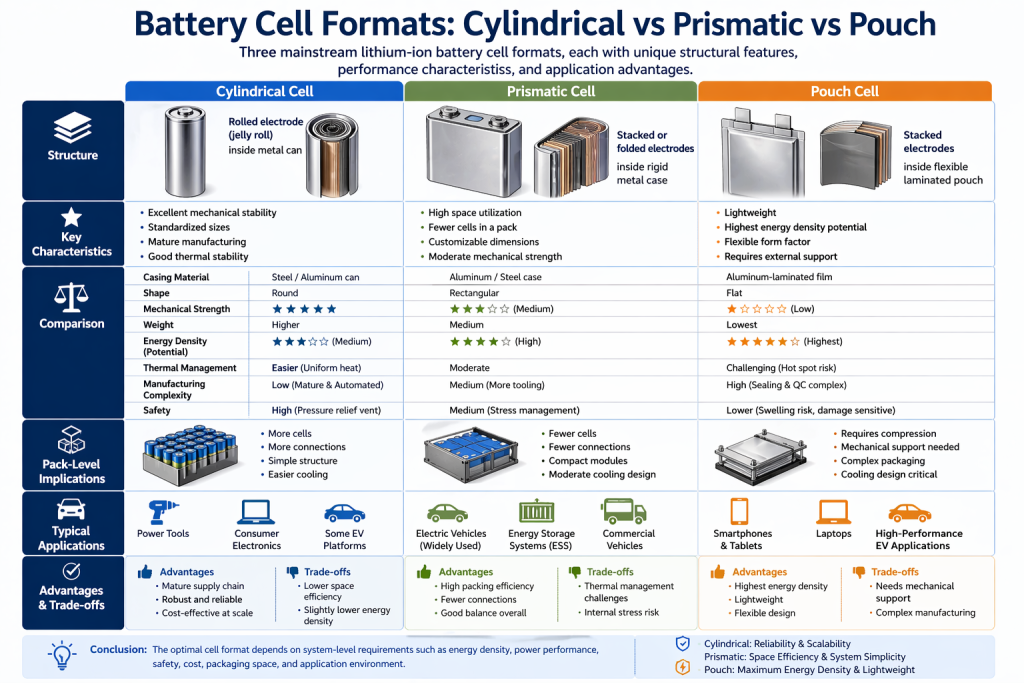
As battery technologies evolve, cell format selection has become a critical design decision impacting performance, safety, cost, and system integration. The three dominant lithium-ion battery formats—cylindrical, prismatic, and pouch cells—each offer unique structural and operational advantages.
Understanding their differences is essential for applications ranging from electric vehicles (EVs) to energy storage systems (ESS) and consumer electronics.
Overview of Battery Cell Formats
1. Cylindrical Cells
Cylindrical cells are the most established format, widely used for decades.
Structure:
- Rolled electrode layers (jelly roll) inside a metal cylindrical can
Common Sizes:
- 18650, 21700, 4680
Key Characteristics:
- Excellent mechanical stability
- Standardized dimensions
- Mature manufacturing processes
2. Prismatic Cells
Prismatic cells use a rectangular metal casing to maximize space efficiency.
Structure:
- Stacked or folded electrodes inside a rigid aluminum or steel case
Key Characteristics:
- Higher space utilization than cylindrical
- Fewer cells required at pack level
- Customizable dimensions
3. Pouch Cells
Pouch cells use a flexible laminated film instead of a rigid casing.
Structure:
- Stacked electrodes enclosed in an aluminum-laminated polymer pouch
Key Characteristics:
- Lightweight
- Highest energy density potential
- Flexible form factor
Structural Comparison
| Feature | Cylindrical | Prismatic | Pouch |
|---|---|---|---|
| Casing | Steel/Aluminum can | Rigid metal case | Flexible pouch film |
| Shape | Round | Rectangular | Flat |
| Mechanical Strength | High | Medium | Low |
| Weight | Higher | Medium | Lowest |
| Energy Density | Medium | High | Highest (potential) |
| Thermal Management | Easier | Moderate | Challenging |
| Manufacturing Complexity | Low | Medium | High |
Key Differences Explained
1. Mechanical Stability
- Cylindrical: Strongest due to pressure-resistant metal casing
- Prismatic: Moderate rigidity
- Pouch: Requires external support due to flexible structure
2. Energy Density
- Pouch cells offer the highest energy density due to minimal casing
- Prismatic cells balance density and structure
- Cylindrical cells sacrifice some density for durability
3. Thermal Management
- Cylindrical cells have uniform heat distribution
- Prismatic and pouch cells may develop hot spots
- Cooling design is more complex for larger-format cells
4. Manufacturing and Cost
- Cylindrical cells benefit from high automation and standardization
- Prismatic cells require more custom tooling
- Pouch cells involve complex sealing and quality control processes
5. Safety Considerations
- Cylindrical: Built-in pressure relief mechanisms
- Prismatic: Risk of internal stress if poorly designed
- Pouch: Swelling and mechanical damage are key concerns
Application Scenarios
Cylindrical Cells
- Power tools
- Consumer electronics
- Some EV platforms
Why: Reliability, scalability, cost efficiency
Prismatic Cells
- Electric vehicles (widely used in EV packs)
- Energy storage systems
Why: Better space utilization and fewer interconnections
Pouch Cells
- Smartphones and laptops
- High-performance EV applications
Why: Lightweight and flexible design
Pack-Level Implications
Choosing a cell format affects:
- Module design
- Cooling strategy
- Structural support
- Assembly complexity
For example:
- Cylindrical → more cells, simpler cooling
- Prismatic → fewer cells, compact modules
- Pouch → requires compression systems
Advantages and Trade-Offs
Cylindrical
✅ Mature supply chain
✅ Robust structure
❌ Lower space efficiency
Prismatic
✅ High packing efficiency
✅ Fewer connections
❌ Thermal and stress management challenges
Pouch
✅ Highest energy density
✅ Lightweight
❌ Requires complex mechanical support
Future Trends
- Large-format cylindrical cells (e.g., 4680) for EVs
- Cell-to-pack (CTP) designs favoring prismatic formats
- Advanced pouch cell reinforcement technologies
- Integration with solid-state batteries
Each battery cell format—cylindrical, prismatic, and pouch—offers distinct advantages depending on the application.
- Choose cylindrical for reliability and scalability
- Choose prismatic for space efficiency and system simplicity
- Choose pouch for maximum energy density and lightweight design
Ultimately, the optimal choice depends on system-level requirements, not just cell-level performance.