
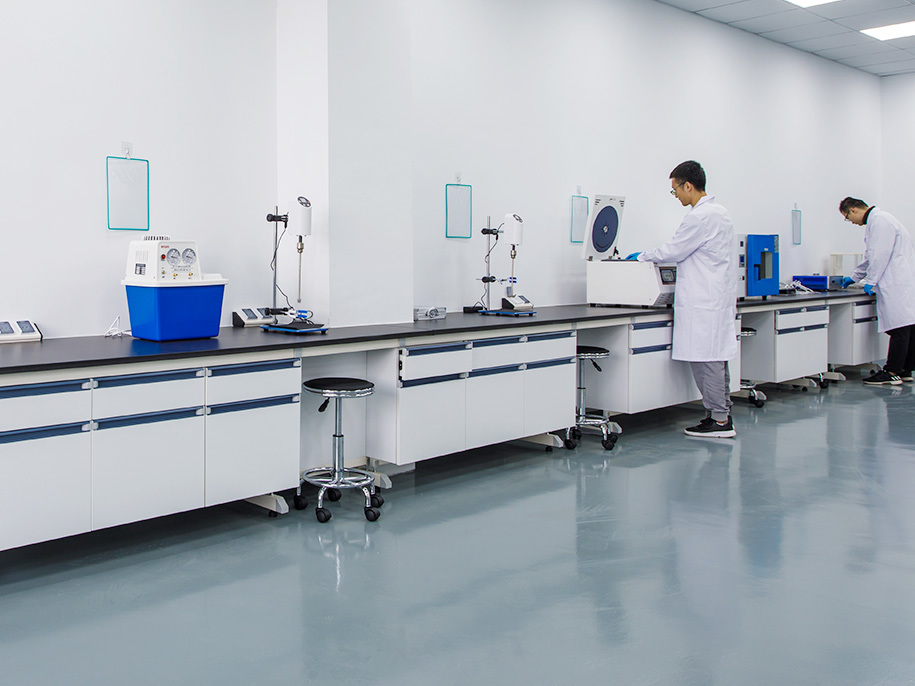
Why Electrode Processing Determines Battery Commercialization Success
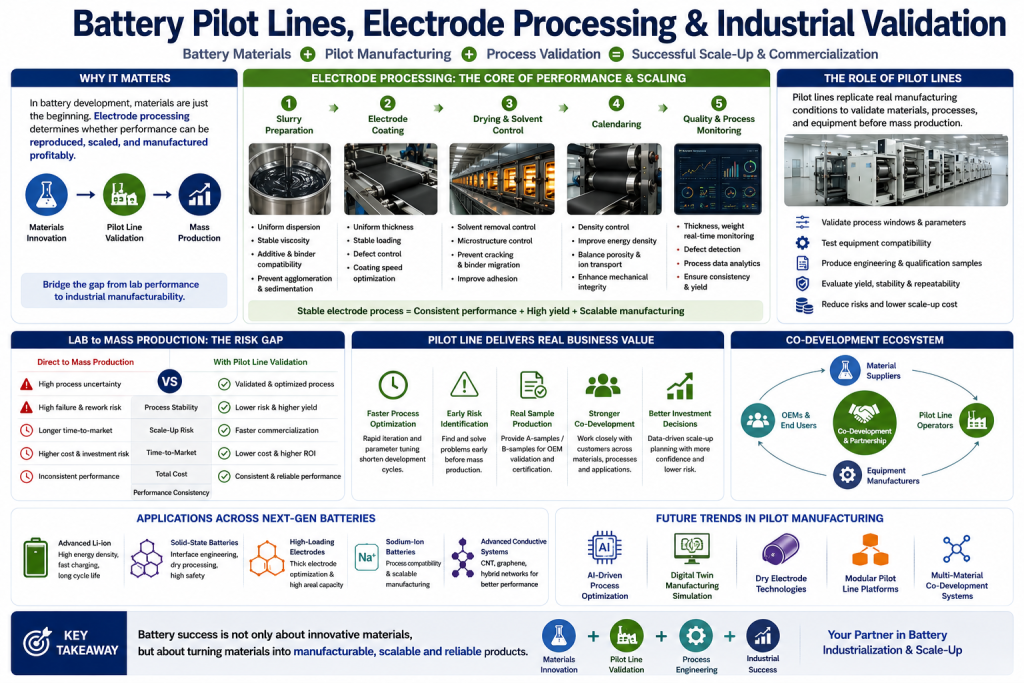
In battery development, breakthrough materials often receive the most attention. However, in real industrial environments, electrode processing is frequently the factor that determines whether a battery technology can truly scale into commercial production.
A material with excellent laboratory performance may still fail during industrialization if the electrode process is unstable, difficult to scale, or incompatible with manufacturing systems. This is why companies increasingly focus not only on battery chemistry, but on pilot manufacturing, process validation, and manufacturability.
Battery Innovation Is No Longer Just About Materials
Modern battery development requires integration between:
- Material science
- Electrode engineering
- Manufacturing processes
- Industrial validation
The key challenge is no longer simply:
“Can the material work?”
But rather:
“Can the material be manufactured consistently, economically, and at scale?”
Why Electrode Processing Matters
Electrodes are the core functional layers of a battery. Their quality directly affects:
- Energy density
- Cycle life
- Internal resistance
- Safety performance
- Production yield
Even small process variations can significantly impact final cell performance.
Critical Electrode Processing Steps
1. Slurry Preparation
Proper slurry formulation determines:
- Dispersion quality
- Viscosity stability
- Coating consistency
Challenges include:
- CNT/graphene agglomeration
- Sedimentation
- Binder compatibility
2. Electrode Coating
Processes such as:
- Slot-die coating
- Roll-to-roll coating
must achieve:
- Uniform thickness
- Stable loading
- Minimal defects
Poor coating directly impacts:
- Capacity consistency
- Cell reliability
3. Drying and Solvent Control
Drying is not simply solvent removal.
It also affects:
- Electrode microstructure
- Porosity distribution
- Adhesion strength
Improper drying can cause:
- Cracking
- Binder migration
- Uneven conductive networks
4. Calendaring
Compression density influences:
- Energy density
- Ion transport pathways
- Mechanical integrity
Balancing density vs diffusion is critical.
The Role of Pilot Lines in Electrode Validation
Pilot lines provide the bridge between:
- Laboratory formulation
- Industrial manufacturing reality
They allow companies to validate:
- Coating behavior
- Process windows
- Yield stability
- Equipment compatibility
before large-scale investment.
Why Pilot Manufacturing Accelerates Commercialization
Faster Process Optimization
Pilot lines enable rapid iteration of:
- Coating parameters
- Drying profiles
- Electrode density
Early Identification of Manufacturing Risks
Issues can be identified before mass production:
- Coating defects
- Material instability
- Scaling limitations
Real Customer Validation
Pilot lines generate:
- Engineering samples
- A-samples / B-samples
for OEM testing and co-development.
Manufacturability Is Becoming a Competitive Advantage
In next-generation batteries, success increasingly depends on:
- Stable production
- Scalable processes
- Yield optimization
- Cross-functional integration
Companies that understand manufacturability early gain:
- Faster time-to-market
- Lower commercialization risk
- Better customer confidence
Co-Development Is the Future
Battery industrialization is shifting toward collaborative ecosystems involving:
- Material suppliers
- Pilot line operators
- Equipment manufacturers
- OEMs
Instead of isolated material development, the industry is moving toward:
Integrated co-development and process validation.
Key Application Areas
Advanced Conductive Systems
- CNT conductive networks
- Graphene-enhanced electrodes
Solid-State Battery Development
- Dry processing
- Interface engineering
High-Loading Electrodes
- Thick electrode optimization
- Fast-charging architectures
Sodium-Ion Battery Scale-Up
- Process compatibility validation
- Manufacturing adaptation
Future Trends
The next generation of battery manufacturing will focus on:
- AI-driven process optimization
- Digital twin manufacturing simulation
- Dry electrode technologies
- Modular pilot manufacturing platforms
- Multi-material co-development systems
Battery commercialization depends not only on innovative materials, but on whether those materials can survive the realities of industrial manufacturing.
Electrode processing, pilot validation, and manufacturability are becoming the true bottlenecks—and competitive advantages—of next-generation battery development.
Companies that position themselves at the intersection of:
- materials
- pilot manufacturing
- process engineering
- industrial validation
will play a critical role in the future battery ecosystem.