
Graphene-Based Heat Dissipation Solutions for Electronics
As electronic devices become more powerful and compact, thermal management has become one of the most critical engineering challenges.
Modern electronics—including:
- Smartphones
- Laptops
- Power electronics
- AI processors
- Data center servers
- Electric vehicle control systems
generate significant amounts of heat during operation.
If this heat is not effectively managed, it can lead to:
- Reduced performance
- Lower energy efficiency
- Accelerated component aging
- Reliability issues
- System failures
To address these challenges, manufacturers are increasingly exploring advanced thermal materials. Among these, graphene has emerged as one of the most promising options for next-generation heat dissipation solutions.
Why Heat Dissipation Matters
Every electronic device converts part of its electrical energy into heat.
As power densities continue to increase, removing that heat becomes more difficult.
Excessive temperatures can cause:
Performance Throttling
Processors automatically reduce operating speeds to prevent overheating.
Reduced Component Lifespan
Higher temperatures accelerate material degradation.
Reliability Problems
Thermal stress can damage solder joints, interfaces, and electronic components.
Energy Losses
Inefficient thermal management often results in reduced system efficiency.
Effective heat dissipation therefore plays a direct role in device performance and reliability.
Why Graphene Attracts Attention for Thermal Management
Graphene possesses several characteristics that make it attractive for electronic cooling applications.
Exceptional Thermal Conductivity
Graphene exhibits extremely high in-plane thermal conductivity, enabling rapid heat spreading.
Lightweight Structure
Graphene-based materials add minimal weight to electronic devices.
Thin-Film Capability
Graphene can be incorporated into ultra-thin thermal solutions suitable for compact electronics.
Mechanical Flexibility
Flexible thermal films can be integrated into complex device architectures.
These properties have made graphene an important material for advanced thermal management research and development.
How Graphene Helps Dissipate Heat
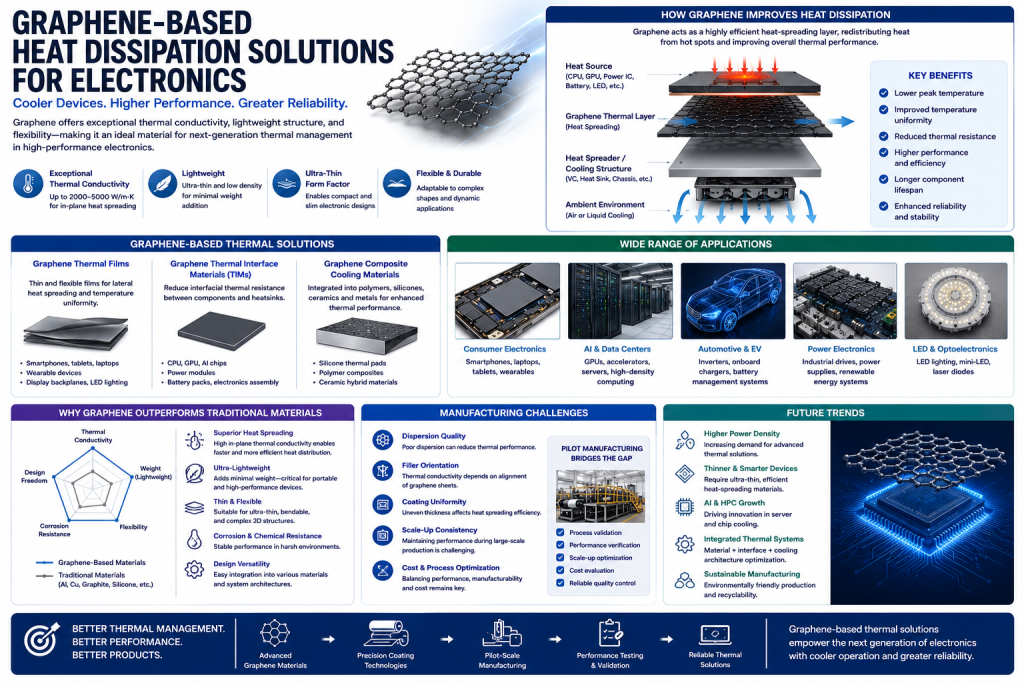
Graphene typically functions as a heat-spreading material rather than a direct heat sink.
Its primary role is to redistribute heat away from localized hot spots.
The thermal management pathway generally follows:
Heat Source
↓
Graphene Thermal Layer
↓
Heat Spreader / Cooling Structure
↓
Ambient Environment
By distributing heat more evenly, graphene helps reduce peak temperatures and improve overall thermal performance.
Graphene Thermal Films
One of the most widely explored applications is graphene thermal films.
These films are designed to:
- Spread heat laterally
- Reduce thermal gradients
- Improve temperature uniformity
Typical applications include:
Smartphones
Managing heat generated by processors and batteries.
Tablets and Laptops
Improving thermal distribution within compact enclosures.
Wearable Electronics
Supporting lightweight and flexible cooling solutions.
Because graphene films can be extremely thin, they fit well within modern electronic designs.
Graphene Thermal Interface Materials (TIMs)
Heat transfer between components often encounters thermal resistance at interfaces.
Graphene-enhanced thermal interface materials help reduce this resistance.
Common applications include:
- CPU cooling
- GPU cooling
- Power modules
- Battery systems
Benefits may include:
- Improved heat transfer efficiency
- Reduced operating temperatures
- Enhanced long-term reliability
TIMs represent one of the most practical routes for graphene integration in thermal management systems.
Graphene Composite Cooling Materials
Graphene is frequently combined with other materials to create thermal composites.
Examples include:
Polymer Composites
Used in lightweight thermal management components.
Silicone-Based Thermal Pads
Providing flexibility and interface compliance.
Ceramic Hybrid Systems
Combining thermal conductivity with electrical insulation.
These composite systems often balance performance, manufacturability, and cost more effectively than pure graphene materials.
Applications in AI and Data Centers
Artificial intelligence infrastructure is creating unprecedented thermal management demands.
Modern AI hardware includes:
- GPUs
- AI accelerators
- High-performance CPUs
- Advanced memory systems
These devices operate at extremely high power densities.
Graphene-based thermal materials are being evaluated for:
- Heat spreading layers
- Thermal interface materials
- Advanced cooling architectures
As AI computing continues to expand, thermal management will remain a major area of innovation.
Applications in Power Electronics
Power electronics generate significant heat due to high current and voltage operation.
Examples include:
- EV inverters
- Power conversion systems
- Renewable energy equipment
- Industrial motor drives
Graphene-enhanced thermal materials may help:
- Lower operating temperatures
- Improve efficiency
- Extend component lifespan
This makes thermal management a critical factor in overall system performance.
Manufacturing Challenges
Despite its potential, graphene thermal material production presents several challenges.
Dispersion Quality
Poor graphene dispersion can significantly reduce thermal performance.
Filler Orientation
Thermal conductivity often depends on how graphene sheets align within a film or composite.
Coating Uniformity
Thickness variations may affect heat-spreading efficiency.
Scale-Up
Maintaining laboratory performance during industrial manufacturing remains a key challenge.
Addressing these issues requires careful process development and validation.
Why Pilot Manufacturing Matters
Many graphene thermal materials perform well in laboratory testing.
However, commercial success requires:
- Consistent quality
- Scalable manufacturing
- Cost-effective production
- Reliable performance
Pilot manufacturing enables engineers to evaluate:
- Coating processes
- Film uniformity
- Material consistency
- Production economics
This stage helps bridge the gap between material innovation and commercial deployment.
Future Trends
Several developments are expected to drive future adoption.
AI Computing Growth
Increasing thermal loads will require advanced cooling materials.
Thinner Electronic Devices
Creating demand for ultra-thin thermal solutions.
Flexible Electronics
Requiring lightweight and adaptable heat-spreading materials.
Integrated Thermal Architectures
Combining materials, interfaces, and cooling systems into optimized solutions.
These trends support continued interest in graphene-based thermal technologies.
As electronics become more powerful and compact, thermal management is increasingly becoming a limiting factor in performance and reliability.
Graphene offers unique advantages through its exceptional thermal conductivity, lightweight structure, flexibility, and thin-film compatibility.
Whether incorporated into thermal films, interface materials, or composite cooling solutions, graphene has the potential to improve heat dissipation across a wide range of electronic applications.
However, successful commercialization depends not only on material performance but also on formulation development, process optimization, pilot-scale validation, and system-level integration.
In the future, the most successful graphene thermal solutions will likely be those that effectively combine advanced materials with scalable manufacturing and practical engineering design.