
Slot-Die Coating in Pilot Production: Precision and Scalability
As advanced materials move from laboratory development to commercial production, coating technologies play a critical role in determining product quality, process consistency, and manufacturing scalability.
Among modern coating methods, slot-die coating has become one of the most widely adopted technologies for pilot-scale manufacturing.
Applications include:
- Lithium-ion battery electrodes
- Graphene films
- CNT-based coatings
- Thermal management materials
- Functional coatings
- Flexible electronics
Its popularity stems from a unique combination of precision, material efficiency, and scalability.
For companies seeking to bridge the gap between R&D and mass production, slot-die coating provides an important pathway toward industrialization.
What Is Slot-Die Coating?
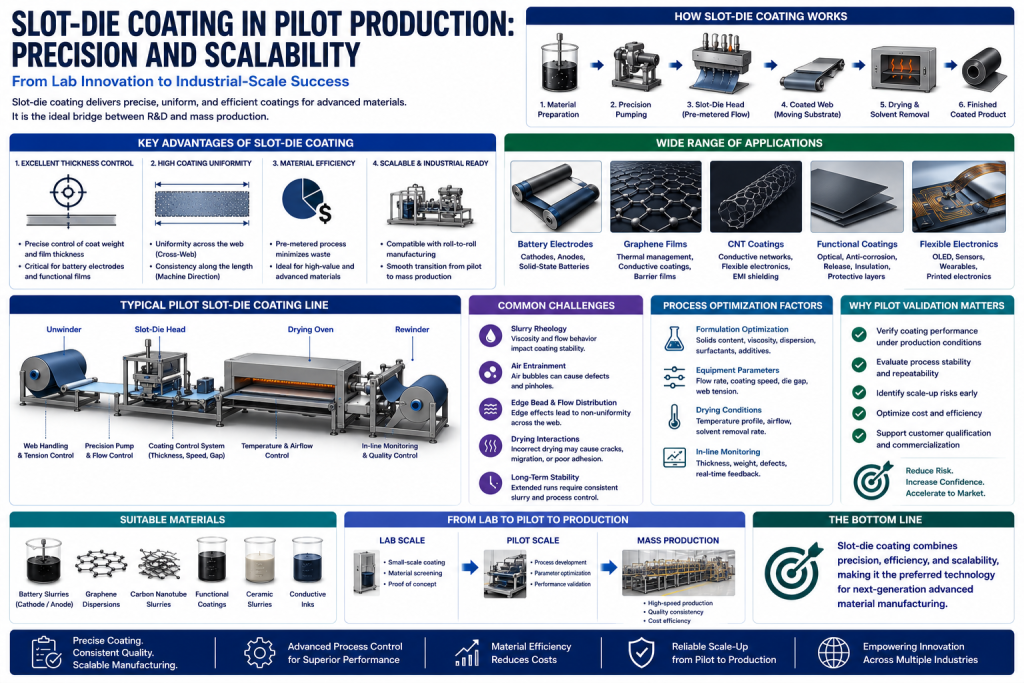
Slot-die coating is a precision coating process in which liquid material is pumped through a specially designed die and deposited onto a moving substrate.
The process typically consists of:
- Material delivery system
- Precision pump
- Slot-die head
- Moving substrate
- Drying section
Unlike many traditional coating methods, slot-die coating operates within a highly controlled flow environment.
This enables manufacturers to achieve excellent thickness control and coating uniformity.
Why Slot-Die Coating Is Important in Pilot Production
Pilot manufacturing serves as the bridge between laboratory research and commercial production.
At this stage, companies must answer several critical questions:
- Can the material be coated consistently?
- Will quality remain stable during scale-up?
- Can the process support future mass production?
- What are the manufacturing costs?
Slot-die coating helps address these questions by providing a scalable and repeatable coating platform.
Key Advantage 1: Excellent Thickness Control
One of the greatest strengths of slot-die coating is precise control over wet film thickness.
Engineers can adjust:
- Pump flow rate
- Coating speed
- Die gap
- Slurry properties
to achieve highly controlled coating weights.
This is particularly important for applications such as battery electrodes, where even small thickness variations can influence:
- Capacity
- Internal resistance
- Fast-charging behavior
- Cell consistency
Key Advantage 2: High Coating Uniformity
Uniform coatings are essential for achieving consistent product performance.
Slot-die systems are designed to maintain:
Cross-Web Uniformity
Consistency across the width of the substrate.
Machine Direction Uniformity
Consistency along the length of the coated material.
High uniformity contributes to:
- Better product quality
- Reduced scrap rates
- Improved manufacturing yield
These advantages become increasingly important as production volumes increase.
Key Advantage 3: Material Efficiency
Many advanced materials are expensive.
Examples include:
- Graphene
- Carbon nanotubes
- Silicon-based materials
- Specialty conductive additives
Slot-die coating is often classified as a pre-metered coating process.
Material flow is carefully controlled, resulting in:
- High transfer efficiency
- Reduced waste
- Lower production costs
This makes the technology particularly attractive for pilot-scale validation of high-value materials.
Key Advantage 4: Compatibility with Roll-to-Roll Manufacturing
Most large-scale manufacturing systems rely on continuous roll-to-roll processing.
Slot-die coating integrates naturally with:
- Web handling systems
- Drying ovens
- Calendering equipment
- Continuous production lines
As a result, process knowledge developed during pilot trials can often be transferred more easily to commercial production.
This scalability is one of the technology’s greatest strengths.
Applications in Battery Manufacturing
Battery production represents one of the largest applications for slot-die coating.
Typical coated layers include:
Cathodes
Containing active materials such as NMC, LFP, or high-nickel chemistries.
Anodes
Including graphite, silicon-enhanced materials, and advanced carbon formulations.
Benefits include:
- Precise coat weight control
- Improved cell consistency
- Higher production efficiency
- Reduced material waste
As battery manufacturers pursue higher energy density and lower costs, slot-die coating continues to gain importance.
Applications in Advanced Carbon Materials
Advanced carbon materials often require highly controlled coating processes.
Examples include:
Graphene Films
Used for:
- Thermal management
- Conductive coatings
- Functional surfaces
CNT Networks
Used in:
- Battery electrodes
- Flexible electronics
- Conductive films
Pilot slot-die coating enables engineers to evaluate dispersion quality, coating behavior, and manufacturing scalability before commercial deployment.
Common Challenges in Pilot Slot-Die Coating
Although slot-die coating offers significant advantages, successful implementation requires careful process control.
Slurry Rheology
Viscosity and flow behavior strongly influence coating stability.
Air Entrainment
Improper operating conditions may introduce air into the coating bead.
Edge Effects
Flow distribution near substrate edges can create coating non-uniformity.
Drying Interactions
Coating quality can be affected by downstream drying conditions.
Long-Term Stability
Extended production runs require consistent slurry behavior and process control.
Addressing these factors is essential for reliable manufacturing.
The Importance of Process Optimization
Successful pilot coating programs typically focus on:
Formulation Development
Optimizing:
- Solids content
- Viscosity
- Dispersion quality
Equipment Parameters
Controlling:
- Flow rate
- Coating speed
- Die gap
- Web tension
Drying Conditions
Managing:
- Temperature profiles
- Airflow distribution
- Solvent removal rates
Together, these variables determine final product quality.
Why Pilot Validation Matters
Many coating processes perform well on small laboratory samples.
However, industrial success depends on repeatability and scalability.
Pilot production allows companies to evaluate:
- Manufacturing robustness
- Product consistency
- Process economics
- Customer qualification requirements
Most importantly, pilot validation helps identify scale-up risks before major investments are made.
This significantly reduces both technical and financial uncertainty.
Future Trends
Several trends are driving continued adoption of slot-die coating technology.
Higher Energy Density Batteries
Demanding tighter coating tolerances.
Advanced Carbon Materials
Requiring precision coating and controlled film formation.
Flexible Electronics
Benefiting from roll-to-roll manufacturing compatibility.
Sustainable Manufacturing
Reducing material waste and improving production efficiency.
As these industries continue to expand, slot-die coating is expected to remain a cornerstone technology for advanced material manufacturing.
Slot-die coating has become one of the most important technologies in pilot-scale manufacturing because it combines precision, efficiency, and scalability.
Its ability to deliver highly uniform coatings, minimize material waste, and integrate seamlessly into roll-to-roll production makes it an ideal platform for advanced materials development.
Whether applied to battery electrodes, graphene films, CNT coatings, thermal management materials, or next-generation electronic products, slot-die coating provides a critical bridge between laboratory innovation and commercial production.
For companies pursuing industrialization, mastering slot-die coating is not simply a process improvement—it is a key step toward successful scale-up and long-term manufacturing success.